I’ve spent the better part of the last seven years in SEO — watching algorithm updates roll through, watching “content is king” turn into “helpful content,” and now watching search itself split into two very different games. If you’re reading this in 2026, you’ve probably already felt it: rankings that used to send steady traffic are suddenly sending impressions with no clicks. That’s not a bug in your SEO. That’s Answer Engine Optimization happening whether you’ve planned for it or not.
This guide is my attempt to lay out AEO the way I’d explain it to a client on a call — no fluff, no vendor pitch, just what it is, why it’s different from what you’ve been doing, and what to actually do about it.
What Is Answer Engine Optimization (AEO)?
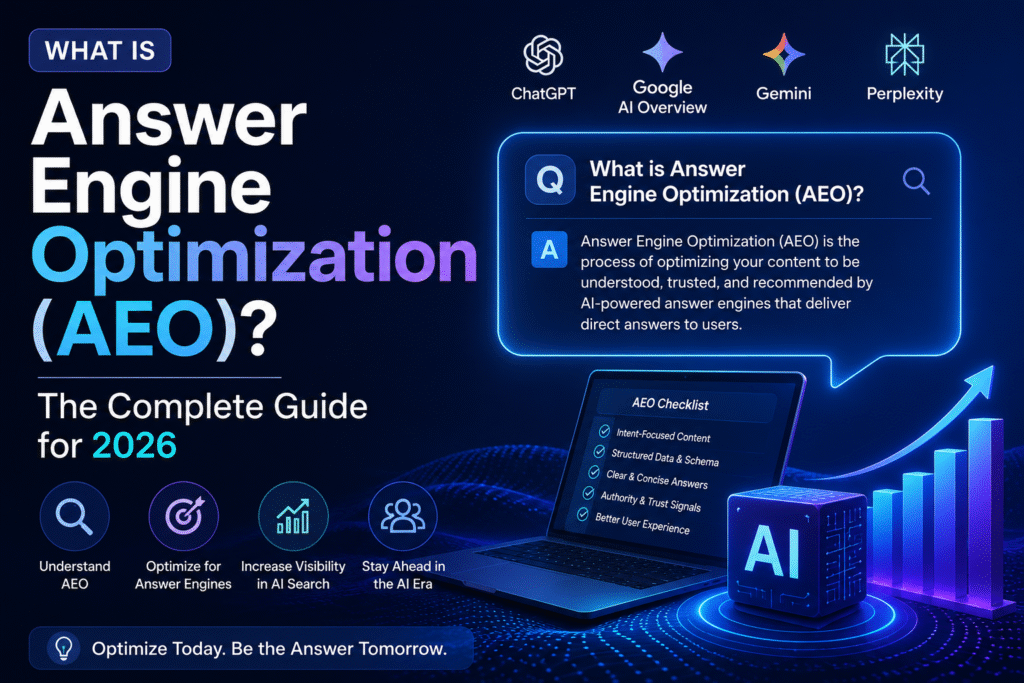
Answer Engine Optimization (AEO) is the practice of structuring and writing content so that AI systems — Google AI Overviews, ChatGPT, Perplexity, Gemini, Copilot — can pull it out, trust it, and use it directly as the answer to a user’s question, instead of just linking to it. Where traditional SEO earns you a spot in a list of results, AEO earns you a spot inside the answer itself, often with no click required at all.
That last part is the uncomfortable bit for a lot of marketers to accept. AEO success doesn’t always look like a traffic spike. Sometimes it looks like your brand name showing up inside a ChatGPT answer, with zero sessions in Google Analytics to show for it. That’s still a win — it’s just a different kind of win than the one SEO has trained us to measure.
Why This Isn’t Optional Anymore
I used to tell clients that voice search and featured snippets were “worth thinking about.” I don’t hedge like that anymore. A few numbers explain why:
- Multiple 2026 industry analyses put Google AI Overviews in roughly half of all search results, with some trackers reporting figures north of that depending on query category.
- ChatGPT’s user base has grown into the hundreds of millions on a weekly basis, and daily query volume is now measured in the billions.
- Gartner’s widely cited forecast puts a 25% drop in traditional organic search volume by 2026 as users shift to AI chat interfaces for research they used to do via a search box.
- Zero-click searches — where the user’s question gets answered without a single link being clicked — now account for a large and growing share of all queries.
None of that means SEO is dying. It means the finish line moved. Ranking #1 no longer guarantees you’re the thing the user actually sees.
AEO vs. SEO vs. GEO vs. LLM Optimization: What’s Actually Different
This is where most of the confusion I see from clients comes from — the terminology gets thrown around interchangeably, and it isn’t. Here’s how I break it down when I’m scoping an SEO service engagement versus an AEO service or GEO service engagement, because the deliverables genuinely differ.
SEO (Search Engine Optimization) is still the foundation. It’s the discipline of making your site crawlable, fast, structurally sound, and relevant enough to earn a top-10 ranking in classic search results. Nothing below this works if the fundamentals aren’t in place — a slow, poorly structured site won’t get pulled into an AI answer any more than it’ll rank on page one.
AEO (Answer Engine Optimization) sits on top of SEO. It’s specifically about formatting content so it can be extracted as a direct answer — think featured snippets, “People Also Ask” boxes, voice assistant responses, and AI Overviews. AEO is largely about structure: clear question-based headings, concise answers positioned right under them, and schema markup that tells machines exactly what they’re looking at.
GEO (Generative Engine Optimization) is the broader discipline. Where AEO is about being extractable, GEO is about being chosen — specifically by generative AI systems like ChatGPT, Perplexity, and Gemini when they synthesize an answer from multiple sources rather than lifting one verbatim. GEO leans harder on off-site authority: how often you’re mentioned across the web, cited by other credible sources, and referenced in places like Reddit, review platforms, and industry publications that these models draw on to judge trustworthiness.
LLM Optimization is the newest and most technical layer, and it’s where a lot of “GEO service” providers are quietly moving. It’s about optimizing specifically for how large language models retrieve and weigh information — which touches things like how your content performs in retrieval-augmented generation (RAG) pipelines, how cleanly your facts can be lifted without needing surrounding context, and how consistently the same facts about your brand appear across every platform an LLM might draw from during training or live retrieval.
In practice, these four disciplines overlap constantly, and I rarely recommend a client invest in one without the others. A strong AEO service builds on solid SEO. A GEO service is close to useless without consistent LLM-optimized entity data behind it. Treat them as layers, not competing strategies.
How Answer Engines Actually Decide What to Show
Understanding the mechanics changes how you write. Most modern answer engines — including Google’s AI features and the major chat platforms — rely on a process called Retrieval-Augmented Generation (RAG). It happens in three broad stages:
- Query interpretation. The system doesn’t match keywords; it identifies the underlying entities, concepts, and relationships in the question. A page about “content structuring for AI search” can surface for a query about “answer engine optimization” even without that exact phrase appearing.
- Retrieval. The engine pulls a candidate set of pages based on conceptual relevance, not just keyword overlap — often still leaning on a traditional search index behind the scenes.
- Ranking, selection, and synthesis. Candidate content gets scored on relevance, authority, structural clarity, and freshness, then the top-weighted passages get synthesized (sometimes verbatim, sometimes reworded) into the final answer, usually with a citation.
The practical takeaway: every stage of that pipeline rewards content that’s unambiguous, well-organized, and easy to lift a clean answer from without needing the rest of the page for context.
Core AEO Techniques That Actually Move the Needle
After running this across dozens of client sites, here’s the checklist I actually use — not a theoretical list, the one I open a doc to on day one of any engagement.
1. Lead with the direct answer. Put the question in the heading, then answer it in the first 40–60 words, in plain language, before you elaborate. This single change is responsible for more featured-snippet and AI-citation wins than anything else on this list.
2. Structure over prose. Convert dense paragraphs into numbered lists, bullet points, and tables wherever the content allows it. Answer engines extract structured information far more reliably than they parse long-form narrative paragraphs.
3. Implement schema markup that matches what’s visible. FAQPage, HowTo, Article, and Organization/Person schema all carry weight — but only when they accurately reflect content that’s actually visible on the page. Markup that implies content the page doesn’t contain is a trust signal working against you.
4. Make every section independently understandable. AI systems frequently extract a single paragraph or list item without the surrounding page. If a section only makes sense in context, rewrite it so the key fact stands on its own.
5. Back claims with specifics. Vague claims (“many businesses see improved results”) get skipped. Concrete numbers, named sources, and attributed expert commentary get cited. Independent GEO research has found that adding expert quotes, statistics, and citations each measurably increases how often content gets pulled into AI-generated answers.
6. Keep facts consistent everywhere. If your business is described one way on your site and differently on your Google Business Profile, LinkedIn, or a directory listing, that inconsistency erodes the confidence an LLM has in citing you at all. This consistency work is really the heart of LLM optimization — the same core facts, repeated accurately, across every surface a model might draw from.
7. Refresh on a real cadence. Commercial and evaluation-stage content especially benefits from staying current — recent industry data shows the large majority of AI citations for buying-decision queries come from content updated within the last year, with a solid share refreshed in the last six months. A dated page quietly falls out of the citation pool even if nothing else about it changed.
8. Build off-site authority deliberately. Reviews, forum mentions, press coverage, and third-party listings all feed the trust signals GEO systems weigh. This is slower work than on-page fixes, but it compounds — brands with a real footprint across review platforms and community discussion are consistently cited more often than brands that only exist on their own website.
Platform-by-Platform Notes
Not every answer engine weighs things the same way, and I’d be doing you a disservice pretending otherwise:
- Google AI Overviews draw heavily from what’s already ranking in the top organic results — so classic SEO fundamentals still gate entry here more than anywhere else.
- Perplexity rewards freshness and clear sourcing more visibly than most platforms.
- Microsoft Copilot leans noticeably on LinkedIn and professional-network content for B2B queries.
- Claude and Gemini tend to favor comprehensive, well-organized long-form content and, in Gemini’s case, can also draw on multimodal content like images and video.
Measuring AEO Success (Without Fooling Yourself)
The single most common mistake I see is teams still judging AEO purely by sessions in Google Analytics. That metric was built for a world where every answer required a click — it wasn’t built for this one. Instead, track:
- Impressions with abnormally low click-through rates in Search Console — this is often a direct sign your content is being shown inside an AI Overview or snippet without generating a click.
- Citation frequency across AI platforms, using AI-mention tracking tools now available from several SEO platforms and specialized AEO trackers.
- Branded search lift — when AI answers mention your brand without linking, some users still search your name directly afterward.
- Assisted conversions, not just last-click attribution — someone who first encountered your brand through an AI answer may convert through a completely different channel days later.
Common Myths I Keep Having to Correct
“AEO replaces SEO.” No. Every credible study and platform I’ve tested confirms answer engines still rely heavily on traditional search indexes to find candidate content in the first place. Weak SEO means you never make it into the pool AI models draw from.
“Someone can guarantee my brand gets cited by ChatGPT.” No legitimate SEO service, AEO service, or GEO service can promise placement in a specific AI answer. Anyone selling that guarantee is selling something else.
“AEO is only relevant to big brands.” Not in my experience. Smaller businesses that clearly define a specific niche and consistently earn genuine third-party mentions within it often out-cite much larger competitors who are vaguely positioned.
Should You Hire an AEO Service, or Handle It In-House?
This depends entirely on where your content currently stands. If your technical SEO is already solid and your team can commit to consistently restructuring content around direct-answer formatting, schema, and freshness, a lot of this is genuinely doable in-house with the checklist above.
Where I typically see teams bring in outside help is on the harder-to-scale pieces: entity-level LLM optimization across every platform where your brand is mentioned, ongoing AI-citation tracking (which requires tooling most in-house teams don’t have), and building the off-site authority signals that GEO systems weigh — press, reviews, community mentions — which is genuinely a different skill set than writing and structuring content. A combined SEO service plus AEO service engagement usually makes sense when you need both the foundational technical work and the newer answer-layer optimization running in parallel rather than sequentially.
Frequently Asked Questions
Is AEO the same as GEO?
No. AEO focuses on structuring content so it’s easily extractable as a direct answer — think featured snippets and FAQ formatting. GEO is the broader discipline of getting AI systems to actively choose and trust your content when synthesizing an answer from multiple sources, which relies more heavily on off-site authority and consistent entity data.
Does AEO replace traditional SEO?
No — it builds on it. Most answer engines still use a traditional search index as the first step in finding candidate content, so weak technical SEO keeps you out of consideration entirely, regardless of how well-structured your content is.
How long does AEO take to show results?
On-page structural changes (direct answers, schema, formatting) can influence extraction within weeks in some cases, since re-crawling and re-indexing happens faster than a full ranking shift. Off-site authority and LLM optimization work — the signals GEO relies on — typically take months to build meaningfully, similar to traditional link-building timelines.
Can I track whether AI platforms are citing my content?
Yes. Watch Search Console for high-impression, low-click queries as an early signal, and use AI-mention or citation-tracking tools (several major SEO platforms now offer this) to see how often and where your brand is referenced across ChatGPT, Perplexity, Gemini, and other platforms.
What is LLM optimization specifically?
LLM optimization is the practice of making your content and brand data easy for large language models to retrieve and cite accurately — primarily by keeping facts about your business consistent across every platform a model might reference, and structuring content so individual facts can be lifted without needing surrounding context.
Do I need an AEO service if I already have an SEO service in place?
Not necessarily as a separate vendor, but you do need the AEO-specific skill set — direct-answer content structuring, schema implementation, and AI-citation tracking — applied on top of your existing SEO work. Some agencies bundle this as an extension of their SEO service; others offer it as a standalone AEO or GEO service.