By Vishal, AI Search & SEO Strategist — 6+ years in SEO, specializing in AI search visibility
Search doesn’t look like it did three years ago. Type a question into Google today and there’s a good chance you get a full answer before you ever reach a blue link. Ask ChatGPT, Perplexity, or Copilot the same question, and you might not see a traditional search result at all — just a direct, conversational answer, sometimes with a source cited, sometimes without.
For businesses, this raises a genuinely uncomfortable question: if AI is answering the question before someone reaches your website, how do you get found at all?
That’s the problem Answer Engine Optimization (AEO) exists to solve.
What Is AEO?
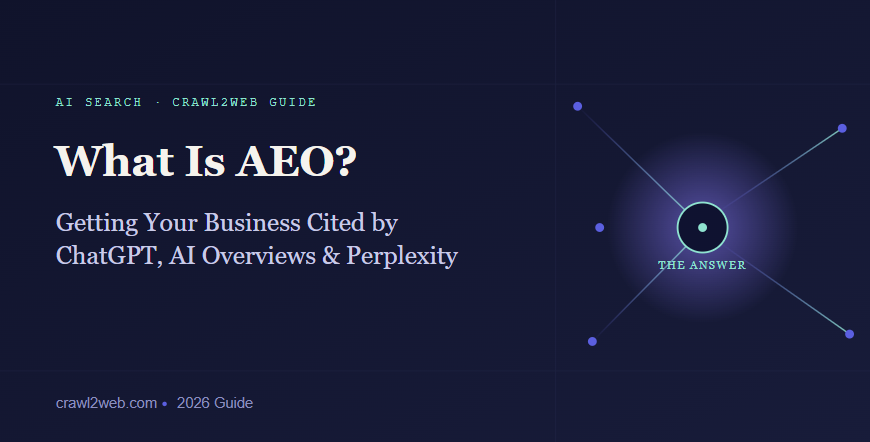
Answer Engine Optimization is the practice of structuring your content, your site, and your online presence so that AI systems — Google AI Overviews, ChatGPT Search, Perplexity, Copilot, Gemini, and voice assistants — can understand it, trust it, and cite it directly in the answers they generate.
Traditional SEO’s job was to get your page to rank so a human would click it. AEO’s job is different: it’s to get your business mentioned, quoted, or recommended inside an AI-generated answer, even when no click happens at all.
It’s closely related to a broader idea called Generative Engine Optimization (GEO) — think of AEO as the more focused practice of winning the specific answer, and GEO as the wider discipline of being understood and referenced across generative AI systems in general. In practice, most businesses need both working together, alongside a solid SEO foundation.
Why AEO Matters Now
This isn’t a future trend — it’s already reshaping how traffic flows. A few data points worth paying attention to:
- Industry research this year has pointed to more than half of Google searches now ending without a click to any website, as AI-generated answers satisfy the query directly on the results page.
- Analyst forecasts from Gartner have projected a significant decline in traditional search engine volume over the next few years as AI chatbots and assistants take over more query types.
- Independent research into AI search behavior has found that a large majority of brand mentions inside AI answers for high-intent, purchase-related questions come from third-party sources — not the brand’s own website — which is exactly why earned visibility and structured content matter so much for AEO.
The takeaway: if your content isn’t structured to be understood and trusted by AI systems, you’re increasingly invisible for a growing share of searches, regardless of how well you rank in a traditional sense.
AEO vs. SEO vs. GEO — What’s the Difference?
| Traditional SEO | AEO | GEO | |
| Goal | Rank high, earn a click | Get cited in a direct AI answer | Be understood/referenced across generative AI broadly |
| Success metric | Rankings, click-through rate | Citation frequency, AI mentions | Share of voice across AI platforms |
| Core tactic | Keywords, backlinks, technical SEO | Structured, answer-first content + schema | Entity clarity, authority signals, distributed presence |
They aren’t competing strategies — they’re layers. Strong technical SEO makes your site eligible to be crawled and understood in the first place. AEO makes your content the answer. GEO makes sure you show up consistently across every AI system, not just one.
How to Actually Optimize for AEO
Based on what’s actually moving the needle for clients right now, here’s where to start:
1. Answer the question in the first 40–60 words. Don’t bury the direct answer under three paragraphs of preamble. Lead with it, then expand. AI systems pull short, self-contained “answer capsules” — write like you’re handing one directly to the model.
2. Use FAQ and Q&A formatting deliberately. Structure genuine, specific questions with clear, complete answers — not vague marketing copy dressed up as a question. This maps directly to how AI systems extract and cite content.
3. Add structured data (schema markup). FAQPage, HowTo, Article, and Organization schema give AI systems explicit, machine-readable signals about what your content actually is — don’t make them guess from unstructured text.
4. Build real entity consistency. Your business name, description, and key facts should be identical across your website, Google Business Profile, LinkedIn, directories, and anywhere else you appear. Inconsistency is one of the fastest ways to lose an AI system’s trust in your information.
5. Demonstrate real E-E-A-T. Named authors with real credentials, cited sources, original data or case studies where possible, and regularly updated content. AI systems are increasingly built to weight content from sources that show genuine experience and expertise — not just keyword-optimized copy.
6. Track citations, not just clicks. Traffic isn’t the only metric anymore. Periodically test your target questions directly inside ChatGPT, Perplexity, and Google AI Overviews to see whether — and how — you’re being mentioned.
Common AEO Mistakes to Avoid
- Treating AEO as a one-time content update instead of an ongoing structural practice
- Writing FAQ sections that exist purely for schema markup rather than answering real questions
- Ignoring entity consistency across your web presence
- Chasing AI visibility while neglecting the technical SEO foundation that makes your site crawlable and trustworthy in the first place
Where to Start
If you’re a small or mid-sized business, you don’t need to do everything at once. Start with your highest-intent pages — the ones people are already asking direct questions about — and restructure those first with clear answer-first sections and proper FAQ schema. From there, build outward.
If you’d rather have this handled for you, this is exactly the kind of work we do — from AEO and GEO strategy to the underlying SEO that supports it. Get in touch and we’ll walk you through where you currently stand.
Frequently Asked Questions
What does AEO stand for?
AEO stands for Answer Engine Optimization — the practice of optimizing content so AI-driven answer engines (Google AI Overviews, ChatGPT, Perplexity, Copilot, and voice assistants) can understand, trust, and cite it directly.
Is AEO replacing SEO?
No. AEO builds on top of solid technical and on-page SEO — it doesn’t replace it. A site that isn’t properly indexed or structured for search engines won’t be well-positioned for AI answer engines either.
How is AEO different from GEO?
AEO typically refers to optimizing for the specific answer given by a search engine or AI assistant. GEO (Generative Engine Optimization) is the broader practice of being understood and referenced consistently across generative AI systems as a whole. In practice, they overlap heavily.
How long does it take to see results from AEO?
It varies, but most businesses start seeing measurable changes in AI citation frequency within a few months of consistent, structured content work — similar timelines to traditional SEO, though the tracking methods differ.
Do I need a developer to add schema markup?
Not necessarily — many CMS platforms and SEO plugins support adding FAQ, Article, and Organization schema without custom development, though a developer or SEO specialist can ensure it’s implemented correctly and matches your visible content.