1. Why AI Search Optimization Matters Right Now
Search behavior has genuinely shifted, not just according to vendor marketing. Google AI Overviews are now appearing on roughly half of tracked search queries, with some independent measurements putting U.S. prevalence even higher by mid-2026. Longer, more specific queries are especially likely to trigger an AI-generated answer rather than a traditional results page.
The practical consequence: for a growing share of searches, there is no results page to rank on. Google — or ChatGPT, Perplexity, or Gemini — shows a synthesized answer with two or three cited sources embedded in it. If your brand isn’t one of those two or three sources, the outcome isn’t a lower ranking. It’s not appearing in the conversation at all, before a single click was ever possible.
This matters more for service businesses (like AI and digital marketing agencies) than for most categories, because buyers researching a marketing partner increasingly ask an AI assistant to compare options rather than scroll through ten search results. If your competitor is the one being recommended by name inside that answer, you’ve lost the lead before your website was ever visited.
That said, it’s worth being precise about what’s changed and what hasn’t. Traffic and citations are not the same thing. Data from Similarweb’s GenAI Brand Visibility research shows that even major publishers frequently cited by AI platforms still receive very little direct referral traffic from those citations. The realistic goal of AEO/GEO in 2026 isn’t primarily driving clicks — it’s building brand visibility and trust inside AI-mediated research, which shows up later as branded search, direct traffic, and inbound leads who already trust you before they contact you.
2. AEO vs. GEO vs. SEO vs. AIO — What’s the Actual Difference
The terminology in this space is genuinely unsettled — industry analysis has found fewer than a third of SEO commentators use these terms consistently. Here’s the clearest working distinction:
| Term | What it targets | Example |
| SEO | Ranking a page on a traditional results list | Ranking #1 for “CTV advertising India” |
| AEO (Answer Engine Optimization) | Being extracted as a direct answer — featured snippets, People Also Ask, voice assistants, AI Overviews | Your definition paragraph becomes the featured snippet |
| GEO (Generative Engine Optimization) | Being cited or mentioned inside a generative AI response synthesized from multiple sources | ChatGPT names your agency when asked “best AEO agencies in India” |
| AIO (AI Optimization) | The broader, ongoing discipline of making AI systems understand, trust, and recommend your brand as an entity — across all of the above | Your brand consistently shows up correctly whenever any AI tool is asked about your category |
Think of AEO as the umbrella strategy for becoming the answer, GEO as the specialized version of that for generative AI platforms specifically, and SEO as the foundation both are built on. None of them replace the others — they’re layers of the same visibility problem.
It’s also worth noting Google’s own position, published in its 2026 Search Central documentation: Google treats AEO and GEO as part of standard SEO for its own AI features, not a separate discipline requiring special tactics. AI Overviews and AI Mode run on Google’s core ranking and quality systems (via retrieval-augmented generation and query fan-out), pulling from the same index as regular Search. That doesn’t necessarily hold for non-Google platforms like ChatGPT or Perplexity, which may weight signals differently — but it’s a useful reality check against vendors selling “proprietary AEO schemas” as something separate from good SEO.
3. How AI Search Engines Actually Choose What to Cite
At a mechanical level, most AI answer systems work in two stages:
- Retrieval — the system pulls a shortlist of candidate pages from a search index (Google’s own index, for AI Overviews) or a live web search (for tools like Perplexity and ChatGPT’s browsing mode).
- Synthesis — the model reads the retrieved passages and generates an answer, selecting which claims to include and which source(s) to attribute them to.
This means two separate things have to go right: your page has to be retrievable (i.e., it needs to rank reasonably well through normal SEO fundamentals), and it has to be extractable and trustworthy enough for the model to prefer quoting it over a competing source once retrieved.
A large-scale 2026 academic study of tens of thousands of Google AI Overview queries found that pages structured around clear questions, direct answers, and strong supporting evidence performed measurably better at getting cited — reinforcing that structure and evidence, not keyword density, are what the synthesis stage rewards.
One important nuance: Google has explicitly stated its systems can identify multiple topics within a single page and surface the specific relevant section, without the page needing to be artificially broken into isolated “chunks.” Write for human readability first; extractability follows from clarity, not from mechanical fragmentation.
4. The AEO + GEO Content Framework
Here’s the practical, repeatable structure we recommend for any page you want AI systems to cite.
Step 1 — Lead with the direct answer
Under each major heading, answer the implied question in the first 1–2 sentences (roughly 40–60 words), before any preamble. AI systems extract specific, self-contained passages — if the answer is buried in paragraph three, it gets skipped in favor of a competitor who put it in sentence one.
Step 2 — Match real question phrasing
Structure headers as the actual questions your buyers type or ask an assistant (“How much does CTV advertising cost in India?”) rather than generic keyword phrases (“CTV Advertising Pricing”). AI query fan-out increasingly maps user intent to natural-language questions, not head-term keywords.
Step 3 — Support every claim with evidence
Attach a number, a named source, a case study, or a first-party data point to significant claims. Original research and proprietary data carry outsized weight in 2026, precisely because AI models can generate generic explanatory text easily but cannot fabricate your first-party results.
Step 4 — Use named entities, not vague references
Mention your brand, specific products, named team members, and named partners rather than generic phrasing. AI systems build understanding around recognized entities, and specificity here directly supports both AEO extraction and entity-level trust.
Step 5 — Build the full question journey into one page
Buyers researching through AI tools often chain questions (“What is GEO?” → “How do I measure it?” → “Which page should I fix first?”). A single well-built pillar page that answers the full sequence has more citation surface area than several thin pages competing with each other.
Step 6 — Add comparison tables and numbered steps
Tables and ordered lists are disproportionately easy for both featured snippets and generative models to extract cleanly — use them for comparisons, pricing tiers, and processes wherever the content naturally supports it.
Step 7 — Refresh on a real schedule
Update service pages, stats, and FAQs at minimum quarterly. AI systems (and Google’s freshness signals) penalize pages that state outdated figures as current fact — a “2025” guide still live in mid-2026 actively damages trust signals.
5. Technical & Schema Checklist
| Item | Why it matters |
| FAQPage schema | Helps structured Q&A content get parsed and, in some cases, surfaced directly in AI Overviews and rich results |
| Article / Service schema | Clarifies entity type and helps AI systems correctly classify what your business actually does |
| Author / Person schema | Ties named-author credentials to content programmatically — increasingly checked by Google’s Author documentation added in early 2026 |
| Consistent NAP & entity data | Cross-platform consistency (site, directories, LinkedIn, Google Business Profile) helps AI systems corroborate that your brand is a real, verifiable entity |
| Clean, crawlable HTML | Structured data and schema are supportive signals, not substitutes for a page Google can actually crawl and index well |
| Descriptive image alt text | Broken or auto-generated alt text (e.g. raw upload filenames) actively hurts both accessibility and image-search extractability |
6. E-E-A-T: The Real Trust Layer Behind AI Citations
If there’s one theme that comes up across nearly every credible 2026 source on this topic, it’s this: E-E-A-T has moved from “nice to have” to the primary filter AI systems use to decide who’s safe to cite.
Here’s why. Research published in Nature Communications found that a large share of citations generated by LLMs don’t fully support the claims attached to them — AI models are, in a real sense, imperfect and sometimes unreliable citers. To manage that risk, AI systems lean toward sources that carry strong, verifiable corroboration signals: a named author with a real, checkable track record; a credible publisher; and claims that are consistent with other authoritative sources on the same topic. Anonymous or generic “content team” bylines give the model nothing to corroborate against.
Google made this concrete in February 2026 by adding a dedicated Authors section to its Search Central documentation — the clearest signal yet that authorship transparency is now an explicit quality consideration, not an implicit one. Google’s Quality Raters are instructed to actively research an author’s name: whether they’re quoted as an expert elsewhere, whether their credentials are verifiable through third-party sources, and whether their reputation is intact.
What this means practically for a page like this one:
- Experience — Write from what your team has actually done: real campaign data, real client outcomes (anonymized where needed), real before/after numbers. Generic explanation of AEO/GEO concepts with no first-hand grounding is now the content type most likely to lose visibility, based on patterns observed after Google’s March 2026 core update.
- Expertise — Attach a real named author with a real bio: their role, relevant experience, and — where applicable — a link to a consistent professional profile (LinkedIn, published work, speaking history). AI-assisted drafting is fine; anonymous AI-generated publishing is what gets filtered out.
- Authoritativeness — Earn mentions and backlinks from other credible, topically relevant sources. Consistency of entity data (your brand name, your experts’ names) across your site and third-party platforms strengthens this.
- Trustworthiness — Keep claims accurate and current, cite primary sources rather than other blogs, disclose AI assistance in your editorial process if asked, and correct outdated information promptly rather than leaving stale stats live.
Before this article goes live, replace the placeholder byline at the top with a real name, real title, and (ideally) a short real bio block at the bottom — this single change does more for both AEO and GEO performance than any schema markup will.
7. What Google Says You Don’t Need to Do
Google’s own 2026 generative AI optimization documentation is unusually direct about which popular “AEO/GEO tactics” are unnecessary for its Search features specifically:
- You don’t need an llms.txt file. Google says it doesn’t require machine-readable AI-specific text files, special markup, or Markdown versions of pages to be discoverable in generative AI search.
- You don’t need to artificially “chunk” your content. Google’s systems can understand multiple topics within a single well-structured page and extract the relevant portion — there’s no requirement to fragment content into isolated micro-sections.
- You don’t need a special “AI schema.” Standard structured data (FAQPage, Article, Organization) is sufficient; there’s no unique schema type reserved for AI Overviews.
This is a useful check against vendors positioning AEO/GEO as an entirely separate, proprietary discipline requiring exotic technical work. The fundamentals — clear structure, real evidence, verifiable expertise — do the job for both traditional rankings and AI citation, because both systems are increasingly built on the same underlying quality signals.
8. How to Measure AI Search Visibility
Traditional rank tracking doesn’t capture whether you’re being cited inside AI answers, so this requires a different measurement layer:
- Manual prompt audits — Regularly query ChatGPT, Gemini, Perplexity, and Google AI Mode with the actual questions your buyers ask, and log whether/how your brand is mentioned.
- Dedicated AI visibility platforms — Tools built specifically for this (e.g., Profound, Ahrefs Brand Radar, Semrush’s AI Overview tracking, Otterly.ai) monitor citation frequency and position across multiple AI engines.
- “Share of voice in AI answers” — An emerging metric tracking what percentage of AI-generated answers for your target questions actually cite your brand — treat this as the AI-era equivalent of a #1 ranking.
One important caveat worth setting expectations around: citation source sets are far less stable than organic rankings. Industry tracking shows a large share of cited sources can rotate month to month across platforms like Google AI Mode and ChatGPT. Consistent presence over time matters more than any single snapshot.
9. Common Mistakes We See Brands Make
- Abandoning SEO fundamentals to chase GEO tactics. Well-structured content, clear entity identification, and authoritative sourcing are the foundation for both — don’t skip proven SEO practice for unproven GEO-specific hacks.
- Publishing content dated to the wrong year. A page still labeled “2025” in mid-2026, with projection stats framed as future events that have already happened, damages both user trust and freshness signals.
- No named author, no bio, no credentials. This is now one of the single biggest structural barriers to AI citation, independent of how well the content itself is written.
- Keyword-first instead of question-first structure. AI query fan-out matches natural questions, not head-term keyword strings.
- Optimizing for referral traffic instead of visibility. Even frequently cited major publishers see minimal direct click-through from AI citations — the value shows up in brand recall and later branded/direct search, not immediate traffic.
- Letting internal pages cannibalize each other. Multiple thin pages competing for the same question fragment authority instead of building one strong, comprehensive answer.
FAQ
What is AI Search Optimization?
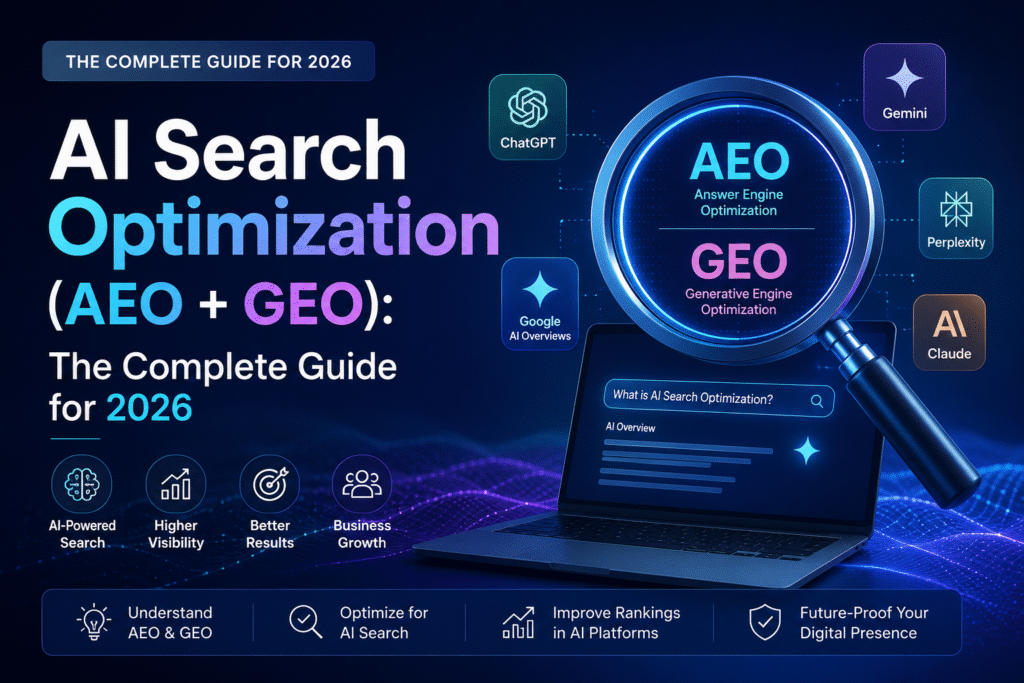
AI Search Optimization is the umbrella term for making a brand’s content visible and citable inside AI-powered search tools — Google AI Overviews, ChatGPT, Perplexity, and Gemini — rather than only in traditional ranked results. It combines AEO (getting extracted as a direct answer) and GEO (getting cited inside generative responses).
Is AEO the same as GEO?
Not exactly, though the terms are often used interchangeably. AEO is the broader idea — being selected as the answer anywhere, including featured snippets and voice search. GEO is the narrower, AI-specific version — being cited inside generative responses from tools like ChatGPT and Gemini.
Do I need to abandon traditional SEO for AEO/GEO?
No. Google explicitly frames AEO/GEO as part of standard SEO for its own AI features rather than a separate discipline. The content practices that support strong organic rankings — clear structure, authoritative sourcing, genuine expertise — are largely the same practices that earn AI citations.
How important is E-E-A-T for AI search visibility?
Very. Because AI models are known to generate citations that don’t always fully support their claims, AI systems increasingly rely on verifiable trust signals — named authors, real credentials, consistent entity data — to decide which sources are safe to cite.
Do I need an llms.txt file or special AI schema?
No. Google has explicitly stated that llms.txt files, artificial content chunking, and special AI-specific schema aren’t required for its generative AI search features. Standard structured data (FAQPage, Article, Organization) and genuinely well-structured content are sufficient.
How do I measure whether I’m showing up in AI search results?
Run regular manual audits by querying ChatGPT, Gemini, Perplexity, and Google AI Mode with your buyers’ actual questions, and/or use a dedicated AI visibility tracking platform. Expect citation results to shift month to month — consistency over time matters more than any single check.
Sources referenced in this guide: Google Search Central documentation (2026), EMARKETER, Search Engine Journal, Similarweb GenAI Brand Visibility Index, Nature Communications, and industry AEO/GEO analyses published between March–June 2026. Full citations available on request.