Written by a search visibility strategist with 7+ years of hands-on experience using AI tools daily across content, SEO, and campaign work. This guide strips the PROMPT framework down to what actually matters for a busy marketer, rather than treating it as a rigid formula to memorize.
Most marketers have had the experience of typing a vague request into ChatGPT, getting a generic, forgettable answer back, and concluding the tool just isn’t that useful for real work. Usually, the tool isn’t the problem — the prompt is. The PROMPT framework is a simple, six-part way of thinking about what to include in a prompt so the output actually reflects your business, your audience, and your standards, instead of a generic internet-average answer. This guide breaks it down plainly, with marketing examples, so you can start using it today without treating prompt writing like a technical skill you need a course for.
What the PROMPT Framework Actually Is
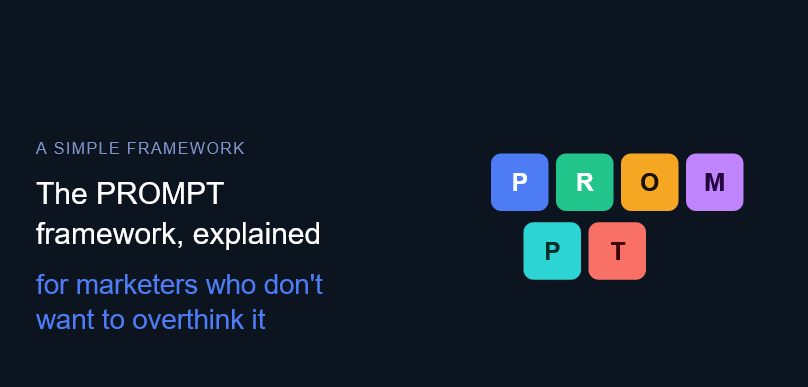
PROMPT stands for six things worth including in a request, roughly in order of importance: Purpose, Relevant context, Output format, Must-haves, Proof and examples, and Tune. Not every prompt needs all six — a quick, simple request might only need the first two or three. But when the output from ChatGPT feels generic, vague, or off-target, it’s almost always because one of these six pieces was missing. This structure aligns closely with how tools like ChatGPT are designed to be used, and it’s consistent with the fundamentals laid out in OpenAI’s own prompt engineering guidance, which recommends the same core idea: describe the task clearly, provide context, define the format, set constraints, and refine as you go.
P: Purpose — Say Exactly What You Want
Start with a clear action and a clear result, not a vague ask. “Help me with my email campaign” gives ChatGPT almost nothing to work with. “Draft a three-email welcome sequence for new newsletter subscribers” gives it an actual task with a defined output. The fix here is simple: use a specific verb (draft, compare, summarize, plan) and name exactly what you want produced.
R: Relevant Context — Give It the Background It’s Missing
ChatGPT doesn’t know your industry, your audience, or your current priorities unless you tell it. This is the single most skipped step, and it’s usually why an otherwise reasonable prompt produces a generic result. A prompt for a LinkedIn post about a new feature launch becomes far more useful once you add: “This is for a B2B SaaS company selling to marketing directors at mid-sized companies, and we’re trying to position this feature as a time-saver, not just a new capability.” That one sentence changes everything about the response.
O: Output — Tell It How to Format the Answer
Specify the shape you actually need: a table, a numbered list, an email with a subject line, a short paragraph under a word count. Marketers frequently skip this and then get frustrated when ChatGPT returns a long block of prose they now have to reformat themselves. If you know you’re going to paste the result into a specific format — a Slack message, a slide, a spreadsheet — say so directly in the prompt.
M: Must-Haves — Set the Non-Negotiables
This is where you tell ChatGPT what absolutely needs to be included, excluded, or followed. Tone requirements, points that must be covered, information that should be left out, brand voice rules — all of it goes here. For a customer email, a must-have might be: “Do not promise a refund; our policy only allows store credit for this situation.” Skipping this step is how a well-meaning AI-generated draft accidentally promises something your business can’t actually deliver.
P: Proof and Examples — Ground It in Real Material
This is the difference between a generic answer and one that actually sounds like your brand and reflects your real data. Paste in past campaign performance, a previous approved email, your actual product details, or customer feedback, and ask ChatGPT to base its response specifically on that material rather than general knowledge. A prompt asking for social captions “in our brand voice” is far weaker than one that includes three examples of your actual past captions to match.
T: Tune — Treat the First Answer as a Draft
The first response is rarely the final one, and that’s normal. Tuning means giving specific, direct feedback: “This is too long, cut it in half,” “The tone is too formal, make it more conversational,” “Keep the structure but focus more on the pricing benefit.” Marketers who stop after one response and either accept or discard it entirely are missing most of the framework’s value — the real improvement usually happens in the second or third exchange.
A Simple Marketing Example, Start to Finish
Purpose: Write a LinkedIn post announcing our new integration with [Tool].
Relevant context: We’re a project management SaaS targeting operations managers at mid-sized companies. This integration solves a common complaint about manually syncing tasks between platforms.
Output: Keep it under 150 words, written for LinkedIn, ending with a question to encourage comments.
Must-haves: Mention the specific pain point this solves. Don’t use the word “revolutionary” or similar hype language — keep the tone practical and confident.
Proof and examples: Here are two of our past LinkedIn posts that performed well, match this tone: [paste examples].
Tune (after the first draft): Good structure, but open with the pain point instead of the announcement — lead with the problem, then reveal the fix.
Why This Matters More as AI Becomes Part of Daily Marketing Work
As AI tools move from novelty to daily workflow, the gap between marketers who get genuinely useful output and those who get generic filler increasingly comes down to prompt quality, not tool access — everyone has the same tool. A structured approach like PROMPT turns AI from an unpredictable coin flip into a repeatable part of the workflow, which matters whether you’re drafting content, testing how your brand shows up in AI-generated answers, or producing social media copy at volume.
Frequently Asked Questions
Do I need to use all six parts of the PROMPT framework every time?
No. Simple, low-stakes requests often work fine with just Purpose and Relevant context. The full framework becomes more valuable as the task gets more complex or the output needs to closely match a specific brand voice or format.
What’s the single biggest mistake marketers make with ChatGPT prompts?
Skipping relevant context. A prompt without background on the audience, industry, or goal forces ChatGPT to guess, which is almost always why the output feels generic.
How is the PROMPT framework different from just writing a detailed prompt?
It’s a structured checklist for what “detailed” should actually include — purpose, context, format, rules, source material, and refinement — rather than just adding more words without a clear structure.
Should I save prompts that work well?
Yes. Once a prompt reliably produces a useful result, save it along with the inputs it needs, so it becomes a reusable template rather than something you have to rebuild from scratch each time.
Is the Tune step really necessary, or can I just write a better first prompt?
A stronger first prompt reduces how much tuning is needed, but even well-constructed prompts benefit from a round of specific feedback. Treating the first response as a draft, not a final answer, consistently produces better results.
Does this framework work for tools other than ChatGPT?
Yes. The same underlying principles — clear purpose, context, format, constraints, and refinement — apply across most AI chat tools, since they reflect how these models generally respond to structured input rather than being specific to one platform.
The PROMPT framework isn’t a rigid formula to memorize word for word — it’s a simple checklist for the handful of things that actually separate a generic AI response from a genuinely useful one. Purpose and context get you most of the way there for everyday tasks; must-haves, proof, and tuning close the gap for anything that needs to sound like your brand and hold up to scrutiny. Start applying even two or three of these elements consistently, and the quality gap between your AI output and everyone else’s generic prompts becomes obvious fast.

Vishal is a Digital Marketing Specialist, SEO Consultant and AEO (Answer Engine Optimisation) Specialist with over 6 years of experience in the digital marketing industry. He has worked on 50+ projects across multiple industries, helping businesses improve their online visibility, organic search performance and digital presence.
His expertise includes Technical SEO, On-Page SEO, Off-Page SEO, Local SEO, Google Ads, Content Optimisation, AI SEO, Generative Engine Optimisation (GEO) and Answer Engine Optimisation (AEO).
Vishal specialises in developing SEO strategies that help businesses improve their visibility across traditional search engines like Google and emerging AI-powered platforms such as ChatGPT, Google Gemini and Perplexity.
He also works with Google Analytics 4 (GA4), Google Search Console and Looker Studio to monitor website performance, analyse search trends and measure digital marketing results.
Through his practical experience working with businesses across different industries, Vishal shares actionable insights, industry knowledge and proven digital marketing practices to help businesses strengthen their online presence and adapt to the evolving search landscape.