
Written by a search visibility strategist with 7+ years of hands-on experience building content clusters for clients across SEO, AEO, and GEO campaigns, including several that started from exactly one well-performing post. This guide reflects that expansion process directly, not a theoretical content strategy framework.
A single blog post, however well-written, rarely earns consistent citations from ChatGPT or Gemini on its own. AI systems favor sources that demonstrate depth across an entire subject, not just a strong answer to one question — which means the real opportunity in a good-performing post usually isn’t in polishing it further, but in using it as the starting point for something larger. This guide walks through exactly how to take one solid blog post and expand it into a genuine content cluster built to earn AI citations, step by step.
Why a Single Post Struggles to Earn Consistent AI Citations
AI systems evaluate topical authority, not just individual page quality, when deciding what to cite. A site with one excellent post on a subject and nothing else around it signals a narrower base of expertise than a site with that same post supported by a dozen related pieces covering the subject from multiple angles. This is a well-documented pattern in content strategy research: structured, interlinked content consistently outperforms standalone content on both traditional rankings and AI citation rates. HubSpot’s own research on this structure found that pages built around a central topic with supporting content earn meaningfully more citations across AI Overviews, Gemini, and Perplexity than isolated posts, particularly when that structure includes strong internal linking and up-to-date, well-sourced content. You can read more in HubSpot’s guide to topic clusters and AEO, which lays out the connection between this content structure and AI citation performance in detail.
The takeaway is straightforward: one great post proves you can write well about a topic. A cluster proves you comprehensively understand it — and that second signal is what AI systems are actually looking for before they cite a source.
Step 1: Identify the Real Scope of Your Original Post
Start by mapping every subtopic your original post touches on briefly but doesn’t fully explore. A post about “choosing a CRM for small teams” likely mentions pricing, integrations, onboarding, and specific use cases without covering any of them in real depth. Each of these underdeveloped mentions is a candidate for its own dedicated piece.
Step 2: Turn the Original Post Into Your Pillar
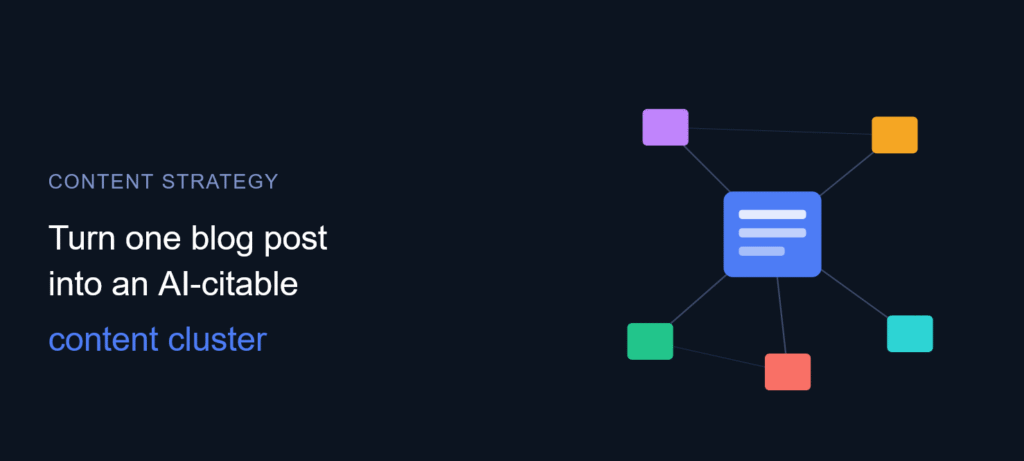
Rather than treating your original post as one piece among many, reposition it as the pillar — the broad, comprehensive overview that a reader (or an AI system) can use as a map to the rest of the subject. This often means expanding it slightly to explicitly reference the subtopics you’re about to build out, so it clearly functions as a hub rather than a standalone piece.
Step 3: Map the Real Questions Behind Each Subtopic
For each subtopic identified in Step 1, gather the specific questions a reader would actually ask about it — pulled from your own customer conversations, question-based platforms like Quora or Reddit, and direct testing in ChatGPT and Gemini to see what follow-up questions come up naturally. This ensures each cluster piece is built around genuine intent rather than a keyword tool’s suggested variants.
Step 4: Build Focused, Comprehensive Cluster Pieces
Write one dedicated piece per subtopic, each answering its specific set of questions directly and thoroughly, rather than superficially touching on many subtopics across several thin pieces. A comprehensive piece on CRM pricing that genuinely answers every reasonable pricing question a buyer might have is far more citable than five shallow posts that each mention pricing in passing.
Step 5: Link Every Cluster Piece Back to the Pillar, and to Each Other
This is the step most content strategies get wrong: writing the supporting pieces without building the internal link structure that actually signals a cluster to both readers and AI systems. Every cluster piece should link back to the pillar with clear, descriptive anchor text, and pieces that are closely related to each other should cross-link directly, rather than relying solely on the pillar to connect everything.
Step 6: Strengthen Each Piece With E-E-A-T Signals
Content structured for AI citation benefits from the same trust signals that strengthen traditional SEO: a named author with relevant expertise, outbound links to credible sources, specific data or statistics rather than vague claims, and a visible “last updated” date. Research on AI citation patterns specifically found that pages featuring these signals — outbound links, statistics, author bios, and visible update dates — earn measurably more citations across AI Overviews, Gemini, and Perplexity than pages without them.
Step 7: Keep the Cluster Current, Not Just Complete
A cluster that was comprehensive a year ago but hasn’t been touched since starts to lose ground, both because information ages and because AI systems favor demonstrably current content. Set a recurring review schedule — quarterly is reasonable for most businesses — to update statistics, check for new subtopics worth adding, and refresh any content that’s become outdated.
A Practical Example
Take a single post titled “How to Choose an SEO Agency in India.” On its own, it’s a reasonable answer to one broad question. Expanded into a cluster, it might include: “SEO Agency Pricing in India: What Determines the Cost,” “Red Flags to Watch For When Hiring an SEO Agency,” “In-House vs. Agency SEO: Which Fits Your Business,” and “Questions to Ask an SEO Agency Before Signing a Contract” — each a focused piece linking back to the original pillar, together demonstrating exactly the kind of comprehensive topical depth that earns AI citations rather than a single, isolated answer.
Why This Matters More in the AI Search Era Specifically
Traditional SEO rewarded topical depth gradually, through improved rankings over time. AI citation behavior appears to reward it more directly — a well-built cluster gives an AI system multiple, mutually reinforcing sources to pull from when constructing an answer, increasing the odds of being cited across a wider range of related questions rather than just the one your original post happened to answer. This is precisely the structural work that dedicated Generative Engine Optimization (GEO) is built around, while the individual pieces within the cluster benefit from being structured for direct extraction through Answer Engine Optimization (AEO) principles. Both disciplines build on the same SEO fundamentals — internal linking, content quality, and site structure — that have always mattered, just applied with AI retrieval behavior specifically in mind.
Frequently Asked Questions
How many cluster pieces do I need before it counts as a real content cluster?
There’s no fixed number, but somewhere between four and eight well-developed cluster pieces around a single pillar is a reasonable starting point for most businesses, expanding further as new subtopics and questions emerge over time.
Should I rewrite my original post, or just build content around it?
Both, ideally. Expand the original post slightly so it functions clearly as a pillar and hub, referencing the subtopics you’re building out, rather than leaving it unchanged as just one piece among several unconnected ones.
How important is internal linking to this process?
Very important. Internal linking is what actually signals a cluster structure to both readers and AI systems. Cluster pieces written without deliberate linking back to the pillar and to each other don’t function as a real cluster, regardless of how good the individual content is.
Does this process work for any industry, or just certain types of businesses?
It works broadly across industries, though the specific subtopics and questions will differ significantly between, for example, a SaaS company and a local service business. The underlying structure — pillar plus focused, interlinked subtopic content — applies regardless of industry.
How long does it take to build a full content cluster from one post?
Timelines vary based on team size and content volume, but a focused effort can produce a meaningful cluster of four to six pieces within one to two months, with ongoing expansion and updates continuing afterward.
Do content clusters help with both traditional SEO and AI citations, or just one?
Both. The same structural signals — topical depth, internal linking, and comprehensive coverage — that improve traditional search rankings also correlate with higher AI citation rates, making this a strategy that reinforces both outcomes simultaneously rather than requiring separate approaches.
Final Thoughts
One good blog post is a starting point, not a finished strategy. Expanding it into a genuine content cluster — built around real subtopics, real questions, and deliberate internal linking — is what turns a single answer into the kind of comprehensive, trustworthy source AI systems are actually built to look for before citing something. The businesses earning consistent AI citations aren’t the ones with the single best post on a subject; they’re the ones that took that post and built an entire, interconnected body of work around it.

Vishal is a Digital Marketing Specialist, SEO Consultant and AEO (Answer Engine Optimisation) Specialist with over 6 years of experience in the digital marketing industry. He has worked on 50+ projects across multiple industries, helping businesses improve their online visibility, organic search performance and digital presence.
His expertise includes Technical SEO, On-Page SEO, Off-Page SEO, Local SEO, Google Ads, Content Optimisation, AI SEO, Generative Engine Optimisation (GEO) and Answer Engine Optimisation (AEO).
Vishal specialises in developing SEO strategies that help businesses improve their visibility across traditional search engines like Google and emerging AI-powered platforms such as ChatGPT, Google Gemini and Perplexity.
He also works with Google Analytics 4 (GA4), Google Search Console and Looker Studio to monitor website performance, analyse search trends and measure digital marketing results.
Through his practical experience working with businesses across different industries, Vishal shares actionable insights, industry knowledge and proven digital marketing practices to help businesses strengthen their online presence and adapt to the evolving search landscape.