Written by a search visibility strategist with 7+ years of hands-on experience managing content refresh schedules for clients across SEO, AEO, and GEO campaigns. This guide reflects real update cadences tested against actual citation results, not a generic “keep your content fresh” platitude.
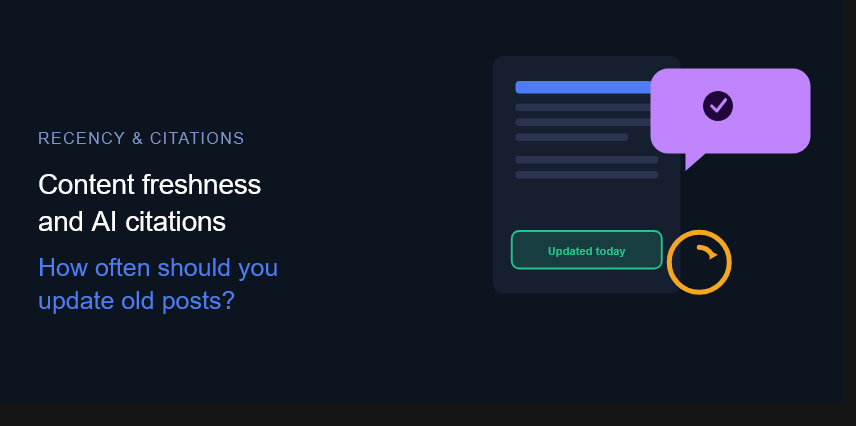
A blog post that earned steady AI citations six months ago can quietly stop showing up in ChatGPT or Gemini answers without a single word of its content actually becoming wrong. This isn’t a bug or a penalty — it’s how AI systems are built to behave. Large language models are trained to avoid presenting outdated information, and that caution shows up directly in which pages get cited and which get quietly passed over. This guide explains exactly how much freshness actually matters for AI citations, and gives you a realistic update schedule instead of a vague “keep it current” recommendation.
Why AI Systems Are More Freshness-Sensitive Than Google
Traditional Google rankings have always had a nuanced relationship with recency — a well-established, authoritative page from years ago can still outrank a newer one if it has enough backlinks and depth. AI citation behavior works differently, and the difference is now well documented at scale. Ahrefs analyzed nearly 17 million citations across ChatGPT, Perplexity, Gemini, Copilot, and Google AI Overviews, and found that AI-cited pages were on average 25.7% fresher than the pages ranking in Google’s own top 10 organic results for the same queries. You can read the full methodology in Ahrefs’ study on whether AI assistants prefer fresh content, which lays out the data behind this freshness gap in detail.
The reasoning behind this behavior is straightforward: an AI system generating a direct answer carries more immediate risk from citing outdated information than a search engine simply listing a link does. A user can judge for themselves whether a five-year-old blog post is still relevant before clicking it. An AI system that confidently states something wrong, sourced from stale content, has no such safety net — so the underlying models are built to lean toward recency as a proxy for accuracy.
How Much Recency Actually Matters, by Platform
Freshness sensitivity isn’t uniform across every AI platform, which matters for deciding where to focus your effort.
- ChatGPT leans heavily toward recency, with cited pages skewing notably newer than what Google’s organic results typically surface, particularly for research and reasoning-style queries where synthesis benefits from current sources.
- Perplexity shows the strongest recency bias of the major platforms, driven by its real-time retrieval architecture — roughly half of its citations come from content published or updated within the current year alone.
- Google AI Overviews tracks much closer to standard Google organic behavior, since it sits on top of the existing Google ranking system rather than running an independent, freshness-first retrieval process.
- Claude weights recency comparatively lightly relative to the others, placing more emphasis on other authority and quality signals.
This means the right update cadence genuinely depends on where your audience is actually encountering your content. A business whose AI-driven traffic comes primarily through ChatGPT and Perplexity has considerably more to gain from an aggressive refresh schedule than one whose visibility is concentrated in Google AI Overviews.
A Realistic Update Schedule, Not a One-Size-Fits-All Rule
- High-priority, commercial, or competitive pages: Every 60 to 90 days. These are the pages where losing citation share to a fresher competitor has the most direct cost.
- Evergreen guides and pillar content: Every 3 to 6 months. Comprehensive, foundational pieces benefit from periodic updates to statistics, examples, and any changed recommendations, without needing the same aggressive cadence as commercial pages.
- Reference, definitional, or historically stable content: Roughly annually. Content answering “what is X” for a stable concept doesn’t need constant refreshing, though a periodic check for accuracy and added depth still helps.
As a baseline across nearly any content type, treat a full calendar quarter without a meaningful update as the outer limit before a page’s freshness signal starts working against it, particularly for anything you want to keep visible in ChatGPT or Perplexity specifically.
What Actually Counts as a Meaningful Update
Not every edit signals freshness the same way. A typo fix or minor formatting change does little to reset how an AI system perceives a page’s currency. Updates that genuinely matter include:
- Adding new statistics or data points, replacing outdated ones
- Expanding coverage with a new section addressing a question the original didn’t cover
- Revising recommendations or conclusions based on new information
- Updating examples, screenshots, or references that have become dated
- Adding a new, relevant subtopic that reflects how the underlying topic has evolved
Simply changing a “last updated” date without making a substantive change to the content itself is both ineffective and detectable — AI systems and search engines are increasingly able to distinguish a superficial timestamp change from genuine content revision, and treating the date field as the update itself misses the point of the signal entirely.
Make the Freshness Signal Visible, Not Just True
A substantive update only helps if it’s clearly signaled to both readers and AI crawlers. Display both the original publish date and a distinct “last updated” date near the top of the page, where it’s encountered early rather than buried in a footer. Pair this with the corresponding structured data field so the update is machine-readable, not just visible to a human reader. A genuinely refreshed page that hides its update date is leaving one of the clearest, lowest-effort freshness signals unused.
Where This Fits Into a Broader Content Strategy
A recurring refresh schedule works best as one part of a larger content system rather than an isolated task. It pairs naturally with the kind of content cluster structure that builds topical depth over time, since a cluster with regularly refreshed cluster pieces signals ongoing expertise far more convincingly than a static one. It’s also worth treating as core Answer Engine Optimization (AEO) maintenance, since content that answers a question well today can quietly stop being the best available answer as the underlying topic evolves. Businesses managing this across dozens or hundreds of pages typically benefit from folding freshness reviews into the same ongoing process as broader SEO and LLM SEO work, rather than treating it as a separate, occasional project.
Frequently Asked Questions
How often should I update a blog post to keep earning AI citations?
For most high-priority or commercial content, every 60 to 90 days is a reasonable cadence. Evergreen guides can extend to 3 to 6 months, while stable reference content can go closer to a year between substantive updates.
Does changing the “last updated” date without editing the content actually help?
No. AI systems and search engines can generally distinguish a superficial date change from a genuine content update, and relying on this shortcut risks looking manipulative rather than helpful.
Is content freshness equally important across ChatGPT, Gemini, Perplexity, and Claude?
No. Perplexity and ChatGPT show the strongest recency bias, Google AI Overviews tracks closer to standard Google organic behavior, and Claude weights freshness comparatively lightly. Prioritize your refresh effort based on where your AI-driven visibility actually comes from.
What counts as a “meaningful” content update?
Adding new data, expanding coverage of an underexplored subtopic, revising outdated recommendations, and updating examples all count as meaningful. Minor formatting or typo fixes generally don’t move the freshness signal in any noticeable way.
Should I display both a publish date and a last-updated date on my content?
Yes. Showing both provides transparency for readers and gives AI crawlers a clear, visible freshness signal, particularly when paired with the corresponding structured data field.
Do evergreen topics really need to be updated if the core information hasn’t changed?
Even genuinely stable topics benefit from periodic review, since AI systems weigh visible recency as a proxy for reliability independent of whether the underlying facts have shifted. A light annual refresh, adding new examples or context, still helps maintain citation potential.
Content freshness has become one of the more directly actionable levers available for AI citation visibility, precisely because it’s something a business can control on a predictable schedule rather than chasing an algorithm change. The data is consistent across independent studies: AI systems meaningfully favor recently updated content over stale pages, even when the underlying information hasn’t materially changed. Building a realistic, tiered refresh schedule — aggressive for commercial pages, moderate for evergreen guides, light for stable reference content — is a far more sustainable approach than either ignoring freshness entirely or trying to update everything constantly.

Vishal is a Digital Marketing Specialist, SEO Consultant and AEO (Answer Engine Optimisation) Specialist with over 6 years of experience in the digital marketing industry. He has worked on 50+ projects across multiple industries, helping businesses improve their online visibility, organic search performance and digital presence.
His expertise includes Technical SEO, On-Page SEO, Off-Page SEO, Local SEO, Google Ads, Content Optimisation, AI SEO, Generative Engine Optimisation (GEO) and Answer Engine Optimisation (AEO).
Vishal specialises in developing SEO strategies that help businesses improve their visibility across traditional search engines like Google and emerging AI-powered platforms such as ChatGPT, Google Gemini and Perplexity.
He also works with Google Analytics 4 (GA4), Google Search Console and Looker Studio to monitor website performance, analyse search trends and measure digital marketing results.
Through his practical experience working with businesses across different industries, Vishal shares actionable insights, industry knowledge and proven digital marketing practices to help businesses strengthen their online presence and adapt to the evolving search landscape.