Written by a search visibility strategist with 7+ years of hands-on experience building comparison and “best of” content for clients across SaaS, ecommerce, and local service businesses. This guide reflects patterns tested against actual AI citation results, not assumptions about content format.
Most businesses put the bulk of their content effort into product and service pages, treating comparison and “best of” content as a lower-priority, secondary asset. The data on how AI systems actually cite content tells a different story. Comparison-style content consistently earns a disproportionate share of AI citations for commercial, buying-stage queries — often outperforming the product pages it’s supposedly less important than. This guide explains exactly why that happens, and what it means for how you should actually be allocating content effort.
What the Data Actually Shows
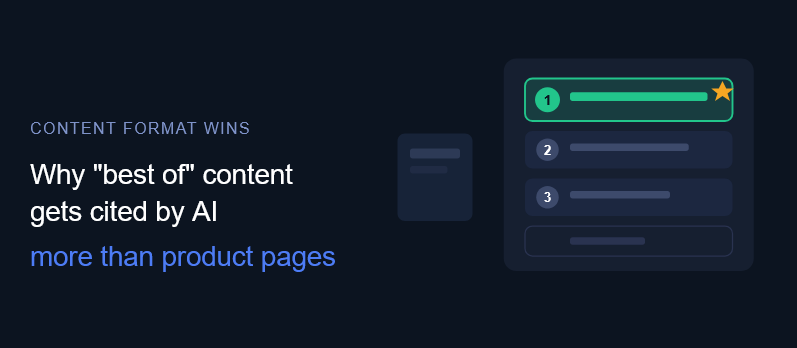
A large-scale analysis of 75,000 AI answers and more than one million citations, covering major platforms including ChatGPT, Gemini, and Perplexity, found that listicles, articles, and product pages together account for roughly 52% of all AI citations — but the split between them depends heavily on query intent. You can read the full findings in Search Engine Land’s coverage of the AI citation study, which breaks down exactly how content format maps to intent. Articles dominated informational queries, cited roughly 2.7 times more often than other formats. But on commercial-intent queries — the exact moment someone is comparing options before buying — listicles captured 40% of citations, nearly double any other single format. Product pages, by contrast, won primarily on transactional and navigational queries, where the user has already decided what they want and just needs to find it.
The pattern is consistent: articles explain, listicles compare, and product pages convert. Most businesses invest heavily in the first and third, while leaving the middle — the exact stage where AI-driven buying research increasingly happens — comparatively underdeveloped.
Why AI Systems Favor Comparison Content Specifically
1. It Compresses Cleanly Into an Answer
A ranked list with stated criteria is structurally easy for an AI system to parse, summarize, and cite with low ambiguity. A product page describing one option in isolation requires the AI system to do its own comparative reasoning across multiple separate sources — comparison content has effectively already done that work, making it a more efficient source to draw from.
2. It Directly Answers the Most Common Commercial Question
“What’s the best X for Y” is one of the most frequent structures behind buying-stage AI queries, and a well-built comparison piece answers that question in the exact shape it was asked. A single product page can only ever answer “is this one option good,” not the broader comparative question a buyer at this stage is actually asking.
3. It Signals Neutrality and Trade-Off Awareness
Content that names multiple options, states clear criteria, and is honest about trade-offs reads as more balanced and trustworthy than a page promoting a single product. AI systems, like human readers, weigh this kind of apparent neutrality as a credibility signal when deciding which source to draw from for a comparative answer.
The Important Caveat: Your Own “Best Of” Page May Not Work the Way You Expect
This is worth being direct about, since it changes how you should approach comparison content. Independent research into how AI Overviews and similar tools use brand-published “best of” content has found a counterintuitive pattern: AI systems sometimes cite a brand’s own comparison page for its category structure and criteria, then use that same criteria to evaluate the broader market — and recommend a competitor instead. Being cited is not the same as being recommended, particularly when the comparison content in question is self-published and evaluating your own product.
This doesn’t mean comparison content isn’t worth building — it means the strategy needs to account for how it’s likely to be used. Genuinely neutral, criteria-driven comparison content, including a fair treatment of competitors, tends to earn more actual recommendation weight than a thinly disguised promotional listicle that happens to rank your own product first.
How to Build Comparison Content That Actually Earns Citations and Recommendations
1. Include Real Competitors, Genuinely and Fairly
A “best CRM tools” post that only features your own product isn’t a comparison — it’s a product page with extra steps, and AI systems are increasingly able to recognize the difference. Including genuine competitors, with honest strengths and weaknesses, is what earns the neutrality signal that makes comparison content citable in the first place.
2. Use Clear, Stated Criteria
Rather than a vague ranking, explicitly state what you’re comparing on — price, features, ease of use, support quality — and apply those criteria consistently across every option. This structure is exactly what makes comparison content easy for an AI system to parse and cite confidently.
3. Keep the Format Current and Structured
The comparison content that earns the most citations tends to share a recognizable shape: a current year in the title, an explicit ranking, roughly ten items, and clear comparison tables. Outdated or vaguely structured comparison posts lose ground quickly to competitors publishing fresher, more clearly organized versions of the same comparison.
4. Don’t Abandon Product Pages Either
None of this means product pages don’t matter — they win decisively once a buyer has moved from comparing to deciding, and they remain essential for ecommerce businesses specifically. The point is balance: businesses that pour all their content effort into product pages and articles, while leaving comparison content thin, are missing the exact format that dominates the buying-stage queries AI systems answer most often.
Mapping Content Format to the Buyer’s Actual Stage
| Query Type | Best-Performing Format | What the Buyer Needs |
|---|---|---|
| Informational (“what is X”) | Articles | Understanding and education |
| Commercial (“best X for Y”) | Listicles / comparison content | Help narrowing down options |
| Transactional (“buy X”) | Product / category pages | A direct path to purchase |
Building content deliberately across all three stages, rather than concentrating effort at either end of the funnel, is what positions a business to be cited at every point in an AI-assisted buying journey — not just the first or last step of it.
Where This Fits Into a Broader AI Visibility Strategy
Building genuinely useful, criteria-driven comparison content is core Generative Engine Optimization (GEO) work, since it’s exactly the kind of comprehensive, comparative resource that establishes topical authority across a category. It also reinforces Answer Engine Optimization (AEO), since a well-structured comparison directly answers one of the most common question formats AI systems handle. Both build on the same content quality and structure fundamentals that have always mattered in SEO, just applied with a clearer understanding of which formats actually earn citations at each stage of the buying journey.
Frequently Asked Questions
Why do listicles and comparison posts get cited more than product pages?
Comparison content directly answers commercial, buying-stage questions in the exact shape they’re asked, compresses cleanly for an AI system to summarize, and signals a level of neutrality that a single product page can’t offer on its own.
Should I stop investing in product pages if comparison content gets cited more?
No. Product pages win decisively on transactional queries, where a buyer has already decided and just needs a direct path to purchase. The two formats serve different stages of the buyer’s journey and both matter.
Is it worth publishing a “best of” list that includes my competitors?
Yes, generally. Comparison content that only features your own product is often recognized as promotional rather than genuinely comparative, which limits both its citation potential and, more importantly, the odds it results in an actual recommendation rather than just background research for a competitor.
How is a listicle different from a regular product page for AI citation purposes?
A listicle explicitly compares multiple options against stated criteria, which is structurally easier for an AI system to parse and cite with confidence. A product page describes only one option, requiring the AI system to do its own comparative reasoning across separate sources.
Does the format of comparison content matter, or just the content itself?
Both matter. Comparison content that earns the most citations tends to include a current year in the title, an explicit ranking, a manageable number of items, and clear comparison tables — structure that makes the content easier to extract and cite confidently.
Can a smaller business compete with larger competitors using comparison content?
Yes. Since AI systems favor clarity, fairness, and structure over brand size, a smaller business publishing a genuinely useful, well-organized comparison can earn citations that a larger competitor’s more promotional content misses.
The data is consistent: comparison and “best of” content earns a disproportionate share of AI citations specifically at the commercial, buying-comparison stage — the exact moment AI-assisted research is reshaping how customers make decisions. But citation isn’t the same as recommendation, and self-serving comparison content risks doing research for a competitor rather than earning the sale for you. Building genuinely fair, well-structured comparison content, alongside strong product pages and informational articles, is what positions a business to be both cited and recommended across the full arc of an AI-assisted buying journey.

Vishal is a Digital Marketing Specialist, SEO Consultant and AEO (Answer Engine Optimisation) Specialist with over 6 years of experience in the digital marketing industry. He has worked on 50+ projects across multiple industries, helping businesses improve their online visibility, organic search performance and digital presence.
His expertise includes Technical SEO, On-Page SEO, Off-Page SEO, Local SEO, Google Ads, Content Optimisation, AI SEO, Generative Engine Optimisation (GEO) and Answer Engine Optimisation (AEO).
Vishal specialises in developing SEO strategies that help businesses improve their visibility across traditional search engines like Google and emerging AI-powered platforms such as ChatGPT, Google Gemini and Perplexity.
He also works with Google Analytics 4 (GA4), Google Search Console and Looker Studio to monitor website performance, analyse search trends and measure digital marketing results.
Through his practical experience working with businesses across different industries, Vishal shares actionable insights, industry knowledge and proven digital marketing practices to help businesses strengthen their online presence and adapt to the evolving search landscape.