By Vishal, AI Search & SEO Strategist — 7+ years of experience across traditional SEO and emerging AI search optimization Last updated: July 2026
I’ve had this exact conversation more times than I can count: a business owner searches for “LLM expert,” ends up talking to a machine learning engineer who fine-tunes models for a living, and walks away confused about why that person can’t help them show up in ChatGPT’s answers. Having worked on the marketing side of this specific confusion for years now, I can tell you it’s one of the most common mismatches in AI-related hiring right now — and it’s worth clearing up properly.
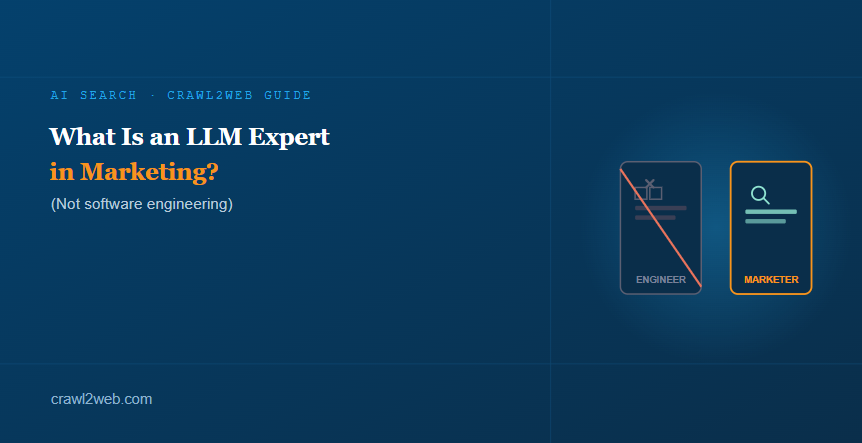
Short answer: In software engineering, an “LLM expert” is someone who builds, trains, fine-tunes, or deploys large language models — deep technical, machine learning work. In marketing, an “LLM expert” means something entirely different: someone who understands how existing large language models like ChatGPT, Gemini, and Claude source, weigh, and represent information about a brand, and who works to improve how that brand shows up in AI-generated answers. Neither definition is more correct than the other — they’re just answering two completely different questions.
The Software Engineering Definition (What You’re Not Looking For)
Large language models are, at a technical level, deep neural networks trained on massive amounts of text data to understand and generate human language. Building and working with them at this level involves training and fine-tuning models, working with model architecture and infrastructure, deploying models via APIs, and managing the real computational, cost, and governance challenges involved in running these systems. This is genuinely specialized machine learning and software engineering work — the kind of role you’d hire if you were building your own AI product or integrating a model deeply into custom software.
If your goal is “I want my business to be mentioned when people ask ChatGPT for a recommendation,” this is almost never the expertise you actually need — even though a search for “LLM expert” will often surface exactly this kind of candidate or content first.
The Marketing Definition (What You’re Actually Looking For)
In a marketing context, an “LLM expert” refers to someone who works with existing, already-built language models from the outside — understanding how they source information, what makes them more likely to trust and cite a particular website or brand, and how to structure content and technical signals to improve that likelihood. This person isn’t training models; they’re studying how already-trained models behave and adjusting a business’s content, structure, and online presence in response.
This is the discipline behind LLM optimization — improving how specific AI platforms individually represent a brand, which overlaps heavily with Generative Engine Optimization and Answer Engine Optimization as related, connected practices rather than a separate technical specialty.
A Direct Comparison
| LLM Engineer (Software) | LLM Expert (Marketing) | |
|---|---|---|
| Core work | Training, fine-tuning, deploying models | Structuring content and signals to influence how models represent a brand |
| Relationship to the model | Builds and modifies the model itself | Works with the model as an external, unmodifiable system |
| Background | Machine learning, data science, software engineering | SEO, content strategy, digital marketing |
| Tools | Model training frameworks, GPUs, ML pipelines | Content platforms, schema markup, AI visibility monitoring tools |
| Typical deliverable | A deployed or fine-tuned model | Improved brand visibility and citation in AI-generated answers |
Why This Confusion Actually Costs Businesses Time
Because “LLM” is fundamentally a technical term — describing the actual architecture behind tools like ChatGPT, Gemini, and Claude — most existing content, job postings, and search results built around “LLM expert” skew heavily toward the engineering definition. A business owner without a technical background searching for marketing help can easily end up evaluating the wrong kind of candidate entirely, or assuming they need much deeper technical expertise than the actual work requires.
The practical fix is being specific about what you’re actually looking for from the start — searching for or asking about “LLM optimization for marketing,” “AI search visibility,” or explicitly clarifying “I’m not looking to build or train a model, I want help with how my brand appears in AI search results” tends to filter out this mismatch quickly.
What This Person Actually Does, Day to Day
In practice, marketing-context LLM expertise overlaps heavily with GEO and AEO work: testing how a brand currently appears across AI platforms, improving structured data and content clarity so models can understand and trust a business, and tracking how that visibility changes over time. It’s a blend of content strategy, light technical implementation, and ongoing research into how these systems behave — not model-building work in any sense.
How to Make Sure You’re Hiring (or Searching For) the Right Kind of Expertise
- Be explicit about the goal, not just the term — “I want my business mentioned in AI search results” is clearer than “I need an LLM expert.”
- Ask directly what a candidate or consultant actually does — training models, or working with existing ones from the outside. Their answer should make the distinction immediately clear.
- Look for SEO or content marketing background, not purely machine learning credentials, if the goal is brand visibility rather than product development.
- Recognize the overlap with GEO and AEO — if a provider offers any of these three services, they’re very likely describing closely related, overlapping work regardless of which specific term they lead with.
“LLM expert” isn’t a single, universally understood role — it splits cleanly into a technical, model-building discipline and a marketing-focused, visibility-building discipline that happen to share the same three-letter term. Knowing which one you actually need before you start searching or hiring saves real time and avoids a genuinely common, easily avoidable mismatch.
Frequently Asked Questions
Do I need a machine learning background to understand LLM optimization for marketing?
No — marketing-context LLM expertise is much closer to SEO and content strategy than to machine learning. It involves understanding how existing AI models behave and adjusting content and structure in response, not building or training models.
Is “LLM expert” the same as a “prompt engineer”?
Not quite, though there’s some overlap. Prompt engineering typically focuses on crafting inputs to get specific outputs from a model, often for product or application development. Marketing-context LLM expertise is broader — focused on how a brand is represented across AI-generated answers generally, not on crafting individual prompts.
What’s the difference between an LLM expert and a GEO expert in marketing?
The terms overlap heavily and are often used to describe very similar work. “LLM expert” or “LLM optimization” sometimes emphasizes platform-specific work (how ChatGPT specifically represents a brand, versus Gemini), while GEO is often used as the broader umbrella term across all generative AI platforms.
How do I avoid hiring the wrong kind of “LLM expert” for my marketing needs?
Be explicit about your actual goal (AI search visibility, not model development) when searching or interviewing, and ask directly whether the person builds/trains models or works with existing models from a content and visibility standpoint.
Is marketing-focused LLM expertise a recognized, standardized field yet?
Not fully — like GEO and AEO, this is a genuinely new and still-forming discipline without standardized credentials. Evaluating based on demonstrated understanding and real past work matters more than the specific title someone uses.