Written by an SEO strategist with 7+ years of hands-on experience in search engine optimization, answer engine optimization (AEO), and generative engine optimization (GEO). This guide is based on live client campaigns, ongoing testing across AI search platforms, and current industry data — not theory.
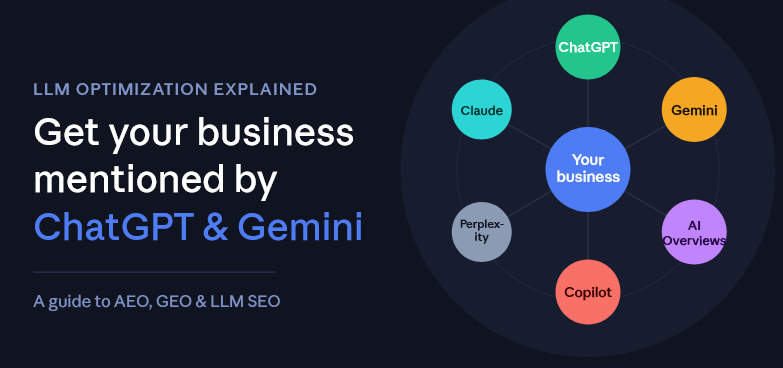
If you’ve noticed AI-generated answers showing up above the regular search results, or your customers mentioning that “ChatGPT recommended a competitor,” you’re not imagining it. Search has quietly split into two tracks: traditional blue-link results, and AI-generated answers pulled together by large language models (LLMs) like ChatGPT, Gemini, Claude, and Copilot.
LLM optimization is the practice of preparing your website and content so these AI systems can find, understand, trust, and ultimately mention your business in their responses. In this guide, I’ll walk through exactly how LLMs decide which brands to cite, what separates LLM SEO from traditional SEO, and the specific steps you can take this quarter to start showing up in AI-generated answers.
What Is LLM Optimization?
LLM optimization (also called LLM SEO) is the process of optimizing your website, content, and digital footprint so AI-powered platforms can accurately interpret your business and recommend it in generated responses. Instead of chasing a ranking position on page one, LLM SEO focuses on becoming a trusted, citable source that an AI model pulls from when it drafts an answer.
This differs from traditional SEO in one key way: traditional SEO optimizes for algorithms that rank pages, while LLM optimization optimizes for models that read, synthesize, and summarize content. A page can rank on page one of Google and still never get referenced by ChatGPT if it isn’t structured clearly, lacks authoritative signals, or fails to answer the underlying question directly.
LLM optimization sits alongside two closely related disciplines:
- Answer Engine Optimization (AEO) — optimizing content to directly answer specific user questions, so AI assistants and voice search engines can lift and present your answer.
- Generative Engine Optimization (GEO) — optimizing your site’s structure, topical authority, and content clusters so generative AI platforms understand your expertise across an entire subject, not just a single page.
Together, AEO, GEO, and LLM SEO form a complete strategy for AI search visibility. AEO gets your individual answers noticed, GEO builds the topical depth that earns trust, and LLM optimization ties it together with entity authority, structured data, and technical accessibility.
Why Getting Mentioned by ChatGPT and Gemini Actually Matters
AI search adoption is no longer a fringe trend. ChatGPT has crossed a billion active users, and Google’s AI Overviews now appear on roughly half of all search queries, reaching more than two billion monthly users worldwide. Independent industry tracking shows AI Overview prevalence has grown roughly four to nine times over the past 15 months, and brands cited inside these AI answers tend to earn significantly more clicks per impression than brands that go uncited.
For a deeper look at how this shift is reshaping click behavior, Search Engine Land regularly tracks zero-click search trends and AI Overview data, which is worth reviewing if you want to understand the scale of this shift: Search Engine Land’s coverage of AI search trends.
What this means practically: users are increasingly getting their first impression of your business from a paragraph an AI model wrote, not from your homepage. If that paragraph doesn’t mention you, you don’t exist in that moment of the buyer’s journey — regardless of how well your site ranks traditionally.
How ChatGPT and Gemini Decide Which Businesses to Mention
Large language models don’t “rank” websites the way Google does. Instead, they draw on a combination of training data, real-time retrieval, and structured signals to decide which sources are trustworthy enough to reference. In practice, three factors consistently influence whether a business gets mentioned:
- Content clarity and directness — Does the page answer the question in plain language, near the top of the content, without requiring the reader to dig for it?
- Entity recognition and authority — Is your business recognized as a distinct, credible entity across the web, with consistent naming, descriptions, and citations from other trusted sources?
- Structured, crawlable content — Is your site technically accessible, fast, and marked up with schema that helps machines parse who you are, what you offer, and why you’re credible?
Businesses that invest in all three tend to show up repeatedly across AI Overviews, ChatGPT responses, and Gemini answers, while businesses that only optimize for keyword rankings often get skipped entirely, even when their content is technically accurate.
Core Pillars of LLM Optimization
1. Write for Direct Answers First
AI systems favor content that states the answer clearly within the first few lines, then supports it with detail. Instead of building up to a conclusion, lead with it. Structure content around the actual questions your audience is typing into ChatGPT or asking a voice assistant, and use headings, short paragraphs, bullet points, and comparison tables so both readers and AI models can extract information quickly.
2. Build Topical Authority Through Content Clusters
A single well-written page rarely earns consistent AI citations on its own. Generative engines look for depth — a cluster of interlinked, well-organized content that covers a subject from multiple angles. Building topic clusters around your core services, linking them together logically, and keeping the information current signals to AI models that your site is a comprehensive, dependable resource on that subject.
3. Strengthen Entity Authority
LLMs are trained to recognize entities — people, brands, and organizations — much like a knowledge graph. Consistent business information across your website, Google Business Profile, industry directories, and third-party mentions strengthens how confidently an AI model can identify and describe your business. Getting mentioned or linked from other credible, relevant websites reinforces this further.
4. Implement Structured Data and Schema Markup
Schema markup (FAQ schema, Organization schema, Product schema, and similar structured data) gives AI crawlers explicit, machine-readable context about your content. This doesn’t guarantee a citation, but it removes ambiguity, making it easier for models to correctly interpret and summarize your pages.
5. Keep Content Technically Accessible
None of the above matters if AI crawlers can’t reach your content. Fast load times, clean site architecture, proper indexing, and crawlable pages are foundational. LLM optimization builds on solid technical SEO rather than replacing it.
6. Maintain and Update Content Regularly
AI models favor current, accurate information. Outdated statistics, old pricing, or stale service descriptions reduce the likelihood of citation. Treat your highest-value pages as living documents that get reviewed and refreshed on a set schedule.
AEO vs. GEO vs. LLM SEO: How They Work Together
| Discipline | Primary Focus | Best For |
|---|---|---|
| AEO | Direct, structured answers to specific questions | Voice search, featured snippets, quick AI answers |
| GEO | Topical depth, content clusters, entity relevance | Long-form AI summaries, comparison-style AI responses |
| LLM SEO | Entity authority, structured data, cross-platform visibility | Being recognized and recommended across ChatGPT, Gemini, Claude, and Copilot |
None of these disciplines replace traditional SEO. They extend it. A strong LLM optimization strategy is built on the same foundation of quality content, technical health, and authority that has always driven organic search — just applied with AI retrieval behavior in mind.
A Practical LLM Optimization Checklist
- Identify the real questions your target customers ask AI assistants about your industry
- Rewrite key pages to answer those questions directly within the first two to three sentences
- Add FAQ sections with concise, accurate answers to common queries
- Implement Organization, FAQ, and relevant Product/Service schema markup
- Build internal links between related content to reinforce topical clusters
- Ensure your business name, description, and details are consistent across your site, directories, and social profiles
- Earn mentions or links from credible, relevant third-party websites
- Audit page speed, mobile experience, and crawlability
- Review and refresh high-priority content on a recurring schedule
- Track brand mentions across ChatGPT, Gemini, and AI Overviews to measure progress
Common Mistakes Businesses Make
- Treating LLM SEO as a one-time project. Like traditional SEO, this is an ongoing process, not a single fix.
- Keyword-stuffing instead of answering questions. AI models penalize unclear, padded content just as readers do.
- Ignoring structured data. Skipping schema markup leaves AI crawlers guessing about your content’s meaning.
- Inconsistent entity information. Conflicting business details across the web weaken trust signals.
- Expecting overnight results. Citation patterns build gradually as authority and content quality compound over time.
Frequently Asked Questions
What is LLM optimization in simple terms?
LLM optimization is the process of making your website and content clear, credible, and structured enough that AI platforms like ChatGPT and Gemini can understand your business and reference it when generating answers for users.
Is LLM optimization different from SEO?
Yes, though the two work together. Traditional SEO focuses on ranking pages in search engine results, while LLM optimization focuses on how AI models retrieve, interpret, and cite content when generating conversational answers.
How long does it take to get mentioned by ChatGPT or Gemini?
There’s no fixed timeline. Like organic SEO, LLM optimization is a long-term strategy that depends on your site’s existing authority, content quality, and competition. Most businesses see gradual improvement over several months of consistent effort.
Do I need schema markup for LLM SEO?
It isn’t strictly mandatory, but structured data significantly reduces ambiguity for AI crawlers, making it easier for them to correctly interpret your content and business details.
Can small businesses compete for AI search visibility?
Yes. AI models value clarity, accuracy, and topical relevance over sheer domain size. A well-structured, niche-focused website can earn citations that a larger, less organized competitor misses.
Which AI platforms should I optimize for first?
Start with the platforms your audience actually uses. For most businesses, that means Google AI Overviews and ChatGPT first, followed by Gemini, Copilot, Claude, and Perplexity as your content and authority mature.
AI-powered search isn’t a future trend to prepare for — it’s already reshaping how customers discover businesses today. Getting mentioned by ChatGPT and Gemini isn’t about gaming an algorithm; it’s about becoming the kind of clear, authoritative, well-structured source that both humans and AI models trust. Businesses that combine solid technical SEO with AEO, GEO, and LLM optimization now will be the ones AI assistants keep recommending as this shift accelerates.