Small businesses across India are no longer debating whether social media matters — that argument ended years ago. The real question now is whether the time and budget going into it is actually producing leads, or just producing likes. After more than seven years of building and managing social campaigns for small and mid-sized businesses, the pattern is consistent: the businesses winning on social media aren’t the ones posting the most. They’re the ones posting with a strategy behind every piece of content.
This guide breaks down what actually works for small businesses in 2026 — platform by platform, budget by budget — without the vague “just be consistent” advice that doesn’t tell you what to actually do.
Why This Still Matters More Than Ever
India now has hundreds of millions of active social media users, and the average person spends well over two hours a day across six or seven different apps. For a small business, that’s not background noise — it’s where a meaningful share of discovery, research, and purchase decisions now happen before a customer ever visits a website. A local boutique can reach customers well beyond its city. A home-based food business can compete visually with established brands. None of that requires a large budget. It requires the right platform and the right content format.
Choosing the Right Platform (Not All of Them)
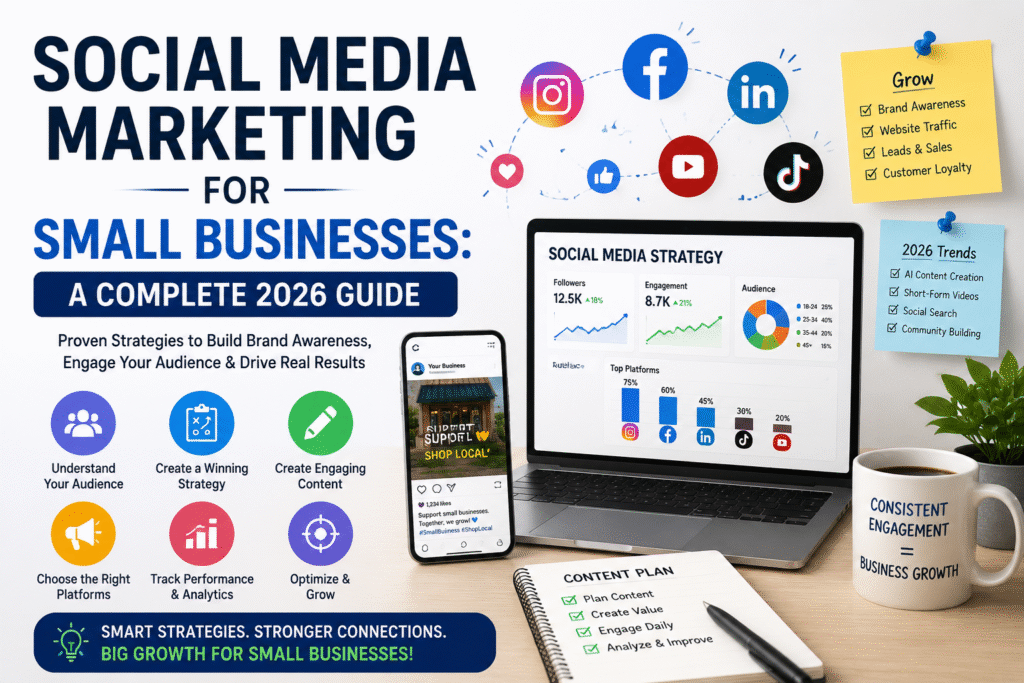
The most common mistake small businesses make is spreading thin across every platform instead of concentrating where their actual customers are. Consumer-facing businesses — fashion, food, personal care, local services, fitness — see the strongest returns on Instagram and Facebook, where visual and short-form video content performs best. B2B companies, consultants, and professional service providers see far better traction on LinkedIn, where the audience is actively there to evaluate credibility, not scroll for entertainment.
Instagram remains the largest platform among Indian users by a wide margin, and short-form video on it continues to outperform static image posts by several multiples in reach. Facebook still holds strong relevance for local businesses and remains the platform most Indian audiences trust for reviews, business hours, and direct enquiries. Trying to run all three at full effort with a small team usually produces mediocre results everywhere instead of strong results somewhere.
The Content Format That Actually Performs in 2026
Video isn’t optional anymore. Across every major platform, short-form video consistently outperforms static posts by a wide margin in both reach and engagement. According to Sprout Social, platforms are actively prioritizing video in their algorithms because it keeps users on the app longer — which means businesses posting only static images are competing at a structural disadvantage before the content quality is even factored in.
That doesn’t mean every post needs production value. A short, genuine behind-the-scenes clip filmed on a phone regularly outperforms a polished, overproduced ad, because it reads as authentic rather than promotional. For small businesses without a marketing team, this is genuinely good news — consistency and authenticity matter more than budget.
Organic vs. Paid: Why Small Businesses Need Both
Organic reach on most platforms has been declining for years, and that trend continues into 2026 — a well-written Facebook post today reaches a small fraction of a page’s followers without paid support. This is where working with a capable SMM agency in India tends to make the biggest measurable difference, since organic content builds trust and brand voice, while paid promotion ensures that content actually reaches beyond existing followers.
Paid social doesn’t need a large budget to be effective. Even a modest monthly spend, properly targeted, can outperform a much larger budget spent without clear audience targeting. This is a specialized skill on its own — a dedicated Facebook Ads expert can typically bring cost-per-lead down significantly compared to boosting posts without a defined audience or objective, simply by structuring campaigns around actual business goals instead of vanity reach numbers.
Measuring What Actually Matters
Follower count and likes are the most commonly tracked metrics and the least useful ones. A page with fifty thousand followers and zero enquiries is not outperforming a page with two thousand followers generating consistent leads. The metrics worth tracking are website traffic from social channels, lead form submissions or calls attributed to social posts, and WhatsApp or DM enquiries originating from social profiles. Any SMM company in India worth hiring should be reporting on these business outcomes monthly, not just engagement screenshots.
Why Small Businesses Should Treat This as a Long-Term Channel
Social media activity doesn’t just build brand presence directly — it also feeds into broader visibility. Increased brand search volume, backlinks earned from content that gets shared widely, and faster indexing of new content are all real, if indirect, benefits of a consistent social presence. Businesses running SMM in India alongside their SEO and paid search efforts consistently see stronger overall results than those treating each channel as a separate, disconnected effort.
Getting Started Without Overextending
Small businesses don’t need to be everywhere at once. Pick one or two platforms where the target customer actually spends time, commit to a realistic posting cadence that can be sustained without burnout, and track business outcomes from the first post rather than waiting months to start measuring. Strategy and consistency, not budget size, are what separate the small businesses winning on social media in 2026 from the ones still wondering if it’s worth the effort.