I get asked some version of this question on nearly every discovery call now: “Should we be doing AEO instead of SEO, or alongside it?” After seven-plus years running SEO programs — and the last two watching AI Overviews and chat-based search eat into click-through rates I used to consider stable — I’ve landed on an answer that isn’t the lazy “do both” every other article gives you. It’s: it depends on the query, not on the year.
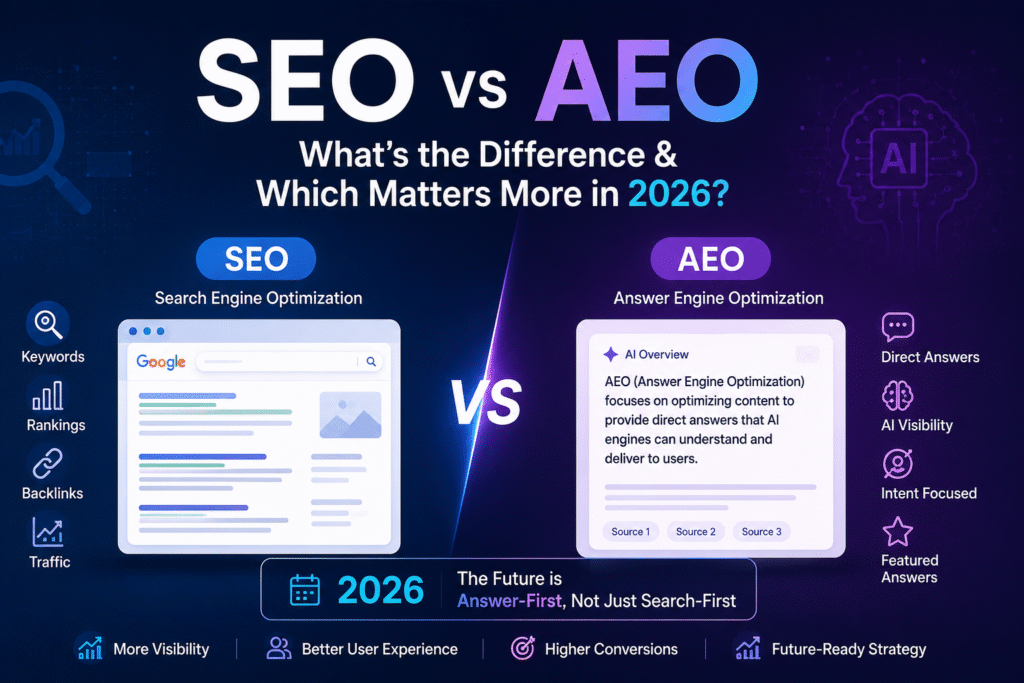
Quick answer: SEO optimizes your content to rank in a list of results people click through; AEO optimizes it to be the answer itself, cited directly inside AI Overviews, ChatGPT, and Perplexity without requiring a click. SEO still drives the majority of measurable organic traffic in 2026. AEO drives something SEO can’t measure with a session count: whether your brand gets named before the user ever visits a website at all. Most businesses need both — but which one deserves more of your next budget cycle depends on the type of query you’re trying to win, which I’ll break down below.
SEO, In Plain Terms
Search Engine Optimization is the discipline of making a page rank in the traditional results list — the ten blue links (now increasingly pushed below AI features, but still there). Its core levers haven’t changed much in a decade: crawlability, page speed, internal linking, keyword-to-intent matching, and backlink authority. Success is measured in rankings, sessions, and conversions.
AEO, In Plain Terms
Answer Engine Optimization is the discipline of structuring content so an AI system — Google’s AI Overviews, ChatGPT, Perplexity, Copilot, Gemini — can lift it directly into a generated answer and attribute it to you. Success here isn’t a click. It’s a citation. Your brand name appearing inside someone’s ChatGPT response, even if they never land on your site, still counts as a win under AEO — it just doesn’t show up in Google Analytics the way a session does.
Head-to-Head: SEO vs AEO
| SEO | AEO | |
| Primary goal | Rank in the results list, earn the click | Get cited inside the generated answer |
| Winning surface | Organic results, page 1 rankings | AI Overviews, ChatGPT, Perplexity, featured snippets, voice assistants |
| User intent it serves best | Comparison, evaluation, research, purchase | Quick factual or definitional questions |
| Core content format | Long-form, keyword-mapped, internally linked | Direct-answer paragraphs, structured lists, FAQ blocks |
| Success metric | Rankings, organic sessions, conversions | Citation frequency, AI Overview inclusion, branded search lift |
| Time to results | Weeks to months, compounding | Days to weeks for on-page changes; months for off-site authority to register |
| Depends on | Technical health, backlinks, content depth | Everything SEO depends on, plus off-site entity consistency and fact clarity |
Notice the last row. That table isn’t really “SEO vs AEO” in the sense of two competing strategies — AEO is closer to a second scoring layer stacked on top of SEO than a genuine alternative to it. A site with broken crawl paths, thin content, or no backlink profile won’t get cited by an AI system any more reliably than it’ll rank on page one. AEO doesn’t skip the foundation. It adds a new test on top of it.
The Numbers That Actually Matter Right Now
A few data points I keep coming back to when I’m making the case for budget allocation internally:
- Independent tracking from SparkToro and Datos puts the share of Google searches in the US that end without any click at around 58% — and that figure climbs sharply, into the low-to-mid 80s, specifically on queries that trigger an AI Overview.
- Gartner’s oft-cited 2026 forecast projects traditional organic search traffic volume declining by roughly a quarter as more research-stage queries move into conversational AI interfaces.
- Ahrefs’ analysis of the most-cited pages inside ChatGPT found that a striking share — more than a quarter — have little to no organic visibility on Google at all, which is worth sitting with: it means AI engines aren’t just re-ranking your existing SEO winners, they’re sometimes pulling from an entirely different pool of sources.
- Despite all of that, SEO isn’t fading quietly — it’s still estimated to account for the overwhelming majority of total measurable search traffic by volume, because most of the internet’s query volume is still evaluation and purchase-stage, and that’s exactly the territory where people still click through to compare.
- Pew Research’s 2026 data on AI adoption shows daily, multiple-times-a-day AI usage is now common among U.S. adults, and it’s especially concentrated among 18–29 year-olds, a growing share of whom now default to AI tools as their first stop for information rather than a search engine.
Read together, these numbers describe two channels growing at once, not one replacing the other — but they also tell you exactly where each one earns its keep.
So Which One Actually Matters More? It Depends on the Query, Not the Trend
This is the part most “SEO vs AEO” articles skip, and it’s the only part that actually helps you make a decision. Break your keyword list into these four buckets before you decide where budget goes:
1. Informational, definitional queries (“what is,” “how does X work”).
AEO wins here, decisively. These are exactly the queries AI Overviews and chat tools now answer directly, and users rarely feel the need to click through when the answer is short and factual. Optimize these for direct-answer formatting and FAQ schema, but don’t expect much session volume even if you win the citation.
2. Comparison and evaluation queries (“best X for Y,” “X vs Y”).
This is genuinely contested ground. AI tools will summarize comparisons, but users evaluating a real purchase decision — especially anything with meaningful cost or risk — still tend to click through to verify pricing, read reviews, and check specifics that a summarized answer glosses over. Invest in both here: a strong comparison page ranks organically and is exactly the kind of structured, fact-dense content AI engines like to cite.
3. Transactional and local queries (“book,” “buy,” “near me,” “pricing”).
SEO still dominates decisively. People converting or looking for a specific local business overwhelmingly still search and click rather than trust a summarized AI answer for something with a direct financial or logistical stake. Don’t deprioritize your product, service, and location pages chasing AI citations — that traffic still needs the click.
4. Brand and reputation queries (“is X legit,” “X reviews,” “who is X”).
This bucket is where AEO and GEO (Generative Engine Optimization, the broader off-site authority discipline) matter most, because this is exactly what AI systems get asked when someone’s deciding whether to trust you before they’ve even found your site. Off-site consistency — reviews, third-party mentions, consistent facts across platforms — carries more weight here than anything on your own page.
The Mistake I See Most Often
Teams treat this as a reallocation decision — pull budget from SEO, put it into AEO — instead of recognizing that roughly 80% of the technical and content work is shared infrastructure. Clean crawlability, fast pages, clear structure, and genuinely well-sourced content improve both simultaneously. The real decision isn’t SEO or AEO. It’s: given a fixed content budget, which query buckets above deserve the next asset you create, and is it built with a direct-answer block up top so it’s positioned to win both a ranking and a citation from the same page.
The second most common mistake: measuring AEO with SEO’s scoreboard. If you’re only watching organic sessions and keyword rank, you’re structurally blind to a citation win — your brand can be showing up inside ChatGPT and Perplexity answers constantly and your traffic dashboard will show nothing for it. Track AI citation frequency and Search Console impression-to-click gaps as a separate, parallel scoreboard, not a subset of your existing one.
My Take, After Running Both
If I’m advising a business with a fixed budget and I can only pick one place to start: fix the SEO foundation first, always — it’s the access layer everything else depends on, AI engines included. But if the foundation is already reasonably solid, the highest-leverage next move in 2026 is almost always AEO work on your informational and brand-reputation content, because that’s the territory where the gap between “ranking fine” and “actually visible” has widened the fastest, and it’s the one most competitors still haven’t touched.
Frequently Asked Questions
Is AEO replacing SEO?
No. AEO depends on SEO’s foundation — crawlability, technical health, and content authority — to even be considered for citation. Think of AEO as an additional layer of evaluation stacked on top of traditional search, not a replacement discipline.
Which drives more traffic, SEO or AEO?
SEO, by a wide margin, when measured in website sessions — it still accounts for the large majority of measurable search traffic. AEO’s value shows up differently: in brand citations, branded search lift, and influence earlier in the decision process, much of which doesn’t register as a session at all.
Can one page rank well in both SEO and AEO at the same time?
Yes, and this should usually be the goal rather than building separate content for each. Lead the page with a concise, direct answer to the core question, then expand into the longer-form sections, comparisons, and internal links that support traditional ranking depth.
Do I need separate content teams or tools for AEO versus SEO?
Not necessarily. The execution skill set overlaps heavily — schema markup, content structure, and technical SEO are shared foundations. What genuinely differs is the measurement layer: you’ll need AI citation tracking alongside your existing rank tracker, since standard SEO tools don’t show you AI Overview or chatbot citation data.
How do I measure AEO success if there’s no click to track?
Watch Search Console for queries with unusually high impressions but low click-through rates — that pattern often indicates your content is being shown inside an AI Overview without generating a visit. Pair that with a dedicated AI citation-tracking tool, and monitor branded search volume and direct traffic for indirect lift, since users who first encounter a brand through an AI answer frequently search or navigate to it directly afterward.
Should a small business with a limited budget prioritize AEO over SEO?
Not before the SEO fundamentals are solid. A small, technically clean, well-structured site with genuinely accurate, fact-dense content can actually out-perform larger, more generically written competitors on AEO citations — but only once the underlying SEO foundation, particularly crawlability and page speed, is already in place.