
Written by a search visibility strategist with 7+ years of hands-on experience diagnosing traffic drops for Indian and international clients across SEO, AEO, and GEO audits. This guide walks through the same diagnostic process used in real client investigations, not a generic checklist.
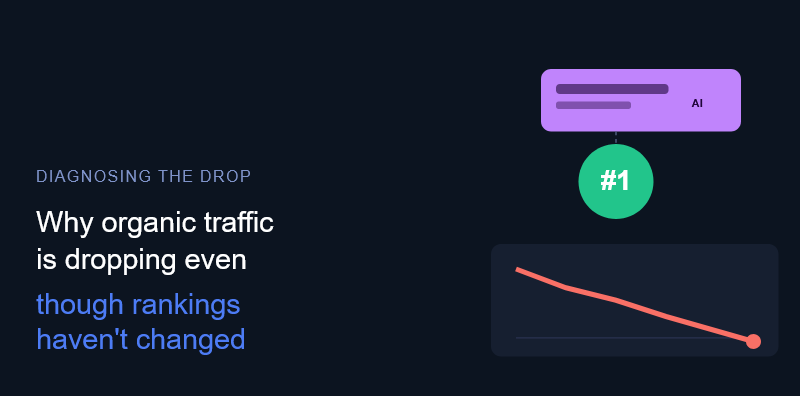
You check Google Search Console, your position for every important keyword looks exactly the same as last quarter, and yet your traffic chart is quietly sliding downward. It’s one of the more disorienting problems in SEO, because the instinct is to assume something must have changed with your rankings — a penalty, a lost backlink, a competitor overtaking you. Increasingly, the real explanation has nothing to do with your position at all. This guide walks through the actual causes behind stable rankings and falling traffic, in the order worth checking, so you can diagnose which one is affecting your site.
The Most Common Cause: AI Overviews Are Absorbing the Click
The single biggest driver of this pattern in 2026 is AI-generated answers appearing directly on the search results page or inside a chat interface, satisfying the user’s question before they ever reach your listing. Independent research confirms just how significant this effect has become. A widely cited Ahrefs study found that the presence of an AI Overview correlates with a roughly 34.5% lower average click-through rate for informational keywords, even when the underlying ranking position doesn’t move at all. You can read more in eMarketer’s coverage of the Ahrefs AI Overview CTR findings, which lays out the data behind this shift.
This explains the exact pattern many site owners are seeing: the page still wins the query, it’s just not winning the click anymore, because a growing share of users get their answer without scrolling past the AI-generated summary at the top of the page.
How to Tell If AI Overviews Are the Cause
Check whether the specific queries driving your traffic decline are informational in nature — “what is,” “how to,” “why does” — since these trigger AI Overviews far more often than transactional or navigational searches. Search Console’s performance report can help here: if impressions have stayed flat or grown while clicks have fallen for the same set of queries, that combination points squarely at AI Overview displacement rather than a ranking or technical problem. A ranking drop shows up as fewer impressions for the same query; an AI Overview problem shows up as flat impressions with falling clicks.
Five Other Causes Worth Ruling Out
AI Overview displacement is the most common explanation in 2026, but it isn’t the only one. A proper diagnosis rules out the following before settling on a conclusion:
1. Content Decay
Pages that once ranked well can lose relevance over time as information goes stale, competitor content improves, or user expectations shift. This shows up as a gradual decline across older content specifically, rather than a sudden drop across the whole site.
2. Seasonal or Search Volume Changes
Sometimes the query itself is simply being searched less often, independent of anything on your site. Checking search volume trends for your target keywords over the same period rules this out quickly.
3. Technical Regressions
A recent site change — a migration, a plugin update, a Core Web Vitals regression — can quietly affect how pages are crawled, indexed, or rendered, even without an obvious ranking change showing up immediately in tracked positions.
4. Lost or Devalued Backlinks
A loss of referring domains, or the devaluation of previously counted links, can reduce a page’s overall authority in ways that don’t always show up as an immediate, visible ranking drop, but that erode traffic more gradually.
5. Competitive Displacement Within the Same Position
Rank tracking tools often show a keyword’s numeric position without capturing what’s actually displayed around it. A competitor gaining a featured snippet, a “People Also Ask” box, or additional SERP real estate can reduce your click share even while your own tracked position stays technically unchanged.
A Simple Diagnostic Process
- Pull Search Console data for the affected pages, comparing impressions and clicks separately, not just overall traffic.
- Check whether impressions have stayed flat while clicks have dropped. This pattern points toward AI Overview or SERP feature displacement rather than a ranking issue.
- Segment by query type. Informational queries losing clicks with stable rankings strongly suggests AI Overview involvement; transactional queries behaving the same way point elsewhere.
- Manually check the search results for your top declining queries to see whether an AI Overview, featured snippet, or expanded SERP feature is now present where it wasn’t before.
- Review recent site changes and backlink profile to rule out technical regressions or link loss as contributing factors.
- Compare year-over-year search volume for the same keywords to rule out simple seasonal or demand shifts.
What to Do Once AI Overview Displacement Is Confirmed
If the diagnosis points to AI-driven click absorption rather than a technical or ranking problem, the fix isn’t more of the same traditional SEO work — it requires a different kind of optimization aimed at the moment before the click even happens:
- Restructure content to directly answer the query near the top of the page, increasing the odds of being the source an AI Overview pulls from and cites, which research shows drives measurably more of the remaining clicks than being excluded from the summary entirely.
- Invest in Answer Engine Optimization (AEO), which is specifically built around structuring content for direct extraction by AI-generated answers.
- Build topical depth through Generative Engine Optimization (GEO), since AI systems favor sources that demonstrate comprehensive coverage of a subject over isolated, single-topic pages.
- Shift success metrics to include AI citation tracking and branded search volume alongside traditional traffic, since traffic alone will understate real visibility going forward.
- Prioritize transactional and decision-stage content, which remains less affected by AI Overview displacement than purely informational queries.
This work sits on top of the same technical SEO foundation that has always mattered — it doesn’t replace it, but it does require a different content and structure approach than traditional ranking optimization alone.
When It’s Not AI Overviews
If your diagnostic process rules out AI Overview involvement — impressions have also dropped, the affected queries are transactional rather than informational, or you find a clear technical or backlink issue — the fix looks more like traditional SEO troubleshooting: recovering lost technical health, rebuilding authority, or refreshing decayed content. It’s worth completing the full diagnostic process rather than assuming AI Overviews are the cause by default, since treating every traffic decline the same way risks missing a real, fixable technical problem.
Frequently Asked Questions
Why would my traffic drop if my rankings haven’t changed at all?
The most common reason in 2026 is AI Overviews or other SERP features appearing above your organic listing, answering the user’s question directly and reducing the click-through rate even though your ranking position stays the same.
How can I tell if AI Overviews are causing my traffic decline?
Check Google Search Console for the affected queries: if impressions have stayed flat or grown while clicks have fallen, and the queries are informational in nature, that pattern strongly points to AI Overview displacement rather than a ranking or technical issue.
Should I stop creating informational content since AI Overviews absorb those clicks?
Not necessarily. Informational content still builds topical authority and can earn AI citations, which carry real value even without a click. The better response is restructuring that content for AI extraction rather than abandoning it.
Does losing traffic to AI Overviews mean my SEO strategy has failed?
No. It reflects a structural shift in how search results are displayed, affecting nearly every site with informational content to some degree. The appropriate response is adapting content and metrics, not concluding that existing SEO work was ineffective.
How long does it take to recover traffic lost to AI Overview displacement?
Full click-based recovery may not be realistic for some informational queries, since AI Overviews aren’t going away. The more realistic goal is shifting focus toward being the cited source within AI Overviews and toward less-affected transactional content, which can show improvement within a few months of restructuring.
What tools can I use to check if AI Overviews are appearing for my target queries?
Google Search Console’s performance report, combined with manually checking search results for your declining queries, is often enough to confirm AI Overview presence without needing a specialized paid tool, though dedicated AI visibility tools can add more consistent tracking over time.
A stable ranking position no longer guarantees stable traffic, and understanding why requires looking past the rank tracker and into the actual behavior behind each query — impressions, clicks, and what’s now displayed above your listing on the results page. For most sites in 2026, AI Overview displacement is the leading explanation, but it’s worth ruling out content decay, technical regressions, and backlink loss before settling on that conclusion. Once the real cause is confirmed, the fix isn’t abandoning SEO — it’s extending it toward the content structure and citation-focused strategy that AI-driven search now demands.