Written by a search visibility strategist with 7+ years of hands-on experience embedding AEO, GEO, and LLM SEO work inside existing marketing and SEO teams. This guide reflects real collaboration patterns from active engagements, not a theoretical org chart.
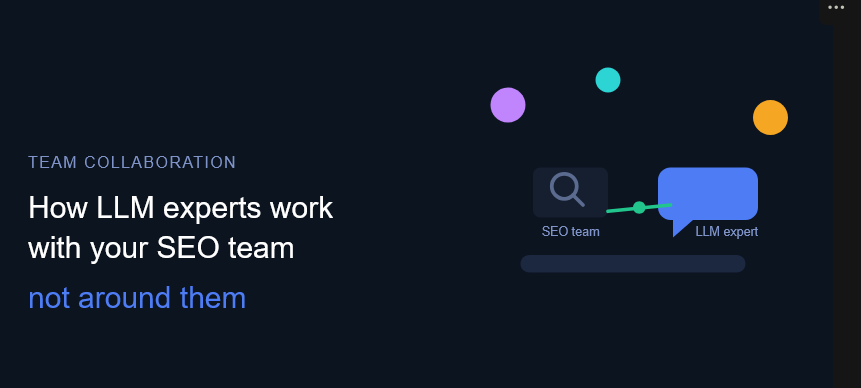
One of the most common concerns marketing leaders raise before bringing in an LLM optimization expert is territorial: will this person step on our SEO team’s toes, duplicate their work, or push a strategy that conflicts with what’s already in motion? It’s a fair question, and the honest answer is that a competent LLM expert shouldn’t operate as a separate, parallel function at all. The best AI search visibility work happens when it’s woven directly into an existing SEO team’s process, not bolted on beside it. This guide explains exactly how that collaboration works in practice — where responsibilities divide, where they overlap, and how the two functions reinforce rather than duplicate each other.
Why This Isn’t a Turf War
LLM optimization and traditional SEO aren’t competing disciplines chasing the same outcome through different means. They’re addressing two connected but distinct questions: SEO asks “how do we rank well in traditional search results,” while LLM optimization asks “how do we become a source AI models trust enough to cite.” Both questions depend on largely the same foundation — technical site health, content quality, and credible authority — which is exactly why the two functions work best in close coordination rather than in isolation.
Industry commentary on this shift makes the same point directly: as AI reshapes search, the isolated, siloed SEO function is giving way to cross-functional collaboration, where the strongest results come from tightly coordinated teams rather than departments working independently toward the same goal. You can read more in Search Engine Land’s coverage of the shift away from siloed SEO, which reflects this broader industry pattern.
Where the Two Roles Naturally Divide
The SEO Team Typically Owns:
- Keyword research and traditional ranking strategy
- Technical SEO fundamentals — site speed, crawlability, indexing, Core Web Vitals
- Backlink strategy and traditional authority building
- On-page optimization for search engine ranking factors
- Ongoing organic traffic performance and reporting
The LLM Optimization Expert Typically Owns:
- AI visibility audits across ChatGPT, Gemini, Claude, and Perplexity
- Structured data implementation specific to AI extraction (FAQ, Organization, and entity-level schema)
- Content restructuring for direct-answer extraction, layered on top of existing SEO content
- Entity authority building across directories, review platforms, and third-party mentions
- AI citation tracking and cross-platform visibility reporting
Where the Two Overlap and Need Close Coordination:
- Content strategy. Both functions care about content quality and structure, so content briefs need to satisfy traditional ranking factors and AI extraction requirements simultaneously, not as two separate passes.
- Technical health. A crawlability or indexing issue affects both traditional rankings and AI visibility, so technical fixes should be prioritized jointly rather than duplicated across two workstreams.
- Reporting and measurement. The most effective setups fold AI citation data directly into existing SEO reporting, rather than creating a separate, disconnected report that leadership has to reconcile manually.
What Good Collaboration Actually Looks Like
1. A Shared Content Calendar, Not Two Competing Ones
Rather than the SEO team and LLM expert independently planning content, the strongest setups run a single, shared content calendar where each piece is evaluated against both traditional ranking potential and AI citation potential from the start. This avoids the common failure mode of good SEO content being restructured for AI visibility after the fact, which is far less efficient than building it in from the outset.
2. Joint Technical Audits
Since technical issues affect both disciplines, LLM experts working well with an existing SEO team typically join technical audits rather than running a separate one. A single, coordinated audit prioritizes fixes based on their combined impact on traditional rankings and AI visibility, rather than each function pushing its own priority list.
3. Integrated Reporting
The most effective engagements add an AI visibility section directly into the existing SEO reporting cadence — citation rates by platform, notable prompt-level wins and losses, and competitive AI visibility benchmarks — rather than presenting a separate, siloed report that competes for the same leadership attention.
4. Clear Ownership Without Rigid Silos
While responsibilities divide reasonably cleanly on paper, the best collaborations stay flexible. An LLM expert who notices a technical issue affecting AI crawlability should flag it to the SEO team rather than working around it, and an SEO lead who spots a content gap relevant to AI citation potential should loop in the LLM expert early rather than treating it as out of scope.
5. A Single Source of Truth for Entity Information
Business name, description, and details need to stay consistent across the website, directories, and third-party platforms for both SEO authority and AI entity recognition. Rather than the SEO team and LLM expert each managing separate versions of this information, the strongest setups maintain one shared source of truth both functions reference and update together.
Signs an LLM Expert Is Working Well With Your Existing Team
- Content briefs already reflect both SEO and AI extraction requirements before writing begins
- Technical issues get flagged and prioritized jointly, not discovered independently by each function
- Reporting includes both traditional SEO metrics and AI visibility data in one place
- Your SEO team’s institutional knowledge about your business and audience is actively incorporated into the AI strategy, not ignored in favor of a generic playbook
- There’s a clear, agreed-upon process for who owns what, with enough flexibility that nothing falls through the cracks between the two functions
Signs of a Problematic Setup
- The LLM expert operates on a completely separate calendar, with no visibility into what the SEO team is already doing
- Technical recommendations conflict, with each function pushing contradictory fixes
- Reporting is siloed, forcing leadership to manually reconcile two disconnected data sets
- The LLM expert treats existing SEO content and strategy as something to be replaced rather than built upon
- There’s no clear process for resolving overlap, leading to duplicated work or gaps neither function catches
Frequently Asked Questions
Will hiring an LLM expert create conflict with our existing SEO team?
It shouldn’t, if the engagement is set up correctly. The two roles address related but distinct goals, and the strongest results come from close coordination — shared content planning, joint technical audits, and integrated reporting — rather than parallel, disconnected work.
Should our SEO team learn LLM optimization themselves instead of hiring a separate expert?
Some SEO professionals do expand into this space over time, but LLM optimization currently requires specialized, fast-changing knowledge that many in-house teams don’t yet have bandwidth to build from scratch. Bringing in a specialist to work alongside the existing team is often the more practical near-term approach.
How do we make sure an LLM expert doesn’t duplicate our SEO team’s work?
Establish a shared content calendar, joint technical audit process, and integrated reporting from the start. Clear, agreed-upon ownership boundaries, with flexibility for overlap, prevent most duplication issues before they start.
What happens if our SEO team and LLM expert disagree on a content or technical decision?
Since both functions share the same underlying goal — a trustworthy, well-structured, authoritative site — most disagreements are resolvable by evaluating the decision against both traditional ranking impact and AI citation potential together, rather than treating it as one function’s priority over the other’s.
Does an LLM expert need full access to our existing SEO data and tools?
Generally, yes. Shared visibility into keyword data, technical audits, and existing content performance helps the LLM expert build on what’s already working rather than duplicating research or working from incomplete information.
Is it better to hire an LLM expert as a contractor or bring them fully into the internal team’s workflow?
Either can work, but regardless of employment structure, the collaboration works best when the LLM expert is treated as an extension of the existing marketing function, with shared calendars, reporting, and communication channels, rather than an outside vendor operating in isolation.
The businesses getting the most out of LLM optimization aren’t the ones treating it as a separate initiative running alongside their SEO program. They’re the ones weaving it directly into existing content planning, technical audits, and reporting, so both functions build on the same foundation instead of duplicating effort or working from conflicting priorities. A good LLM expert should make your existing SEO team’s work more effective, not compete with it — and that collaboration, done well, is often the clearest signal that an engagement is set up to actually succeed.