Written by a search visibility strategist with 7+ years of hands-on experience running AEO, GEO, and LLM SEO campaigns, including projects that started as DIY efforts before being handed off for professional help. This guide gives a genuinely balanced answer, not a sales pitch disguised as advice.
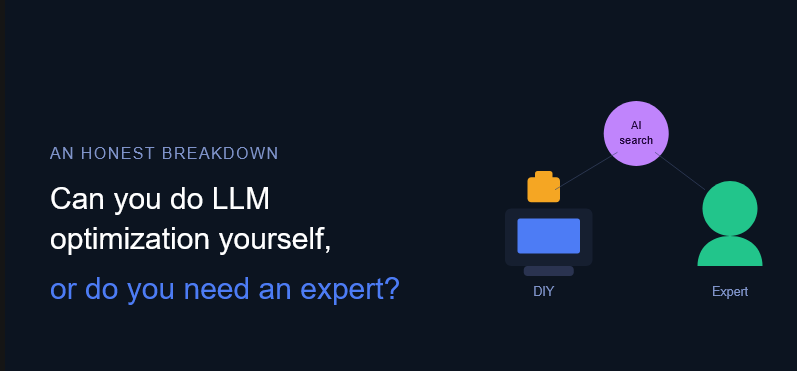
Every business owner researching how to get found by ChatGPT and Gemini eventually asks the same practical question: can I just do this myself? It’s a fair question, and the honest answer is more nuanced than most agency blog posts admit. Some parts of LLM optimization are genuinely accessible to a business owner with time and patience. Other parts require specialized, current knowledge that’s difficult to build without dedicated focus. This guide breaks down exactly which is which, so you can make a realistic decision instead of guessing.
What LLM Optimization Actually Involves
Before deciding whether to DIY it, it helps to see the full scope. LLM optimization typically spans three connected areas: Answer Engine Optimization (AEO), which structures content to directly answer specific questions AI assistants get asked; Generative Engine Optimization (GEO), which builds topical authority through content clusters so generative AI platforms trust a site as a comprehensive source; and LLM SEO, which strengthens entity recognition through structured data and consistent business information across the web.
Some of this work overlaps closely with tasks a motivated business owner can reasonably learn. Other parts require ongoing, specialized attention that’s genuinely difficult to sustain alongside running a business.
What You Can Realistically Do Yourself
1. Basic Content Restructuring for Direct Answers
Rewriting key pages so they answer common customer questions clearly, near the top of the page, is a skill most business owners can learn. This doesn’t require deep technical knowledge — mostly discipline about stating the answer first, then supporting it with detail, rather than burying it under long introductions.
2. Simple FAQ Sections
Adding a clear FAQ section that answers the specific questions your customers actually ask is straightforward to do yourself, and it’s one of the higher-leverage, lower-effort moves available for AI visibility.
3. Basic Structured Data Implementation
Many website platforms, including WordPress plugins like Yoast SEO or RankMath, can implement common schema types like FAQ, Organization, and LocalBusiness markup with minimal technical setup. For businesses wanting to understand the underlying standard directly, Google’s own documentation provides a clear reference. You can review it in Google’s guide to structured data markup, which explains exactly how this works and why it matters for machine-readable content.
4. Keeping Business Information Consistent
Making sure your business name, description, and contact details match across your website, Google Business Profile, and major directories is tedious but not technically difficult. This is a task any business owner can handle with a checklist and some time.
5. Manual AI Visibility Checks
Running a handful of test prompts in ChatGPT and Claude to see whether your business gets mentioned for relevant questions is something anyone can do. It won’t match the rigor of a full professional audit, but it gives a useful starting signal.
What Genuinely Benefits From Expert Help
1. Comprehensive AI Visibility Audits
A proper audit requires a structured, repeated prompt set run across multiple AI platforms, scored consistently, and benchmarked against competitors. This is possible to attempt manually, but doing it rigorously and repeatedly, month after month, is time-intensive in a way that’s hard to sustain without dedicated focus.
2. Advanced Technical SEO Work
Site architecture issues, crawlability problems, and Core Web Vitals optimization require technical knowledge that goes well beyond installing a plugin. Getting these wrong can actively hurt both traditional rankings and AI visibility, making this an area where inexperienced DIY attempts carry real risk.
3. Entity Authority Building at Scale
Earning credible mentions and citations from third-party sources, review platforms, and industry publications requires outreach skills, existing relationships, and time that most business owners simply don’t have alongside running their core operations.
4. Content Strategy Across a Full Topic Cluster
Building genuinely comprehensive, interlinked content that establishes topical authority across a subject requires ongoing content planning and execution at a scale that’s difficult to sustain solo, especially alongside daily business operations.
5. Staying Current With a Fast-Changing Field
AI models, citation patterns, and best practices shift frequently. Specialists who work in this space daily can track and adapt to these changes far more efficiently than someone doing it as a secondary responsibility.
6. Interpreting Ambiguous or Conflicting Signals
When AI visibility efforts show mixed results, knowing which lever to pull next requires pattern recognition built from working across multiple accounts and situations. This kind of judgment is hard to develop from a single business’s own limited data.
A Realistic Framework for Deciding
- If you have more time than budget, start with the DIY-friendly tasks: content restructuring, FAQ sections, basic schema, and entity consistency. This builds a genuine foundation without a fixed cost.
- If you have more budget than time, or your business is in a competitive category, expert help on the technical and strategic work will likely move faster and avoid costly mistakes.
- If you’re testing whether AI visibility matters for your business at all, a lighter DIY effort for a few months can validate the opportunity before committing to a larger, ongoing investment.
- If your industry is complex, competitive, or high-stakes (such as healthcare, finance, or a crowded e-commerce category), the margin for DIY error is much narrower, and expert guidance tends to pay for itself faster.
Signs You’ve Outgrown the DIY Approach
- You’ve implemented the basics — FAQ content, simple schema, consistent business information — but visibility still isn’t improving
- Competitors are consistently mentioned in AI responses when your business isn’t, despite comparable effort
- You’re spending significant time on AI visibility work with no clear way to measure whether it’s working
- Your business has grown complex enough that ad hoc, self-taught efforts can no longer keep pace with what’s needed
Frequently Asked Questions
Is it realistic to do LLM optimization entirely on my own?
For a simple, low-competition business, a well-executed DIY approach covering FAQ content, basic schema, and consistent business information can provide a genuine foundation. For more competitive or complex situations, some form of expert involvement typically produces faster, more reliable results.
What’s the easiest place to start if I want to try LLM optimization myself?
Begin with restructuring a few key pages to answer common customer questions directly, add a clear FAQ section, and ensure your business information is consistent across your website and major directories. These require no technical expertise and provide a meaningful starting point.
How do I know if I need to hire an expert instead of continuing DIY?
If you’ve implemented the basics without meaningful improvement, if competitors consistently outperform you in AI visibility despite similar effort, or if your time is better spent elsewhere in the business, that’s usually a sign expert help will be worth the investment.
Can I use free tools instead of hiring an expert?
Free tools can help with basic manual prompt testing and simple schema implementation, but they generally can’t replace the structured, repeated auditing methodology or the strategic judgment an experienced specialist brings, especially for more complex situations.
Is DIY LLM optimization risky for my business?
The lower-effort tasks like FAQ content and business information consistency carry little risk. More technical work, like site architecture changes, carries more risk if done incorrectly, which is where expert guidance becomes more valuable.
Should I start DIY and hire an expert later, or the other way around?
Starting with DIY-friendly tasks and bringing in expert help once you’ve validated the opportunity or hit a visible plateau is a reasonable, low-risk approach for many small businesses, though highly competitive or complex categories may benefit from expert involvement earlier.
There’s no universally correct answer to whether you should DIY your LLM optimization or hire an expert — it depends on your time, budget, industry complexity, and how quickly you need results. The honest answer is that some of this work is genuinely accessible to a motivated business owner, while other parts benefit significantly from specialized, current expertise. Start with what you can realistically sustain yourself, watch for the signs that you’ve hit a plateau, and bring in expert help for the parts of the work where the gap between effort and result becomes too wide to close alone.