Most of the business owners I talk to still think of SEO the way it worked five years ago: pick keywords, write pages, build links, watch rankings climb. I’ve spent over seven years running SEO programs across industries, and I’ll be direct with you — that model still matters, but it’s no longer the whole picture. AI has quietly rewritten several of the rules, and the businesses that don’t notice are the ones who’ll wonder next year why their traffic dropped even though “nothing changed” on their end.
This isn’t a technical deep-dive. It’s what I’d actually tell you if you sat across from me and asked what’s different now — no jargon, just the five shifts that actually affect how customers find you.
1. Google Itself Is Now an AI Answer, Not Just a List of Links
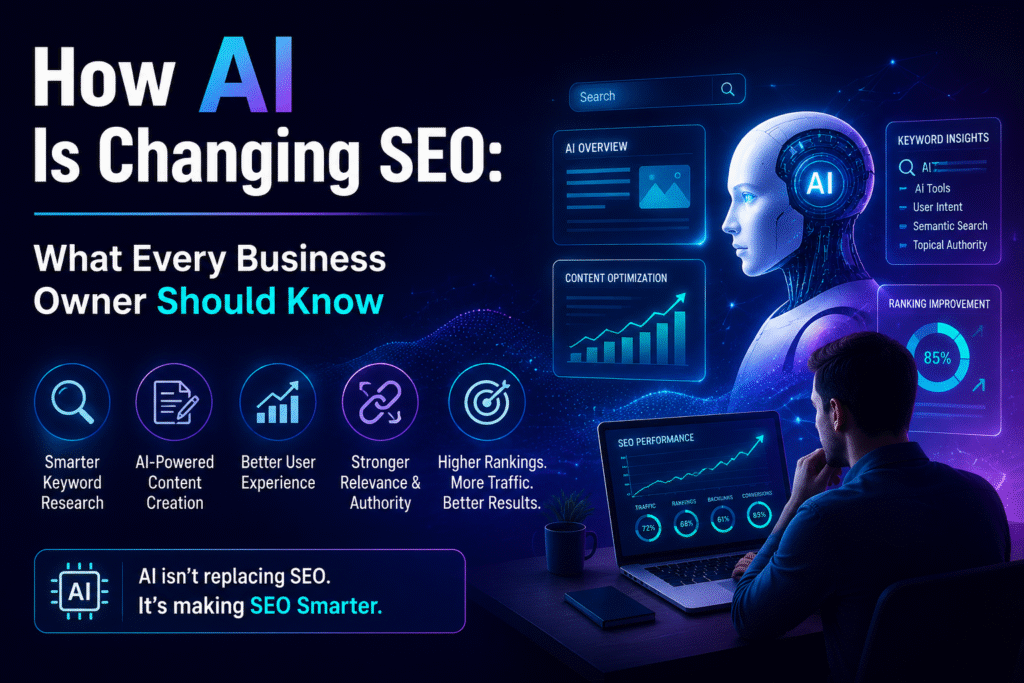
AI Overviews now appear on a large share of Google searches, sitting above the traditional results and answering the question directly, often without the user needing to click anything. Search Engine Journal reported that Google’s AI Mode alone had crossed 75 million users — and that’s on top of the AI Overviews already embedded in standard search. If your content isn’t structured to be pulled into that answer box, you’re increasingly invisible even when you’re technically “ranking.”
What this means for you: your top pages need a clear, direct answer near the top — not buried three paragraphs in after a long introduction.
2. Your Customers Are Researching Somewhere Other Than Google
ChatGPT, Perplexity, and Gemini have gone from novelty tools to genuine research habits for a meaningful share of your customers, especially younger buyers. That means your brand can be recommended, compared, or dismissed inside a conversation that never touches your website at all. A good seo agency in india is now tracking brand mentions across these platforms, not just keyword rankings, because that’s where a growing slice of first impressions actually happen.
What this means for you: ask yourself honestly — if someone asked ChatGPT about businesses like yours today, would you be mentioned at all?
3. Facts About Your Business Need to Match, Everywhere
AI systems cross-check information across the web before deciding whether to trust and cite a source. If your business hours, address, pricing, or services are described differently on your website, Google Business Profile, and third-party directories, that inconsistency actively works against you. This is a newer, quieter discipline — sometimes called LLM optimization — and it’s one most businesses haven’t touched yet.
What this means for you: an audit of where your business is mentioned online, and cleaning up mismatches, is now genuinely worth the time it takes.
4. Thin, Generic Content Is Getting Filtered Out Faster
AI systems are unusually good at spotting content that says a lot without saying much — the kind of page that could apply to any business in any city with a find-and-replace. Any experienced seo company in india will tell you this isn’t new advice, but it matters more now than it ever did, because both Google’s ranking systems and AI citation models are explicitly built to reward specific, first-hand, verifiable content over generic marketing copy.
What this means for you: real numbers, named examples, and specific claims about your own business will consistently outperform vague statements about quality and expertise.
5. Clicks Are No Longer the Only Metric That Matters
This is the hardest shift for business owners to accept. Your content can be doing real work — building trust, getting cited, shaping a buyer’s shortlist — without ever showing up as a session in your analytics. If you’re only judging your content by traffic numbers, you’re structurally blind to a growing share of its actual impact.
What this means for you: start watching Search Console for pages with high impressions but low clicks — that pattern often means you’re being shown inside an AI answer without getting the visit. It’s a sign of visibility working differently, not visibility disappearing.
So Does SEO Still Matter for Your Business?
Yes — more than ever, just differently. Every AI system still leans on the same underlying signals traditional SEO has always required: technical health, genuine authority, and content that actually answers the question. SEO in India specifically is still an early-mover opportunity — most local competitors haven’t adjusted their content or strategy for how AI now shapes discovery, which means the businesses that adapt first have a real window before this becomes standard practice.
What I’d Actually Recommend
Don’t panic and rebuild everything. Start with your highest-value pages — the ones tied to your actual revenue — and restructure them with a direct answer up top, specific facts instead of generic claims, and consistent business information across every platform where you’re listed. If you’re not sure where to start or don’t have the internal bandwidth to audit this properly, working with a best seo expert in india or a dedicated seo expert who understands both traditional rankings and AI visibility will save you months of guessing.
AI didn’t kill SEO. It just added a second scoreboard — and most business owners haven’t started keeping score on it yet. The ones who start now will have a real head start over the ones who wait until it’s the only scoreboard left, and by then, catching up will cost far more than getting ahead does today.