
By Vishal, AI Search & SEO Strategist — 7+ years of experience across traditional SEO and emerging AI search optimization Last updated: July 2026
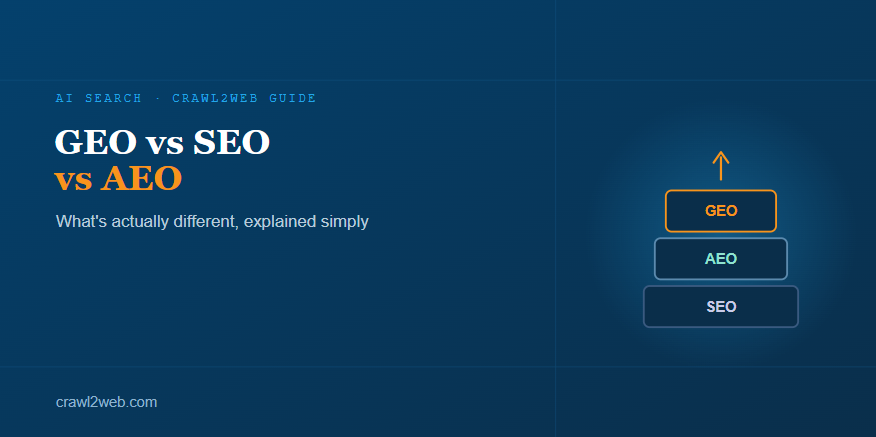
Short answer: SEO (Search Engine Optimization) is about ranking in traditional search results. AEO (Answer Engine Optimization) is about being the direct answer shown in featured snippets, voice assistants, and AI answer boxes. GEO (Generative Engine Optimization) is about being cited as a source within AI-generated responses from tools like ChatGPT and Perplexity. They’re related, overlapping disciplines built on the same foundation, not three competing strategies you have to choose between.
If you’ve read three different articles about GEO and AEO and come away with three different definitions, that’s not you misunderstanding something — it’s a genuinely unsettled area of terminology. Here’s the most honest, useful breakdown available right now.
First, an Honest Caveat Worth Knowing
There is currently no single, universally agreed definition distinguishing SEO, AEO, and GEO. Industry practitioners, vendors, and publications use these terms inconsistently, and in a lot of trade and marketing content, they’re used almost interchangeably. Some sources treat AEO as a subset of GEO. Others treat them as parallel, separate disciplines. This isn’t a sign the field is fake or unimportant — it’s simply a sign that the terminology is still settling in a genuinely new, fast-moving space. Anyone presenting rigid, universally agreed definitions as established fact is overstating how settled this actually is.
With that caveat in place, here’s how these terms are most commonly and usefully distinguished in practice.
SEO: Search Engine Optimization
The original, most established of the three. SEO is the practice of improving a website so it ranks higher in traditional organic search results — the list of blue links Google shows for a query. It covers technical site health, keyword targeting, content quality, and backlinks, and it remains the foundation everything else in this article is built on top of. Neither AEO nor GEO replace SEO; they extend it into new surfaces search itself has expanded into.
AEO: Answer Engine Optimization
Answer Engine Optimization focuses on a more specific goal: being the direct answer, not just a ranked link. This covers featured snippets, voice assistant responses, and the direct answer boxes that appear above traditional results. AEO tends to reward content structured for extraction — clear, self-contained answers near the top of a page, genuine FAQ formatting, and content organized around the exact way people phrase questions. This is the discipline behind Answer Engine Optimization services — structuring content so it’s positioned to be pulled directly into these answer formats.
GEO: Generative Engine Optimization
Generative Engine Optimization is the newer term, gaining traction specifically because of tools like ChatGPT, Perplexity, and Google’s AI Overviews. Where AEO is about winning a single, direct answer slot, GEO is about being one of the sources a generative AI system draws from and cites when it synthesizes a response from multiple places — the content doesn’t need to be the single “answer,” it needs to be substantial, trustworthy, and clearly written enough that an AI model chooses to reference it while constructing its own response. This is a genuinely different content requirement: less about rigid, extractable structure, and more about comprehensive, credible coverage of a topic. This is the focus of Generative Engine Optimization services — building the kind of content depth and trust signals that get a brand woven into AI-generated answers, not just extracted from.
Where LLM Optimization Fits In
You’ll also see the term “LLM optimization” (sometimes LLMO) used, largely overlapping with GEO — the practical difference is mostly one of framing rather than substance. LLM optimization tends to describe the work at the level of specific platforms (ChatGPT, Gemini, Claude, and similar large language models) and how each one individually sources, weighs, and represents information about a brand. In practice, LLM optimization work and GEO work overlap heavily and are often delivered as the same engagement — the distinction matters more in how the service is described than in what actually gets built.
A Simple Comparison
| SEO | AEO | GEO / LLM Optimization | |
|---|---|---|---|
| Goal | Rank in traditional search results | Be the direct answer shown to the user | Be cited as a trusted source in an AI-generated response |
| Where it shows up | Google, Bing search results | Featured snippets, voice assistants, answer boxes | ChatGPT, Perplexity, Google AI Overviews, Gemini |
| Core content need | Keyword relevance, technical health, backlinks | Clear, extractable, self-contained answers | Comprehensive, trustworthy, well-structured coverage |
| Foundation | The original discipline | Built on top of SEO | Built on top of both SEO and AEO |
Why This Distinction Actually Matters for Your Business
This isn’t just semantics — the underlying shift is real and measurable. Recent industry analysis has found that AI Overviews have reduced click-through rates for top-ranking Google content substantially, with some estimates placing the drop as high as 58% year-over-year. Separately, ChatGPT alone processes billions of prompts daily, a majority of which function as search queries, with dramatically lower click-through behavior than a traditional Google search. Some analysts have projected conventional search traffic could decline by as much as half over the next few years, with that volume shifting toward generative engines instead.
What this means practically: a business relying purely on traditional SEO is optimizing for a shrinking share of how people actually find information. That doesn’t mean SEO stops mattering — it remains the foundation everything else is built on — but treating AEO and GEO as optional extras rather than a genuine, current part of the strategy is increasingly a real gap.
Common Misconceptions
- “GEO replaces SEO.” It doesn’t — GEO depends on the same underlying content SEO already produces; it’s an extension, not a replacement.
- “AEO and GEO are the same thing.” They overlap significantly, but AEO is more focused on winning a single direct-answer slot, while GEO is about being one of several sources an AI system draws from and synthesizes.
- “These are settled, standardized disciplines with agreed methodologies.” They’re not yet — this is genuinely new territory, and anyone claiming complete certainty about exact mechanisms is overstating the current state of the field.
- “Small businesses can’t compete here.” Because GEO and AEO are still early, well-established competitors haven’t necessarily built the same advantage they have in traditional SEO — which is a genuine opportunity, not just marketing language.
How This Comes Together in Practice
A business doesn’t need to pick one of these three. The realistic, working approach treats SEO as the foundation, then layers AEO-focused structure (clear, extractable answers) and GEO-focused depth (comprehensive, trustworthy coverage built for AI synthesis) on top of that same foundation — three related disciplines pointed at the same underlying content, rather than three separate content strategies competing for resources.
Frequently Asked Questions
Is GEO the same as AEO?
They overlap significantly and are sometimes used interchangeably, but they’re most usefully distinguished by focus: AEO targets winning a single direct-answer placement (like a featured snippet), while GEO targets being cited as a source within a broader AI-generated response synthesized from multiple sources.
Do I need to choose between SEO, AEO, and GEO?
No — they build on each other rather than competing. SEO remains the foundation, and AEO/GEO extend that same work toward newer AI-driven search surfaces rather than requiring a separate content strategy.
Is there an official, agreed-upon definition of GEO vs AEO?
Not yet — this is genuinely unsettled terminology, and different sources define these terms somewhat differently. Treat any source presenting rigid, universally agreed definitions with some skepticism, since the field itself hasn’t fully standardized.
What’s the difference between GEO and LLM optimization?
They overlap heavily. LLM optimization tends to refer to platform-specific work (optimizing for how a specific model like ChatGPT or Gemini represents your brand), while GEO is often used as the broader umbrella term — in practice, the work delivered under either label is very similar.
Is it too early for a small business to invest in AEO or GEO?
Not necessarily — because these disciplines are still developing, established competitors haven’t necessarily built the same entrenched advantage they have in traditional SEO, which can make this a genuine opportunity for smaller or newer businesses rather than a disadvantage.