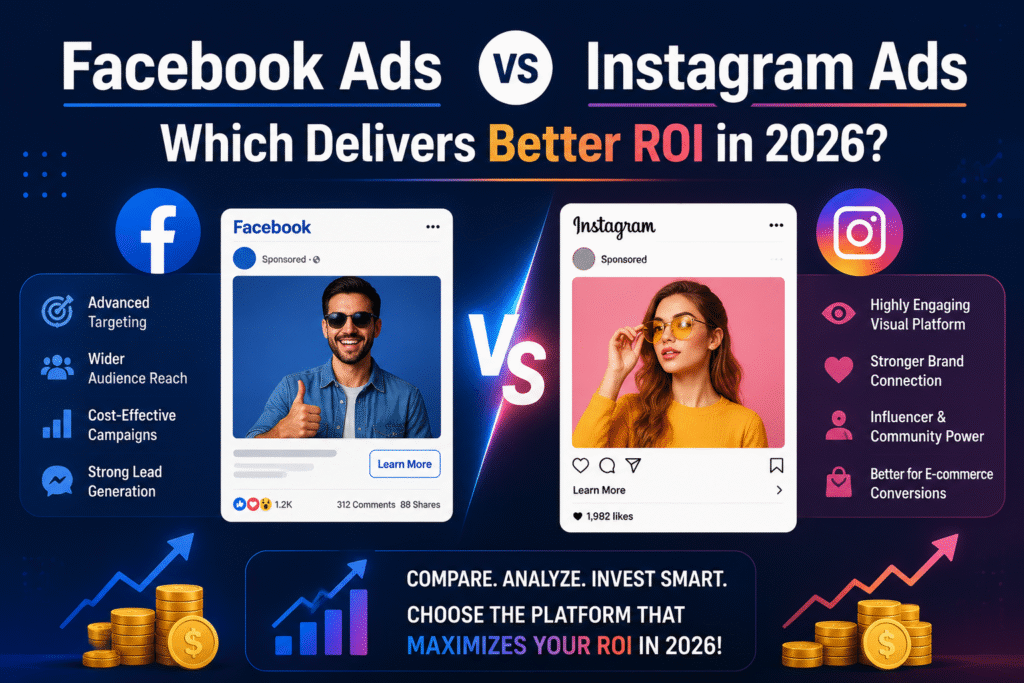
Every business running Meta ads eventually asks the same question: should the budget go to Facebook, Instagram, or split between both? The honest answer isn’t a single platform — it’s understanding what each one is actually good at, and matching that to the specific goal of the campaign. Treating Facebook and Instagram as interchangeable, which is what Meta’s automatic Advantage+ placements quietly encourage, is one of the most common ways businesses leave a meaningful share of their ad budget underperforming.
Quick answer: Facebook generally delivers lower cost-per-click and stronger direct-response conversions, especially for service-based businesses and older demographics. Instagram typically delivers higher engagement and stronger ROAS for visual, lifestyle, and e-commerce brands, particularly through Reels. Neither platform wins outright — the better question is which stage of the funnel each is being asked to do.
What the 2026 Numbers Actually Show
Cost comparisons between the two platforms vary depending on the source, but the pattern across most 2026 benchmarks is consistent: Facebook typically runs a CPC between $0.50 and $2.00, while Instagram runs somewhat higher, often between $0.80 and $3.00 depending on placement. Facebook is generally 25–40% cheaper per click on average — but Instagram Reels placements buck that trend entirely, often running the lowest CPM across the whole Meta ecosystem.
CPM tells a similar story: Facebook typically sits around $9–$14, Instagram slightly higher at $11–$16, though this narrows considerably depending on region — Indian CPMs, for instance, run dramatically lower than US or UK benchmarks, which is exactly why Meta advertising remains one of the most cost-efficient channels available to Indian small businesses right now.
The number that actually matters more than any of this, though, is cost per acquisition. Despite Facebook’s lower CPC and CPM, Instagram’s CPA is sometimes lower — particularly for e-commerce brands with strong visual creative, because the platform’s audience converts at a higher rate once they click.
Where Facebook Wins
Facebook’s audience skews toward higher purchase intent and an older demographic that responds well to detailed ad copy, product explanations, and direct offers. Service-based businesses — local services, B2B, insurance, legal, healthcare — tend to see stronger lead quality on Facebook, largely because the platform’s feed format supports longer-form copy that pre-qualifies a click before it happens. Retargeting also performs consistently well here, since Facebook’s audience tends to research more before converting, making a well-built retargeting sequence highly effective.
Where Instagram Wins
Instagram’s user intent centers on visual discovery, and ads that don’t match that — anything that looks like a traditional banner ad rather than native content — get scrolled past fast. Fashion, beauty, lifestyle, food, and other visually driven categories consistently see 15–25% higher ROAS on Instagram compared to Facebook, largely thanks to Reels and Shopping integration. A polished product shot or an authentic, UGC-style Reel routinely outperforms a formal, text-heavy ad on this platform, which is worth remembering before repurposing the same creative across both channels.
The Format Question Matters More Than the Platform Question
Reels ads on both platforms run 30–40% lower CPM than standard feed placements, making them the most cost-efficient format in the entire Meta ecosystem right now. Stories placements tend to deliver the best cost per conversion for e-commerce specifically. This means the platform-vs-platform debate is often secondary to a simpler decision: is the creative built for scroll-stopping vertical video, or is it a static image awkwardly resized to fit a video-first placement? A capable Facebook Ads expert will typically build format-specific creative for each placement rather than running one asset everywhere and hoping the algorithm compensates.
So Which Should Get the Budget?
For most businesses, the right answer isn’t either-or — it’s sequencing based on funnel stage. Instagram tends to do the heavier lifting for top-of-funnel visibility and brand discovery, especially through Reels. Facebook tends to close the loop through retargeting and direct-response conversion, particularly for businesses selling something that needs explanation or trust-building before a purchase. According to Meta’s own advertising guidance, campaigns structured around a clear objective — awareness, consideration, or conversion — consistently outperform generic “boost this post” spend, which reinforces exactly why platform selection should follow campaign goal rather than personal preference.
What This Means for Indian Businesses Specifically
Working with a genuine SMM agency in India matters more here than the raw CPC numbers suggest, because regional CPM advantages mean Indian advertisers are already getting more reach per rupee than most global benchmarks assume — but only if campaigns are actually structured around the right platform and format for the goal. Businesses running paid social without that structure typically overspend on the wrong placements while underspending on the ones actually driving conversions.
Choosing a Partner to Manage This
Not every SMM company in India approaches Facebook and Instagram the same way, and that difference shows up directly in cost per lead. The right question to ask any vendor isn’t which platform they prefer — it’s how they decide budget allocation between the two based on funnel stage and creative performance data. A business genuinely doing SMM in India well should be able to show real CPA comparisons across both platforms from past accounts, not just a general preference for one over the other.
Facebook and Instagram aren’t competing channels — they’re two stages of the same funnel. Instagram builds visibility and desire; Facebook converts and retains. Budgets split evenly by default, or allocated purely by gut instinct, consistently underperform budgets built around funnel stage, format, and actual conversion data. The businesses winning at Meta advertising in 2026 aren’t picking a side — they’re building both into one connected strategy.