Written by a search visibility strategist with 7+ years of hands-on experience helping Indian small and mid-sized businesses grow through SEO, AEO, and GEO. This article reflects real client budgets, timelines, and outcomes — not a sales pitch dressed up as advice.
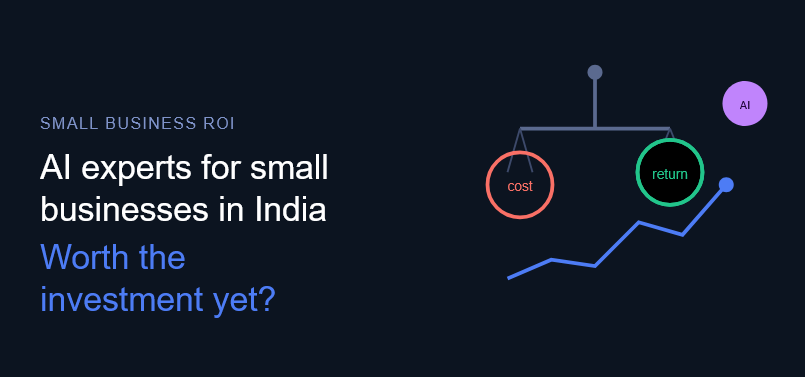
Every small business owner evaluating a marketing budget eventually asks a version of the same question: is this actually worth spending money on, or is it just the latest buzzword? Right now, that question is being asked about AI experts — consultants and agencies who specialize in getting businesses discovered by ChatGPT, Gemini, and Google AI Overviews. It’s a fair question, and it deserves an honest answer rather than a rehearsed pitch. This article breaks down what AI experts actually cost, what kind of returns are realistic, and how to decide whether now is the right time for your business specifically.
What Does “AI Expert” Actually Mean for a Small Business?
Before weighing the investment, it helps to be clear about the service itself. An AI expert working with small businesses typically covers three connected areas:
- Answer Engine Optimization (AEO) — structuring your website content to directly answer the specific questions your customers ask AI assistants, so those answers get lifted and presented in tools like ChatGPT and voice search.
- Generative Engine Optimization (GEO) — building topical depth and authority through well-organized content clusters, so generative AI platforms trust your site as a comprehensive source on your subject.
- LLM SEO — strengthening how confidently AI models recognize your business as a credible entity, through structured data, consistent business information, and technical accessibility.
A genuine AI expert works across all three, layered on top of solid traditional SEO. Anyone offering to “get you into ChatGPT” without touching schema markup, content structure, or entity consistency is likely offering a rebranded, surface-level service.
Is AI Search Visibility Actually Worth Money Right Now?
This is the honest part most agencies skip. Google still sends the overwhelming majority of referral traffic worldwide, and that isn’t going to change overnight. But the visitors who do come through AI platforms behave very differently — and that difference matters for small businesses with limited budgets.
Multiple 2026 industry studies, compiled and reported by Search Engine Journal, point to AI-referred visitors converting at meaningfully higher rates than typical organic search traffic, alongside longer session times and higher engagement. You can read more in Search Engine Journal’s coverage of enterprise AI search findings, which reflects a pattern many independent studies are now confirming: AI search traffic is smaller in volume today, but it arrives closer to a decision.
For a small business, that translates into a specific opportunity: fewer visitors, but visitors who are more likely to convert into a genuine inquiry or sale. The volume is still modest compared to Google search overall, so this isn’t a reason to abandon traditional SEO — it’s a reason to add AI visibility as a complementary channel while competition for it is still relatively low.
The Real Cost-Benefit Breakdown
The Case For Investing Now
- Low competition, for now. Most small businesses in India haven’t touched AEO, GEO, or LLM SEO yet, which means the businesses that start now have a real chance to become the default AI recommendation in their category before it gets crowded.
- AI-referred visitors tend to convert well. Even at smaller volumes, higher-intent traffic can meaningfully impact a small business with a modest monthly lead target.
- Much of the work strengthens traditional SEO too. Clearer content structure, better schema, and stronger entity signals improve your regular Google rankings at the same time, so the investment isn’t siloed to one channel.
- Being absent has a cost. If a competitor is being recommended by ChatGPT when your business isn’t, that’s a lost opportunity you may never even see in your analytics.
The Case for Waiting or Starting Small
- AI search still sends a small fraction of total traffic. For a business with a tight marketing budget, a full-scale AI optimization program may not yet outperform strengthening core SEO or paid search first.
- Results build gradually. Like SEO, AI visibility isn’t instant. Businesses expecting citations within a few weeks are often disappointed.
- Not every business needs the same depth of service. A local shop with a simple, well-structured website may need only light AEO improvements, not a full ongoing engagement.
How to Decide If Now Is the Right Time for Your Business
Ask yourself these questions before committing budget:
- Do your competitors already show up when customers ask AI assistants for recommendations in your category? If yes, the cost of waiting grows every month.
- Is your website already technically sound, with reasonably clear content? If your site has deeper SEO problems, fix those fundamentals first — AI optimization builds on top of them, not around them.
- Can you commit to at least 4 to 6 months before expecting meaningful results? If your budget requires quick wins only, this may not be the right channel yet.
- Is your industry research-heavy or comparison-driven? Categories like professional services, healthcare, education, and B2B tend to see AI assistants used earlier in the buying journey, which makes AI visibility more valuable sooner.
A Realistic Timeline for Small Businesses
| Phase | Timeframe | What to Expect |
|---|---|---|
| Foundation | Weeks 1–4 | Technical fixes, schema implementation, content audit and restructuring |
| Early signals | Weeks 4–12 | Improved content clarity, early entity consistency, initial visibility tests across AI platforms |
| Momentum | Months 3–6 | Growing topical authority, occasional citations, rising branded search |
| Compounding | Months 6–12+ | More consistent AI mentions, stronger entity recognition, measurable lead contribution |
Any expert promising guaranteed ChatGPT or Gemini citations within weeks is overselling. No one controls exactly what an AI model chooses to cite, and honest experts will say so upfront.
What to Look For Before Hiring an AI Expert in India
- Clear, specific deliverables rather than vague promises like “we’ll get you into ChatGPT”
- Verifiable case studies and references you can actually contact
- A process that includes technical SEO, structured data, and content strategy — not content writing alone
- Transparent reporting that explains how AI visibility progress is being tracked, since traditional ranking reports don’t apply the same way
- Realistic timelines that acknowledge this is a compounding, long-term investment
Frequently Asked Questions
Is it worth hiring an AI expert for a small business in India right now?
For many businesses, yes — particularly those in research-heavy or comparison-driven industries where competitors haven’t yet invested in AI visibility. Businesses with tighter budgets or weaker technical foundations may benefit from strengthening core SEO first.
How much should a small business budget for AI search optimization?
Costs vary based on scope, business size, and whether you hire a freelancer, agency, or in-house specialist. Ask for a clear breakdown of deliverables rather than comparing price alone, since the depth of work required differs significantly between a simple local business and a content-heavy service business.
How long does it take to see results from AI search optimization?
Most businesses see early technical and content improvements within the first month, but meaningful, consistent AI citations typically build over four to twelve months, similar to how traditional SEO compounds over time.
Can a small business do AI search optimization without hiring an expert?
Some basic improvements, like clearer content structure and consistent business information, can be done in-house. However, structured data implementation, entity-building strategy, and ongoing AI visibility monitoring usually require specialized, current expertise that changes frequently.
Does investing in AI search optimization mean I can stop investing in traditional SEO?
No. AI search optimization builds on top of traditional SEO fundamentals. Businesses that abandon SEO in favor of AI-only tactics typically lose ground on both channels rather than gaining an advantage.
What industries benefit most from AI search optimization right now?
Research-heavy and comparison-driven industries — professional services, healthcare, education, home services, and B2B — tend to see AI assistants used earlier in the customer’s decision process, making early investment more valuable.
For most small businesses in India, AI search optimization is worth exploring now, not because it will replace traditional SEO, but because it adds a complementary channel that’s still relatively uncrowded. The businesses that benefit most are the ones that treat it as a gradual, compounding investment rather than expecting instant citations. If your competitors haven’t started yet, that’s exactly the window worth acting on — carefully, with realistic expectations, and with an expert who’s honest about the timeline.