Written by a search visibility strategist with 7+ years of hands-on experience reporting SEO and AI search performance to Indian business owners and marketing teams. This article reflects real reporting conversations where traffic numbers and actual business results stopped lining up, not a theoretical shift.
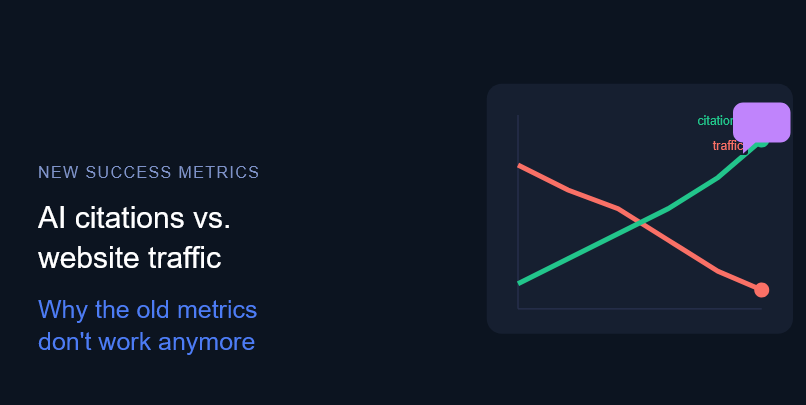
A business owner checks their analytics dashboard, sees organic traffic has dropped, and immediately assumes something has gone wrong — a penalty, a lost ranking, a technical issue. Increasingly, that assumption is wrong. Rankings can stay exactly the same while traffic falls, because the page is still winning the query, it’s just not winning the click anymore. This guide explains why website traffic has quietly stopped being a reliable success metric on its own, what AI citations measure instead, and how to build a scorecard that actually reflects what’s happening to your visibility.
Why Traffic Is Falling Even When Rankings Aren’t
The core mechanic behind this shift is straightforward: AI Overviews, featured answers, and chat-based search increasingly answer a user’s question directly on the results page or inside a conversation, so the click that used to follow a search often never happens. Multiple independent studies confirm just how large this effect has become. Ahrefs’ analysis of 300,000 keywords found that the presence of an AI Overview correlates with a roughly 58% drop in click-through rate for the position-one organic result, more than double what the same research found just months earlier. You can read more in Search Engine Land’s coverage of the Ahrefs and Amsive CTR studies, which breaks down the data behind this shift in detail.
This means a page can hold its exact ranking position, receive the same search volume behind its target keywords, and still see traffic fall — because a growing share of users who see that page in the results, or who ask an AI assistant the same question, get their answer without ever clicking through.
Why “Traffic Went Down” No Longer Means “Visibility Went Down”
This is the mental shift that trips up most business owners and even some experienced marketers: traffic and visibility used to move together closely enough that traffic was a reasonable proxy for both. That relationship has broken. A brand can lose a meaningful share of website sessions while simultaneously gaining visibility, citations, and brand recall — because being named or summarized inside an AI-generated answer is itself a visibility event, even when it produces no click at all. Research increasingly shows that citation-based exposure translates into real downstream value even without a corresponding site visit: users who do click through from an AI-driven recommendation tend to arrive further along in their decision process, converting at meaningfully higher rates than typical organic visitors.
Put simply, a shrinking traffic number and a shrinking business opportunity are no longer the same thing, and treating them as identical leads to the wrong conclusions and, often, the wrong fixes.
What AI Citations Actually Measure
An AI citation is a mention of your business, product, or content inside an AI-generated response — whether that’s a Google AI Overview, a ChatGPT answer, a Perplexity summary, or a Gemini response. Unlike a traditional ranking, a citation doesn’t measure where you sit in a list of ten blue links. It measures whether an AI system trusts your content enough to draw from it when constructing an answer for someone who may never see your website at all.
This is the outcome that dedicated AEO and GEO work is specifically built to influence — structuring content for direct extraction and building the topical authority that makes a source worth citing — because neither discipline is optimizing for the click itself. They’re optimizing for the moment before the click even becomes possible.
Comparing the Two Metrics Side by Side
| Website Traffic | AI Citations | |
|---|---|---|
| What it measures | Sessions that reach your website | Mentions inside AI-generated answers |
| What it misses | Awareness and influence that never produce a click | Whether that visibility eventually converts |
| How it’s tracked | Analytics tools (GA4, Search Console) | Prompt testing, citation monitoring tools |
| What a decline means | Could reflect fewer clicks, not less visibility | Could reflect a genuine visibility problem |
| Best used for | Measuring on-site engagement and conversion paths | Measuring upstream brand consideration |
Neither metric tells the full story alone. A business tracking only traffic can conclude visibility is collapsing when it’s actually shifting to a channel that isn’t being measured. A business tracking only citations can miss real technical or content problems that are also suppressing traditional rankings. The two need to be read together.
What to Track Instead of Relying on Traffic Alone
- Click-through rate by query type, not just total traffic, since a stable or improving CTR on the queries that still send clicks tells a very different story than a raw traffic decline.
- Citation frequency and share of voice across ChatGPT, Gemini, and Google AI Overviews for the questions your buyers actually ask.
- Branded search volume, since growing AI visibility often shows up first as more people searching for your business by name.
- Self-reported attribution from lead forms, asking directly whether a prospect discovered you through an AI assistant.
- Conversion rate of the traffic that does arrive, since AI-referred visitors and citation-influenced direct traffic tend to convert at a higher rate than average organic sessions, even at lower volume.
Why This Matters More for Content-Driven and Informational Businesses
The traffic-to-citation shift isn’t uniform across every type of query. Informational content — guides, explainers, comparison articles — is hit hardest by AI Overview and chat-based answer displacement, since these are exactly the queries AI systems answer most confidently on their own. Transactional and highly local queries are comparatively insulated, since users still need to visit a website or contact a business directly to complete an action. This means businesses relying heavily on informational content for traffic — blogs, educational resources, research-style publishing — need to adapt their success metrics earliest and most deliberately, while transactional and service-based businesses may see the shift more gradually.
A Practical Scorecard for the Transition
- Keep tracking traditional traffic and rankings, since they still matter for transactional and navigational queries.
- Add citation tracking through repeated, structured prompt testing across major AI platforms.
- Monitor branded search volume monthly as an early indicator of growing AI-driven awareness.
- Add an AI-source option to every lead capture form to start collecting direct attribution data.
- Review both traffic and citation data together each month, rather than treating either as a standalone verdict on performance.
Frequently Asked Questions
Why is my website traffic dropping even though my Google rankings haven’t changed?
AI Overviews and chat-based search increasingly answer a user’s question directly on the results page or inside a conversation, so users who previously clicked through now often get their answer without visiting your site, even while your ranking position stays the same.
Does declining traffic always mean declining visibility?
No. A business can lose website sessions while gaining visibility through AI citations and brand mentions that never produce a click. The two metrics need to be tracked separately to understand what’s actually happening.
What is an AI citation, and how is it different from a search ranking?
An AI citation is a mention of your business inside an AI-generated answer, such as a ChatGPT response or Google AI Overview. Unlike a ranking, which measures position in a list of results, a citation measures whether an AI system trusts your content enough to reference it directly.
Should I stop tracking website traffic altogether?
No. Traffic remains an important metric, particularly for transactional and local queries where AI displacement is less severe. The goal is to track traffic alongside AI citation data, not to replace one with the other.
How can a small business start tracking AI citations without expensive tools?
Manually running a set of realistic buyer questions through ChatGPT, Gemini, and Perplexity on a recurring basis, and recording whether and how the business is mentioned, provides a useful starting signal without requiring paid monitoring software.
Which types of businesses are most affected by this shift?
Businesses relying heavily on informational content — guides, explainers, educational resources — tend to see the sharpest traffic impact, since these queries are most commonly answered directly by AI systems. Transactional and highly local queries are comparatively less affected.
Website traffic hasn’t stopped mattering, but it has stopped being a complete measure of visibility on its own. The businesses adjusting fastest to this shift are the ones tracking AI citations and traditional traffic side by side, rather than treating a falling session count as an automatic sign that something is broken. Understanding the difference between the two — and building a scorecard that captures both — is quickly becoming a basic requirement for reading your own performance accurately, not an optional refinement.