Written by a search visibility strategist with 7+ years of hands-on experience running SEO, AEO, GEO, and LLM SEO campaigns across multiple industries. This article is grounded in current 2026 search data, not speculation about where things might be headed.
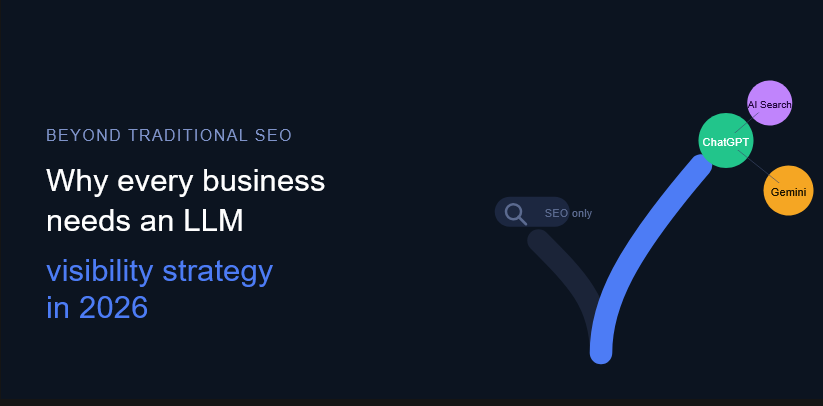
For two decades, “getting found online” meant one thing: ranking well on Google. That assumption no longer holds. A growing share of searches never produce a click at all, and an even larger share of customer research now happens entirely inside an AI conversation — ChatGPT, Gemini, Perplexity, Google AI Mode — before a business ever gets the chance to be found the traditional way. Businesses that still measure their online visibility purely through search rankings are increasingly missing where their customers actually are. This article lays out exactly why an LLM visibility strategy has become essential in 2026, and why it can no longer be treated as an optional add-on to SEO.
The Numbers Behind This Shift
The scale of this change is no longer speculative. Google’s own zero-click search rate has climbed sharply, and Search Engine Land’s coverage of recent industry research found that the share of Google searches resulting in at least one click fell nearly 10 percentage points between 2024 and 2026, a decline of close to 23%. You can read more in Search Engine Land’s reporting on zero-click search data, which tracks this shift in detail.
At the same time, AI-native search platforms behave very differently from traditional Google results. Zero-click rates on ChatGPT Search, Perplexity, and Google AI Mode range from roughly 60% to over 90%, since these platforms are built to answer queries directly rather than send users to a website. Meanwhile, AI search visit volume is growing fast — industry data shows AI search visits rising by more than 40% year over year in early 2026, even as growth in traditional Google search visits stayed comparatively modest.
Put simply: fewer searches are ending in a website visit, and a larger share of the visits that do happen are being replaced by an AI-generated answer that either mentions your business or doesn’t.
Why SEO Alone No Longer Covers the Full Picture
Traditional SEO was built around a single core mechanic: rank a page highly enough, and users will click through to your site. That mechanic still matters, but it no longer describes the whole customer journey. When a user asks ChatGPT to recommend a service, compare two products, or explain an option, the AI model synthesizes an answer from a small number of trusted sources and presents it directly — often without a single click occurring. If your business isn’t one of the sources that answer draws from, ranking well on Google for the same query doesn’t help you in that moment at all.
This is the core reason LLM visibility deserves its own strategy, not just a checkbox added to an existing SEO plan. It requires different signals: content clarity for direct answers, structured data for accurate machine interpretation, and entity authority that lets an AI model confidently recognize and recommend your business by name.
What an LLM Visibility Strategy Actually Includes
A complete LLM visibility strategy in 2026 typically combines three connected disciplines:
- Answer Engine Optimization (AEO) — structuring content to directly answer the specific questions customers ask AI assistants, increasing the chance of being lifted into a quick AI or voice search response.
- Generative Engine Optimization (GEO) — building topical depth through interlinked content clusters, so generative AI platforms recognize a business as a comprehensive, trustworthy source on its subject rather than a single isolated page.
- LLM SEO — strengthening entity authority through structured data, consistent business information, and technical accessibility, so AI models can accurately identify and cite a business across multiple platforms.
None of these replace traditional SEO. They extend it, built on the same foundation of technical health, quality content, and credible authority that has always mattered — just applied with how AI models retrieve and synthesize information in mind.
Why Waiting Has a Real Cost
Unlike some marketing trends, this shift isn’t reversible or temporary. AI-assisted research is becoming the default starting point for an increasing share of buyers across nearly every industry, and that behavior isn’t likely to revert to keyword-typing and blue-link scanning. Businesses that delay building LLM visibility face two compounding disadvantages: competitors who start earlier get more time to build the entity authority and content depth AI models favor, and every month of AI-driven research that doesn’t include your business is a month of missed consideration that traditional analytics often can’t even measure.
Signs Your Business Is Already Behind
- Your organic search traffic has softened even though your Google rankings haven’t changed, suggesting more of your audience is now getting answers without clicking through
- Competitors are being named when customers ask AI assistants for recommendations in your category, and you aren’t
- Your content answers questions indirectly, without the kind of clear, structured format AI models favor for extraction
- You have no structured data or schema markup implemented on key pages
- Your business information is inconsistent across your website, directories, and social profiles, weakening how confidently AI models can recognize you as a credible entity
How to Start Building an LLM Visibility Strategy
- Audit your current AI visibility. Test how ChatGPT, Gemini, Perplexity, and Google AI Overviews currently describe or recommend businesses in your category, and see whether yours appears at all.
- Identify the real questions your customers ask AI assistants, not just the keywords they type into a search bar.
- Restructure key content for direct, extractable answers, with the most important information stated clearly near the top of the page.
- Implement structured data so AI systems have unambiguous, machine-readable context about your business, products, and services.
- Strengthen entity consistency across your website, directories, and third-party mentions.
- Monitor and adjust regularly, since AI platforms and citation patterns continue to evolve.
Frequently Asked Questions
Is SEO becoming obsolete because of AI search?
No. Traditional SEO fundamentals — technical health, quality content, and authority — remain the foundation LLM visibility is built on. What’s changing is that SEO alone no longer covers the full picture of how customers discover businesses.
How is an LLM visibility strategy different from a regular SEO strategy?
SEO focuses on ranking pages in search engine results. An LLM visibility strategy focuses on becoming a source that AI models can confidently extract information from and cite directly in a generated answer, which requires additional emphasis on structured data, entity authority, and direct-answer content.
How urgent is it for a business to start building LLM visibility now?
Given how quickly AI-assisted research is growing and how gradually AI citation authority builds, earlier action generally compounds into a meaningful advantage. Businesses that wait risk losing consideration in a growing share of customer research they can’t easily measure or recover.
Do small businesses need an LLM visibility strategy, or is this only relevant for large companies?
Small businesses can benefit significantly, particularly in niche or local categories where competition for AI citations is still relatively low. Clear, well-structured, and accurate content can help a smaller business earn recommendations alongside larger competitors.
What’s the biggest mistake businesses make regarding LLM visibility?
Assuming that strong Google rankings automatically translate into AI search visibility. The two are related but distinct, and a page-one ranking offers no guarantee of being cited inside an AI-generated answer.
How long does it take to see results from an LLM visibility strategy?
Similar to organic SEO, results build gradually. Early improvements in content clarity and structured data often appear within weeks, while consistent AI citation patterns typically develop over several months as authority and content depth compound.
The businesses that treated SEO as optional in the early 2000s got left behind by the ones that didn’t. The same pattern is repeating with LLM visibility in 2026 — except this time, the shift is happening faster, and the cost of being invisible in an AI-generated answer is harder to see in traditional analytics until it’s already cost you a customer. An LLM visibility strategy isn’t a replacement for SEO, and it isn’t a passing trend to watch from the sidelines. It’s the next layer of how businesses get found, and the businesses building that foundation now are the ones AI platforms will keep recommending as this shift continues to accelerate.