Written by a search visibility strategist with 7+ years of hands-on experience reporting organic performance to Indian business owners through a period when the definition of the metric itself started shifting underneath the reporting. This guide reflects that lived shift, not a textbook restatement.
For most of the last two decades, “organic traffic” had a simple, stable definition: the number of visitors who landed on your website through unpaid search engine results. It was a clean metric, easy to track, easy to report, and closely tied to how well a site ranked. That definition is starting to strain under the weight of how search actually works now. A page can rank exactly where it always has and generate far fewer visits, while simultaneously being read, summarized, and recommended by an AI system to people who never click through at all. This guide walks through what organic traffic has traditionally meant, why that definition is becoming incomplete, and how to think about it more accurately in 2026.
The Traditional Definition, and Why It Worked for So Long
Organic traffic has conventionally referred to unpaid visits that arrive through a search engine’s results page, as distinct from paid ads, direct visits, social referrals, or email traffic. For most of the search era, this definition worked well because visibility and traffic moved together closely: a higher ranking reliably produced more clicks, and a page’s organic traffic number was a fair proxy for how visible and authoritative it was in that search engine’s eyes. Semrush’s own explainer on organic traffic captures this traditional framing clearly, describing it as the visitors who reach a site through unpaid search listings, distinct from every other channel. You can review that baseline definition in Semrush’s guide to organic traffic, which remains a useful reference for the classic mechanics still relevant to transactional and navigational search.
The problem isn’t that this definition was ever wrong. It’s that it was built for a search experience where the results page was mostly a list of links, and clicking one of those links was the only way to get an answer.
Why the Definition Is Becoming Incomplete
Search results pages increasingly answer questions directly, rather than simply pointing toward pages that might answer them. Google AI Overviews summarize information at the top of the results page. ChatGPT, Gemini, and Perplexity generate conversational answers that often cite or paraphrase content without a clickable link at all. In each of these scenarios, a user can be fully served by a source’s content, form an impression of that brand, and never generate a session that any analytics tool would count as organic traffic.
This creates a genuine measurement gap: a business can be losing organic traffic while gaining visibility, and a traditional organic traffic report has no way to distinguish between “we’re less relevant now” and “we’re being read without being clicked.” Treating both scenarios identically, using only the traditional definition, leads to the wrong read on what’s actually happening to a business’s search presence.
A More Complete Way to Think About Organic Traffic Today
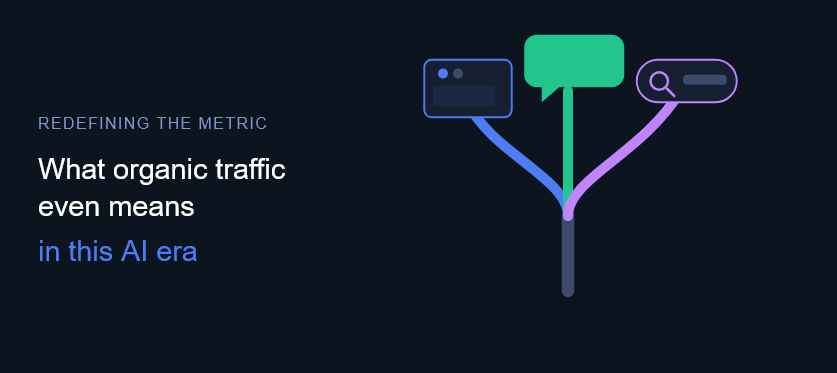
Rather than discarding the traditional definition, it helps to think of organic traffic as one layer within a broader concept: organic visibility. That broader concept includes at least three distinct forms of unpaid discovery:
1. Click-Based Organic Traffic
This is the traditional definition — visits generated by a user clicking a link from a traditional search results listing. It remains fully relevant, particularly for transactional and navigational queries, where a user still needs to reach a website to complete an action like a purchase, booking, or contact form submission.
2. AI Citation Visibility
This covers instances where a business or its content is referenced, summarized, or cited inside an AI-generated answer — a Google AI Overview, a ChatGPT response, a Perplexity summary — regardless of whether a click occurs. This is genuinely new territory for measurement, since it produces real brand exposure and influence with no corresponding session in most analytics tools.
3. AI-Influenced Direct and Branded Traffic
This covers the traffic that does eventually reach a website, but through an indirect path: a user encounters a brand inside an AI conversation, then later searches for that brand by name or types the URL directly, arriving as “direct” or “branded organic” traffic with no trace of the AI interaction that actually drove the visit.
Read together, these three layers paint a far more complete picture than click-based organic traffic alone. A business can be flat or declining on the first layer while growing meaningfully on the second and third — and missing that distinction is exactly what leads business owners to conclude their search presence is shrinking when it’s actually just changing shape.
What This Means for How You Should Report on Organic Traffic
- Stop treating organic traffic as a single number. Segment it by query type — informational versus transactional — since AI displacement affects them very differently.
- Add AI citation tracking as a companion metric, not a replacement, so visibility that doesn’t show up as a session still gets counted somewhere.
- Watch branded search volume as an indicator that AI-influenced awareness is translating into direct interest, even without attributable AI referral traffic.
- Reframe organic traffic goals around outcomes, not just sessions, since a smaller but higher-intent traffic pool, supplemented by growing AI visibility, can represent genuine progress even when the raw traffic number looks flat or declining.
Why This Redefinition Matters Practically, Not Just Semantically
This isn’t an academic distinction. A business that only measures the traditional definition of organic traffic can make real strategic mistakes — cutting content investment because “traffic isn’t growing,” when in reality the content is earning consistent AI citations that are building brand awareness and trust upstream of a measurable session. Conversely, a business that ignores click-based traffic in favor of chasing AI visibility risks losing the transactional, decision-stage traffic that still converts through a traditional click and still matters enormously to revenue.
Getting this right increasingly depends on treating traditional SEO, Answer Engine Optimization (AEO), and Generative Engine Optimization (GEO) as three connected layers of the same underlying goal — being found, understood, and trusted — rather than treating “organic traffic” as a single metric that any one discipline is solely responsible for.
Frequently Asked Questions
Is organic traffic still a meaningful metric to track?
Yes, particularly for transactional and navigational queries where users still need to click through to complete an action. It’s incomplete on its own, not obsolete, and works best alongside AI citation and branded search tracking.
Why has my organic traffic declined even though my content quality hasn’t changed?
This often reflects AI Overviews or chat-based search answering the user’s question directly, reducing the click-through rate for pages that still rank in the same position, rather than any actual decline in content quality or relevance.
What’s the difference between organic traffic and organic visibility?
Organic traffic specifically counts click-based sessions from search results. Organic visibility is a broader concept that also includes AI citation exposure and AI-influenced direct traffic, giving a more complete picture of how a business is actually being discovered.
How can I measure the parts of organic visibility that don’t show up as traffic?
Track AI citation frequency and share of voice through repeated prompt testing across major AI platforms, and monitor branded search volume growth as an indicator that AI-driven exposure is translating into direct interest.
Should businesses stop creating informational content since it’s most affected by AI Overviews? No. Informational content still builds topical authority and can earn AI citations, which carry real brand value even without a click. The more effective response is restructuring that content for AI extraction rather than abandoning it.
Will the definition of organic traffic keep changing?
Likely, as AI-driven search continues to evolve. The most durable approach is measuring outcomes — visibility, trust, and conversions — across multiple layers, rather than anchoring reporting to any single metric that depends on how today’s search interfaces happen to be built.
Organic traffic hasn’t become meaningless, but it has become an incomplete way to describe what’s actually happening to a business’s search presence in 2026. The businesses reading their performance most accurately are the ones treating click-based traffic as one layer of a broader picture that also includes AI citation visibility and AI-influenced brand awareness — not because the old definition was wrong, but because it was built for a search experience that no longer fully describes how people find and evaluate businesses today.