A year or two ago, if you’d asked someone what a “GEO expert” does, you’d have gotten a blank stare. Today, it’s one of the fastest-growing roles in digital marketing — and one of the least understood. People assume it’s just SEO with a new name. It isn’t.
Having spent the last several years watching search shift from ten blue links to AI-generated answers, I can say this plainly: a GEO expert’s day looks nothing like a traditional SEO specialist’s day. There’s less time spent chasing rankings and far more time spent making sure AI systems — ChatGPT, Gemini, Perplexity, Google AI Overviews — actually understand, trust, and reference what a business publishes.
Here’s what that actually looks like, hour by hour.
What Is a GEO Expert, Exactly?
A GEO expert is someone who optimizes a website’s content, structure, and authority so that generative AI platforms can understand it, trust it, and reference it when generating answers to user queries. Where traditional SEO is built around ranking pages in a results list, Generative Engine Optimization is built around a different question entirely: will an AI model choose to cite this content when someone asks a related question?
That distinction shapes everything about the role. A GEO expert isn’t just thinking about keywords and backlinks anymore — they’re thinking about how clearly a piece of content answers a question, how well it’s structured for machine comprehension, and whether the site as a whole reads as a credible, topically authoritative source.
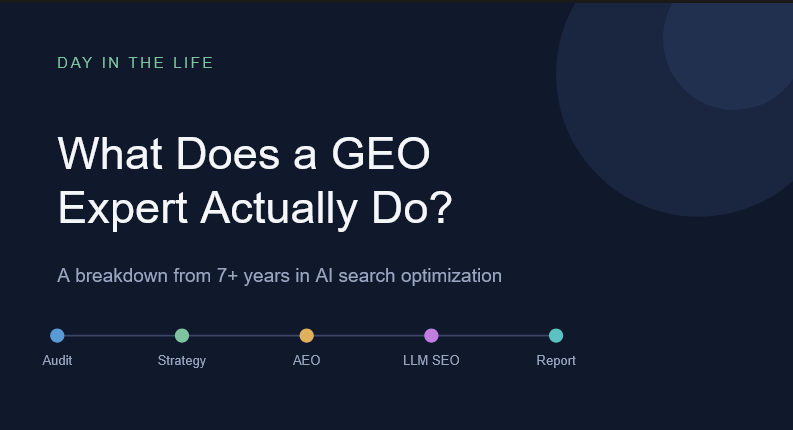
Morning: Auditing AI Visibility
The day usually starts with a visibility check — not a rankings check. Before writing a single word of content, a GEO expert needs to know where a client’s brand currently stands inside AI-generated answers. Is the business showing up when someone asks ChatGPT or Perplexity a question in its category? Is it being cited at all, misrepresented, or missing entirely?
This is closer to detective work than traditional SEO reporting. It involves running a series of real prompts across multiple AI platforms, documenting what comes back, and comparing it against what competitors are showing up for. This early-morning audit sets the priorities for everything that follows in the day.
Midday: Content Strategy and Topical Authority
Once the visibility gaps are clear, the next block of the day is spent on content strategy — deciding what needs to be created or restructured so AI systems can better understand a business’s expertise. This is where most of a GEO expert’s core work lives: organizing content into logical topic clusters, strengthening internal linking so relationships between pages are obvious to both users and AI crawlers, and making sure every page reinforces the same core entities and expertise areas rather than working against each other.
This part of the job overlaps heavily with what a structured GEO strategy actually involves — website analysis, AI search research, and building topical depth around the concepts a business genuinely wants to be known for, rather than chasing scattered keywords with no coherent theme.
Afternoon: Structuring Content for Direct Answers
By early afternoon, the focus usually shifts toward the page level — rewriting or restructuring individual pieces of content so they answer real user questions clearly and directly, rather than burying the answer three paragraphs deep. This means clear headings, concise paragraphs, well-formatted FAQs, and content organized the way an AI system actually parses information, not the way a page was traditionally written to rank.
This is where the discipline of Answer Engine Optimization comes in directly — identifying the exact questions an audience is asking, and building content that answers them in a way both users and AI assistants can immediately extract and reference.
Late Afternoon: Entity and LLM-Level Optimization
The later part of the day often turns toward more technical work — structured data, schema markup, and reinforcing a brand’s identity as a recognizable “entity” across the web, not just a website. This is the layer that helps large language models connect a business’s name, expertise, and content consistently, rather than treating it as an isolated, unverified source.
This is essentially the core of LLM SEO work — building the kind of structured, authoritative digital footprint that helps a brand get recognized and recommended across ChatGPT, Gemini, Claude, Copilot, and other AI platforms, not just referenced once and forgotten.
Evening: Monitoring, Reporting, and Iterating
The day typically closes with monitoring — checking whether recent content changes are showing up in AI-generated answers yet, tracking which prompts are starting to surface a client’s brand, and documenting what’s working versus what needs another round of refinement. Unlike traditional SEO, where rank tracking is fairly standardized, AI visibility tracking is still evolving, which means a GEO expert spends real time simply testing prompts manually and documenting patterns by hand.
This constant cycle of testing and adjusting is less about instant results and more about compounding authority over time — a business that consistently gets recommended in AI answers today has usually earned that through months of steady, structured work, not a single optimization pass.
Core Skills a GEO Expert Actually Needs
- Strong content writing ability, since clarity and structure directly determine whether AI systems can parse and trust a page
- A working understanding of how large language models process and rank information, not just how traditional search algorithms do
- Technical SEO fundamentals, including schema markup, site structure, and crawlability
- Analytical patience, since AI visibility tracking still requires manual prompt testing rather than fully automated reporting
- Cross-platform awareness, since content that performs well for Google AI Overviews doesn’t always perform identically on ChatGPT or Perplexity
GEO vs SEO vs AEO vs LLM SEO: How These Actually Relate
These terms get used interchangeably online, which causes a lot of confusion. In practice, they overlap but aren’t identical:
| Discipline | Primary Focus |
|---|---|
| SEO | Ranking web pages in traditional search engine results |
| GEO | Optimizing content so generative AI platforms understand and reference it |
| AEO | Structuring content to directly answer user questions for AI and voice assistants |
| LLM SEO | Building entity-level authority and structured data so large language models recognize and recommend a brand |
A GEO expert typically works across all four, since none of them function well in isolation anymore — a site with strong AEO-structured answers but weak technical SEO still struggles to get crawled and understood consistently, and a strong LLM SEO strategy without solid GEO-level content depth has little substance to point to.
Why This Role Is Becoming Essential
More users are getting answers directly from AI assistants without ever clicking through to a website. Google itself has acknowledged this fundamental shift in how people search, particularly as AI-generated overviews and conversational search experiences become a standard part of the results page rather than an experiment. Businesses that ignore this shift risk becoming invisible in exactly the moment a potential customer is asking the question their business could answer.
A GEO expert’s job, at its core, is making sure that doesn’t happen — that when someone asks an AI assistant a question a business is genuinely qualified to answer, that business is the one being cited, not a competitor who invested earlier in getting AI-ready.