Written by a search visibility strategist with 7+ years of hands-on experience running local SEO and AI search visibility campaigns for Indian businesses, including audits comparing Google Maps rankings against actual AI recommendations for the same queries. This guide reflects those real, side-by-side findings, not a general theory about how AI search might work.
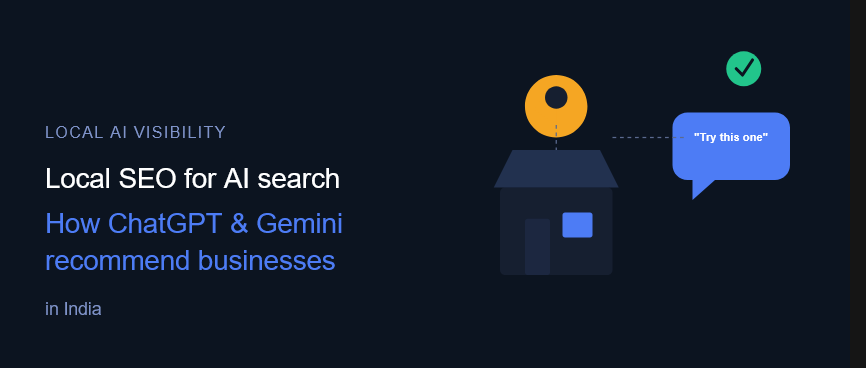
A plumber ranking in the top three of Google’s Local Pack used to be enough to win the call. Today, a growing share of customers skip that list entirely and ask ChatGPT or Gemini directly: “who’s a reliable plumber near me in Bangalore?” What comes back isn’t ten ranked listings — it’s one or two names, stated with confidence. Strong Google Maps rankings no longer guarantee a business makes that shortlist, and for many local businesses, the gap between the two is wider than they realize. This guide explains exactly how AI assistants decide which local businesses to recommend, and what it actually takes to become the name they give.
Why This Shift Is Happening So Fast
The scale of this change is no longer a prediction — it’s already measurable. BrightLocal’s 2026 Local Consumer Review Survey, based on a representative panel of Indian and global consumers, found that the share of people using AI tools to find local business recommendations jumped from just 6% to 45% in a single year, making AI the third most-used local discovery channel, behind only Google and Facebook. You can read more in BrightLocal’s research on AI and local business recommendations, which lays out the consumer behavior data behind this shift in detail.
For Indian local businesses — restaurants, clinics, salons, contractors, real estate agents — this means a meaningful and fast-growing share of potential customers are forming their first impression, and often their final shortlist, entirely inside an AI conversation, before a Google search ever happens.
How ChatGPT and Gemini Actually Decide Who to Recommend
AI assistants don’t rank local businesses the way Google’s Local Pack does. Instead, they run a decision process built around trust and verification, drawing from a small number of consistent data sources and cross-checking them against each other before naming a business.
1. They Cross-Reference Multiple Data Sources for Consistency
ChatGPT and Gemini typically pull from a business’s own website, its Google Business Profile, and high-traffic platforms like Justdial, Zomato, or industry-specific directories, checking whether the business name, address, phone number, and details agree everywhere. A business with an inconsistent phone number or mismatched address across even one of these sources risks being filtered out before it’s ever considered, simply because the AI system can’t confirm the information is reliable.
2. Review Volume and Recency Weigh Heavily
Star ratings alone aren’t enough. AI systems favor businesses with an active, recent flow of reviews over one with a high rating but few recent entries. A business that stopped collecting reviews eighteen months ago signals less current relevance than a competitor with a steady, recent review pattern, even if the overall rating is similar.
3. Review Response Behavior Matters
Businesses that respond to reviews — especially promptly — are treated as more actively managed and trustworthy. This is a signal many Indian small businesses overlook entirely, treating review responses as optional rather than as a genuine visibility factor.
4. A Complete, Well-Structured Google Business Profile Is Close to a Baseline Requirement
Category accuracy, complete service listings, updated hours, and photos all feed into how confidently an AI system can describe a business. A thin or outdated profile makes it harder for an AI assistant to justify recommending that business over a competitor with more complete information. Strengthening this foundation is exactly what dedicated Google Business Profile optimization work is built around, since it’s often the single highest-leverage fix available to a local business.
5. Website Content Still Matters, Even for GBP-Heavy Categories
A Google Business Profile alone can produce some visibility, but AI systems increasingly cross-reference GBP information against the business’s own website to verify accuracy and depth. Businesses without a website, or with a thin one, are capped in how confidently they can be recommended for more specific or complex queries, since there’s no deeper content to confirm details or answer follow-up questions.
Why Strong Google Rankings Don’t Guarantee AI Recommendations
This is the finding that surprises most business owners: strong performance in Google’s traditional local rankings and strong AI recommendation visibility are related but distinct outcomes. A business can hold a top-three Google Maps position for years and still be completely absent when the same query is asked of ChatGPT or Gemini, because AI systems weigh entity consistency, review depth, and content verification differently than Google’s local ranking algorithm does. Local SEO rankings and AI recommendation visibility have to be earned separately — one doesn’t automatically produce the other.
What Local Businesses in India Should Actually Do
1. Audit Your Current AI Visibility Directly
Ask ChatGPT and Gemini the exact questions a customer would ask — “best [category] in [your city/area],” “[category] near [landmark]” — and see whether your business is named at all, and how it’s described. This is the single fastest way to understand where you actually stand, independent of your Google Maps ranking.
2. Fix Data Consistency Across Every Platform First
Before anything else, ensure your business name, address, phone number, and category are identical across your website, Google Business Profile, and every directory you’re listed on. This is foundational, low-cost work that removes the most common reason a business gets filtered out before evaluation even begins.
3. Build a Steady, Recent Review Flow
Actively request reviews from recent customers rather than relying on a historical rating built years ago, and respond to reviews consistently. Recency and responsiveness both factor into how AI systems assess ongoing trustworthiness.
4. Strengthen Your Website Alongside Your Google Business Profile
A clear, well-structured website that answers common customer questions directly supports the verification AI systems perform against your GBP data, and helps you get recommended for more specific, longer-tail local queries. This is where SEO and Answer Engine Optimization (AEO) work directly reinforce local visibility, rather than functioning as separate initiatives.
5. Build Topical and Local Authority Beyond a Single Listing Page
Content that establishes genuine expertise in your service area — locality guides, service-specific pages, common-question content — builds the kind of depth that Generative Engine Optimization (GEO) and broader LLM SEO work are designed to strengthen, increasing the odds of being cited for a wider range of related local queries over time.
Frequently Asked Questions
How do ChatGPT and Gemini find local businesses in India? They primarily draw from a business’s own website, Google Business Profile, and high-traffic review or directory platforms, cross-referencing these sources for consistency before recommending a business, rather than ranking a list the way traditional search results do.
Why isn’t my business recommended by ChatGPT even though I rank well on Google Maps?
AI recommendation visibility depends on different signals than Google’s local ranking algorithm, including data consistency across platforms, review recency, and website content depth. A strong Google Maps position doesn’t automatically transfer into AI recommendation visibility.
Does my Google Business Profile need to be perfect to get recommended by AI assistants?
It needs to be complete, accurate, and consistent with your other listings at minimum. A thin, outdated, or inconsistent profile makes it significantly harder for an AI system to confidently recommend a business over a more complete competitor.
How important are reviews for getting recommended by AI search?
Very important. AI systems weigh both the volume and recency of reviews, along with how consistently a business responds to them, as core trust signals when deciding which local businesses to recommend.
Can a small local business compete with larger, more established competitors for AI recommendations?
Yes. AI systems favor consistency, completeness, and trust signals over sheer business size, which means a smaller business with accurate, well-maintained information can outperform a larger competitor with inconsistent or outdated data.
How long does it take to start getting recommended by ChatGPT and Gemini for local searches?
Fixing data consistency and completing a Google Business Profile can show initial improvement relatively quickly, while building the review volume and content depth needed for consistent, reliable recommendations typically takes several months of sustained effort, similar to traditional local SEO timelines.
Getting recommended by ChatGPT and Gemini isn’t an extension of ranking well on Google Maps — it’s a related but separate outcome that has to be earned through data consistency, review management, and content depth built specifically with AI verification in mind. For local businesses in India, where a growing share of customers are already asking AI assistants for recommendations before ever opening a search engine, closing that gap now is far easier than trying to catch up once a competitor has already become the name AI systems default to in your category.