Written by a search visibility strategist with 7+ years of hands-on experience working both as an outsourced consultant and alongside in-house marketing teams on AEO, GEO, and LLM SEO projects. This guide reflects real budget conversations and staffing decisions, not a generic pros-and-cons list.
Once a business decides that getting found by ChatGPT and Google AI Overviews matters, the next question is almost always practical: should we hire someone full-time, or bring in an outsourced consultant or agency? This isn’t a question with one universal answer. The right choice depends heavily on your business size, budget, and how central AI search visibility is to your growth strategy. This guide breaks down the real costs, trade-offs, and decision points for both paths, so you can make the call that actually fits your business.
What an In-House AI Expert vs. an Outsourced AI Consultant Actually Involves
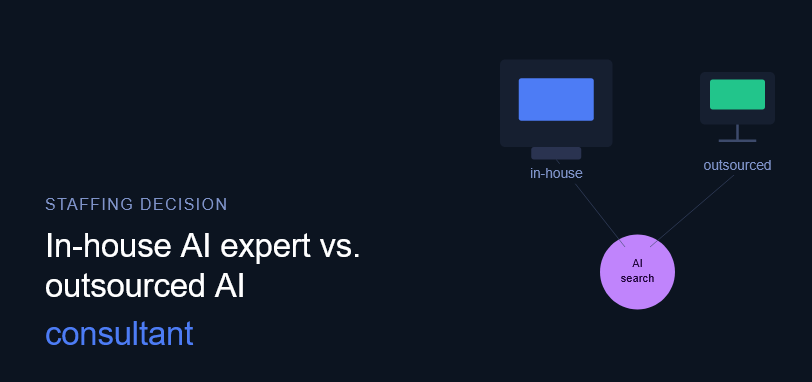
Before comparing costs, it helps to define the roles clearly. An in-house AI expert is a full-time employee dedicated to AI search visibility work — auditing how AI platforms currently represent your business, restructuring content, implementing structured data, and building entity authority as an ongoing part of your team. An outsourced AI consultant or agency provides the same expertise, but on a contract or retainer basis, often working across multiple clients rather than dedicating full-time hours to one business.
Both approaches can cover the same core work: Answer Engine Optimization (AEO) for direct-answer visibility, Generative Engine Optimization (GEO) for topical authority and citation potential, and LLM SEO for entity recognition and structured data. What differs isn’t the discipline itself, but how it’s staffed, managed, and paid for.
The Real Cost Comparison
In-House Hiring Costs
A single experienced marketing specialist in most markets carries a fully loaded cost well beyond base salary once benefits, software subscriptions, recruitment, and training are factored in. Industry cost breakdowns for 2026 consistently show that a full-time marketing hire’s total cost typically runs 20 to 40% above their base salary once payroll taxes, benefits, and tools are included. For a business needing broader coverage — content, technical SEO, and structured data implementation together — that often means more than one hire, which compounds the fixed cost significantly.
Outsourced Consultant or Agency Costs
Outsourced arrangements typically operate on a variable-cost model, whether that’s a monthly retainer, project-based fee, or hourly consulting rate. This structure lets a business pay only for the scope of work needed, without the fixed overhead of a full-time salary, benefits, and idle capacity during slower periods.
A Framework for Deciding: Strategic Core vs. Specialized Function
One of the clearest ways to think through this decision comes from a long-standing principle in outsourcing strategy: functions that provide a genuine strategic advantage and require deep, constant institutional knowledge tend to make more sense in-house, while specialized, evolving functions that don’t need daily oversight often make more sense outsourced. Harvard Business Review has long applied this framework to broader technology and operations decisions, and it applies directly to AI search visibility work. You can read more in Harvard Business Review’s classic outsourcing decision framework, which remains a useful lens for evaluating specialized, fast-changing disciplines like AI search optimization.
For most businesses, AI search visibility is a highly specialized, rapidly evolving function — exactly the kind of work that benefits from outsourced expertise rather than requiring a dedicated full-time hire from day one.
When In-House Makes Sense
- Large businesses with ongoing, high-volume content needs. If your business publishes content constantly and needs AI search considerations built into every piece from the start, a dedicated in-house specialist can integrate more tightly with your broader content and product teams.
- Businesses where AI visibility is central to the growth strategy. If AI-driven discovery is expected to become a primary channel for leads or sales, having someone embedded full-time who understands your brand deeply can be worth the fixed cost.
- Organizations with existing marketing infrastructure. If you already have a content team, a designer, and technical resources, adding one dedicated AI search specialist to coordinate with them can work efficiently.
When Outsourcing Makes Sense
- Small and mid-sized businesses without an existing marketing team. Outsourcing gives access to a broader skill set — technical SEO, content strategy, structured data, entity building — without the cost of hiring for each specialty separately.
- Businesses still testing whether AI search visibility drives real returns. A retainer or project-based engagement lets you evaluate results before committing to a fixed, ongoing salary cost.
- Companies that need current, cross-industry expertise. AI search behavior changes quickly. A consultant or agency working across multiple clients often has broader, more current exposure to what’s working across industries than a single in-house hire might.
- Businesses without the internal capacity to manage a specialist’s output. A dedicated hire still needs oversight and direction. If there’s no one internally who can manage that relationship, an agency’s built-in project management often fills that gap more efficiently.
Business Size Breakdown: What Usually Makes Sense
| Business Size | Typical Recommendation | Why |
|---|---|---|
| Solo or micro business | Outsourced consultant (project-based) | Low, predictable cost with no fixed overhead |
| Small business (under 20 employees) | Outsourced agency (retainer) | Access to a full skill set without multiple hires |
| Growing mid-sized business | Outsourced agency, with an internal point of contact | Balances specialized expertise with internal coordination |
| Established mid-to-large business | Hybrid: in-house lead + outsourced specialist support | Combines brand depth with current, specialized execution |
| Enterprise | In-house team, often supplemented by outsourced expertise for specific projects | Scale and integration needs justify dedicated headcount |
This isn’t a rigid rule — a fast-growing small business investing heavily in content may justify an early in-house hire, while a larger business testing a new market might start with an outsourced consultant before committing to a full-time role.
Questions to Ask Before Deciding
- Is AI search visibility a core, differentiating part of your growth strategy, or a supporting function alongside other marketing work?
- Do you have the internal capacity to manage and direct a full-time hire’s daily work?
- Would broader, current, cross-industry expertise serve you better than deep, brand-specific knowledge right now?
- Can your budget absorb a fixed salary cost, or does a variable, scalable cost model fit better?
- How quickly do you need results, and does that timeline favor someone who can start immediately versus a lengthy hiring process?
A Hybrid Approach Is Often the Practical Middle Ground
Many growing businesses land somewhere between the two extremes: an outsourced agency or consultant handles the specialized AEO, GEO, and LLM SEO work, while an internal marketing team member serves as the point of contact, ensuring the strategy stays aligned with the broader brand and business goals. This hybrid model often delivers the deep, current expertise of outsourcing with the coordination benefits of having someone in-house who understands the strategy end to end.
Frequently Asked Questions
Is it cheaper to hire an in-house AI expert or outsource to a consultant?
For most small and mid-sized businesses, outsourcing is significantly cheaper on a total-cost basis, since it avoids salary, benefits, software, and training overhead. In-house hiring becomes more cost-competitive at scale, once a business has enough ongoing work to justify a full-time role.
How do I know if my business is ready for an in-house AI expert?
If AI search visibility is central to your growth strategy, you have consistent, high-volume content needs, and you have the internal capacity to manage a full-time specialist, an in-house hire may be worth the investment. Most businesses outgrow outsourcing into in-house hiring gradually, not all at once.
Can a small business get good results from an outsourced AI consultant?
Yes. Outsourced consultants and agencies often bring broader, more current expertise across multiple industries than a single in-house hire would have access to, which can be a genuine advantage for smaller businesses.
What should I look for when choosing between an in-house hire and an outsourced consultant?
Look at your budget structure, the internal capacity you have to manage the work, how central AI search visibility is to your strategy, and whether you need deep brand-specific knowledge or broad, current cross-industry expertise.
Is a hybrid model between in-house and outsourced actually common?
Yes. Many growing businesses use an outsourced agency or consultant for specialized AEO, GEO, and LLM SEO execution while keeping an internal team member as the strategic point of contact.
Does business size alone determine whether I should go in-house or outsource?
Business size is a strong signal, but it isn’t the only factor. How central AI visibility is to your growth strategy, your existing marketing infrastructure, and your internal capacity to manage a hire all matter just as much as headcount.
There’s no universally correct answer to in-house versus outsourced AI expertise — the right choice depends on your business size, budget structure, and how central AI search visibility is to your growth strategy. For most small and mid-sized businesses, an outsourced consultant or agency offers the most practical starting point: lower fixed cost, broader current expertise, and the flexibility to scale up or reassess as results come in. Larger, more established businesses with consistent, high-volume needs may eventually find that an in-house hire, or a hybrid of both, makes more sense. Whichever path you choose, the underlying work — AEO, GEO, and LLM SEO built on solid SEO fundamentals — stays the same.