
Written by a search visibility strategist with 7+ years of hands-on experience managing SEO timelines and setting realistic client expectations against actual ranking outcomes. This guide is built on published, large-scale ranking data rather than the vague “it depends” answer most agencies give without ever citing a number.
Every business owner publishing a new page asks some version of the same question within the first few weeks: when will this actually show up on Google? The honest answer, backed by real data rather than guesswork, is discouraging for anyone hoping for a quick win — and useful for anyone willing to plan around reality instead of hope. This guide breaks down exactly what the data shows about ranking timelines, what actually speeds the process up, and what a realistic expectation looks like for a new page in 2026.
The Real Answer, Backed by Data
A large-scale 2025 study by Ahrefs, analyzing over 1 million URLs and 1.3 million keywords, found that only 1.74% of newly published pages reach Google’s top 10 within a year — down sharply from 5.7% in a similar 2017 study. The SERPs have also gotten measurably older: 72.9% of pages currently in the top 10 are more than three years old, up from 59% in 2017, and the average page holding position #1 is now roughly five years old, up from just two years in 2017. You can review the full methodology and data in Ahrefs’ original study on how long it takes to rank in Google, which remains the most rigorous, large-sample research available on this exact question.
The clear trend across both studies: ranking in Google’s top 10 has gotten harder and slower over time, not easier, as more content competes for the same positions and Google’s results increasingly favor established, proven pages over new ones.
What This Actually Means for a New Page
Despite the discouraging headline numbers, the data isn’t entirely bleak. Among the small percentage of pages that did rank within a year, a meaningful share achieved it relatively quickly — roughly 41% of pages that eventually ranked in the top 10 did so within just one month, according to the same 2025 Ahrefs data. This tells an important, easily missed part of the story: it’s not that ranking always takes years. It’s that most pages never rank competitively at all, while a smaller set of well-executed pages can rank quite fast — and the gap between those two outcomes usually comes down to a specific set of controllable factors, not luck.
What Actually Speeds Up or Slows Down Ranking Time
1. Domain Authority and History
Publishing new content on an already-established, high-authority domain consistently ranks faster than the same content on a brand-new site. A well-documented pattern shows that identical content can rank in days to weeks on an established domain, while a new website with no accumulated authority typically needs six to twelve months or more for comparable keywords, even with strong content.
2. Keyword Competitiveness and Search Volume
Lower-competition, more specific keywords generally rank faster than broad, high-volume terms with more established competition. A niche, well-targeted long-tail query can realistically rank within weeks, while a competitive head term realistically takes months to over a year, regardless of content quality.
3. Backlink Profile
Pages and domains with a stronger backlink profile consistently outperform those without one, both in ranking speed and in the position ultimately achieved. This remains one of the most consistent patterns across ranking studies, even as other ranking factors evolve.
4. Content Depth and Relevance
Thin or superficial content competing against comprehensive, well-structured pages on the same topic tends to rank slower and lower, regardless of domain authority. Content that genuinely covers a topic in depth gives Google more confidence in matching it to a broader range of related queries.
5. Technical Health
Crawlability issues, slow page speed, or indexing problems can delay ranking regardless of how strong the content itself is, simply by preventing Google from properly discovering, rendering, or trusting the page in the first place.
A Realistic Timeline Framework
- Weeks to 1 month: Achievable for low-competition, specific keywords on an already-established, authoritative domain with strong existing content around the topic.
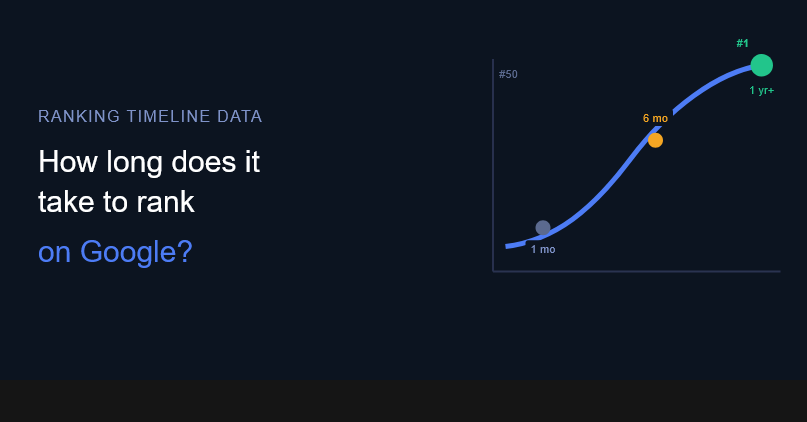
- 3 to 6 months: A realistic range for most well-executed new content on a moderately established site targeting reasonably competitive keywords.
- 6 to 12+ months: Typical for new websites, highly competitive keywords, or content entering a crowded space with well-established competitors already dominating page one.
- 12+ months, ongoing: Common for genuinely competitive, high-value keywords, where sustained content, backlink building, and authority development continue to improve rankings incrementally well beyond the first year.
Any individual page can outperform or underperform these ranges significantly depending on the specific competitive landscape for that keyword — these are reasonable planning bands, not guarantees.
Why So Many Businesses Get This Timeline Wrong
The most common mistake is judging a new page’s performance against a one- or two-month window, then concluding SEO “isn’t working” and either abandoning the effort or drastically changing strategy before the page has had a realistic chance to rank. Given that the majority of pages which do eventually rank well take considerably longer than a couple of months, this pattern of premature judgment is one of the most common ways businesses undermine their own SEO investment — not because the strategy was wrong, but because the evaluation window was too short to see it play out.
How to Realistically Speed Up Your Own Ranking Timeline
- Target more specific, lower-competition keywords first, building topical authority before attempting to rank for broader, more competitive terms.
- Build on an existing page or domain’s authority where possible, rather than starting every new topic from a completely fresh page with no supporting context.
- Invest in genuine content depth, covering a topic comprehensively enough to compete with established, three-plus-year-old pages already occupying page one.
- Fix technical issues before publishing, ensuring crawlability and indexing aren’t adding unnecessary delay to an otherwise strong page.
- Build internal links from related, already-indexed content, giving Google both a faster discovery path and stronger topical context for the new page.
This groundwork is the same foundation that supports both traditional SEO performance and the content depth that increasingly matters for Generative Engine Optimization (GEO) and AI citation visibility, since both reward the same underlying signals of authority, depth, and technical health.
Frequently Asked Questions
How long does it typically take for a new page to rank on Google?
Based on large-scale data, only a small percentage of new pages reach the top 10 within a year at all. Among those that do rank well, a meaningful share do so within a month, while realistic timelines for most well-executed content fall between three and twelve months depending on competition and domain authority.
Why do older pages dominate Google’s top 10 rankings?
Research shows the majority of top 10 pages are several years old, likely reflecting accumulated backlinks, user engagement data, and content maturity built up over time, rather than page age itself being a direct ranking factor.
Can a brand-new website ever rank quickly?
It’s possible but uncommon. New websites typically need six to twelve months or more to rank competitively, since they lack the accumulated authority that established domains bring, even when publishing strong, well-optimized content.
Does keyword competition affect how long ranking takes?
Significantly. Lower-competition, specific keywords can realistically rank within weeks, while broad, high-volume, competitive terms often take many months to over a year, regardless of how well the content itself is written.
Is it a bad sign if my page isn’t ranking after one month?
Not necessarily. Data shows most pages that eventually rank well take considerably longer than a month, so judging performance too early is one of the most common reasons businesses prematurely abandon otherwise sound SEO strategies.
What’s the fastest way to improve ranking speed for new content?
Publishing on an already-authoritative domain, targeting appropriately specific keywords, ensuring strong technical health, and building internal links from related, already-indexed content are the most reliable, controllable levers for reducing ranking time.
The honest answer to how long it takes to rank on Google is: longer than most businesses expect, and increasingly so as competition for top positions grows. Large-scale data consistently shows that Google’s top rankings are dominated by established, multi-year-old pages, with only a small fraction of new content breaking through within a year. That’s not a reason to abandon SEO — it’s a reason to plan around realistic timelines, focus effort on the factors that genuinely speed up the process, and judge new content against a window long enough to actually reflect how ranking really works.

Vishal is a Digital Marketing Specialist, SEO Consultant and AEO (Answer Engine Optimisation) Specialist with over 6 years of experience in the digital marketing industry. He has worked on 50+ projects across multiple industries, helping businesses improve their online visibility, organic search performance and digital presence.
His expertise includes Technical SEO, On-Page SEO, Off-Page SEO, Local SEO, Google Ads, Content Optimisation, AI SEO, Generative Engine Optimisation (GEO) and Answer Engine Optimisation (AEO).
Vishal specialises in developing SEO strategies that help businesses improve their visibility across traditional search engines like Google and emerging AI-powered platforms such as ChatGPT, Google Gemini and Perplexity.
He also works with Google Analytics 4 (GA4), Google Search Console and Looker Studio to monitor website performance, analyse search trends and measure digital marketing results.
Through his practical experience working with businesses across different industries, Vishal shares actionable insights, industry knowledge and proven digital marketing practices to help businesses strengthen their online presence and adapt to the evolving search landscape.