I’ve managed Google Ads budgets for Indian businesses for over seven years now, and the question I get on nearly every first call is some version of “just tell me the number.” I understand why — but the honest answer is that Google Ads has no rate card. It runs on a live auction, repriced millions of times a day, based on how many advertisers want the same customer you do. What I can give you instead is what that auction actually costs across real industries in India in 2026, and how to budget for it without guessing.
Quick Answer: Average Google Ads CPC in India (2026)
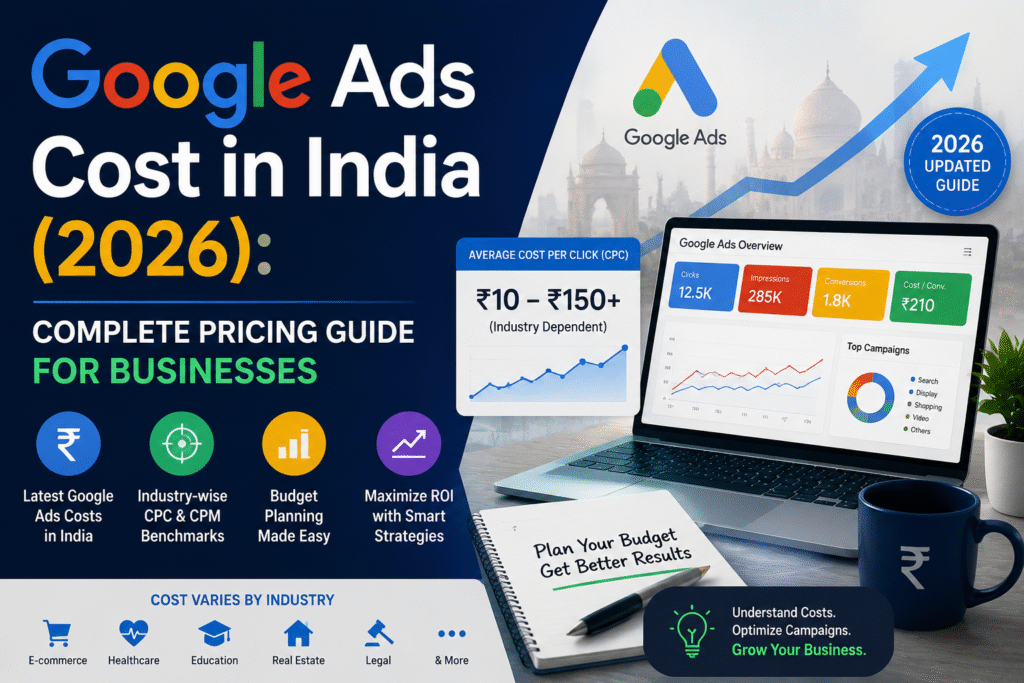
The average cost-per-click across Indian industries sits between ₹20 and ₹60 in 2026. The realistic range spans from ₹5 for low-competition local searches to ₹500–₹600+ for high-value sectors like legal, insurance, and lending. There’s no single “normal” number — your industry determines your CPC far more than any general benchmark does.
CPC by Industry: What You’ll Actually Pay
Based on campaigns I’ve run and current India-wide benchmarks, here’s a realistic breakdown for 2026:
| Industry | Typical CPC Range |
| Local services (salons, repairs, clinics) | ₹10 – ₹60 |
| E-commerce / D2C | ₹15 – ₹80 |
| Education & coaching | ₹20 – ₹120 |
| Healthcare & diagnostics | ₹20 – ₹100 |
| Digital marketing / IT services | ₹40 – ₹200 |
| Real estate | ₹50 – ₹300 |
| Legal, finance & insurance | ₹100 – ₹600+ |
The 30–60x spread between the cheapest and most expensive clicks isn’t a pricing error — it reflects how much a single customer is actually worth in each industry. A furniture retailer and an insurance broker can be bidding in the same city, same month, and pay wildly different prices for the exact same platform.
How Much Should You Actually Budget?
For most small businesses, I recommend starting with ₹15,000 to ₹30,000 per month in ad spend for low-CPC verticals, and ₹50,000+ for high-CPC sectors like fintech, legal, or B2B SaaS. Technically, you can launch a campaign for ₹100/day, but at that level you’ll generate enough clicks to test ad copy and nothing more — not enough data to actually optimize toward conversions. That’s the mistake I see most first-time advertisers make: they treat the minimum viable budget as the recommended one.
On top of ad spend, budget separately for management. If you’re working with an agency, fees typically run ₹5,000 to ₹25,000 per month depending on account complexity, in addition to what you pay Google directly for clicks.
What Actually Controls Your Cost Per Click
This is the part most business owners skip past, and it’s the part that actually saves money. Google prices your ad using Ad Rank — your bid multiplied by your Quality Score. Two advertisers bidding the exact same amount can pay meaningfully different prices depending on that score. In my experience, a well-optimized account with strong Quality Scores can pay close to half of what a poorly managed account pays for the identical keyword. The levers that move it: tightly relevant ad copy, a landing page that actually matches the search intent, and disciplined use of negative keywords to stop paying for clicks that were never going to convert.
Google Ads vs. SEO: Where SEM Fits
I get asked constantly whether a business should run SEM in India or focus purely on SEO, and the honest answer is that they solve different problems. Google Ads gets you instant, controllable visibility the moment your campaign goes live — but that visibility stops the day your budget does. SEO is slower to build but keeps working without ongoing spend once it’s ranking. Most of the businesses I work with run both in parallel: paid search for immediate lead flow while organic rankings compound in the background.
Choosing Who Runs Your Campaigns
This decision affects your cost as much as your industry does. A capable SEM agency in India brings structured account management, ongoing Quality Score optimization, and reporting discipline that a self-managed account often lacks — and over a few months, that difference in execution frequently outweighs the management fee itself through lower CPCs and better conversion rates. If you’re evaluating vendors, ask specifically how they’ve improved Quality Score on past accounts, not just what budgets they’ve managed — that’s the number that actually reflects skill.
Whether you go with an established SEM company in India or a specialist you’ve vetted directly, insist on seeing real account structure and past performance data before committing, not just a pitch deck. According to Google’s own Ads guidance, Ad Rank and Quality Score directly determine both your ad position and what you pay per click — which is exactly why execution quality, not just budget size, decides your real cost per acquisition.
My Recommendation After Seven Years of Running These Accounts
Don’t fixate on the lowest possible CPC — fixate on cost per acquisition. A ₹200 click that converts at 5% is cheaper, in real terms, than a ₹40 click that converts at 0.3%. Start with a realistic budget for your industry, track conversions properly from day one, and give any account at least 4–6 weeks of real data before judging performance. If you’re serious about scaling paid search this year, working with a genuine Google Ads expert in India who can show you Quality Score improvements and conversion data — not just spend numbers — is worth far more than chasing the cheapest possible click.
Google Ads in India isn’t expensive. Running it without a strategy is.