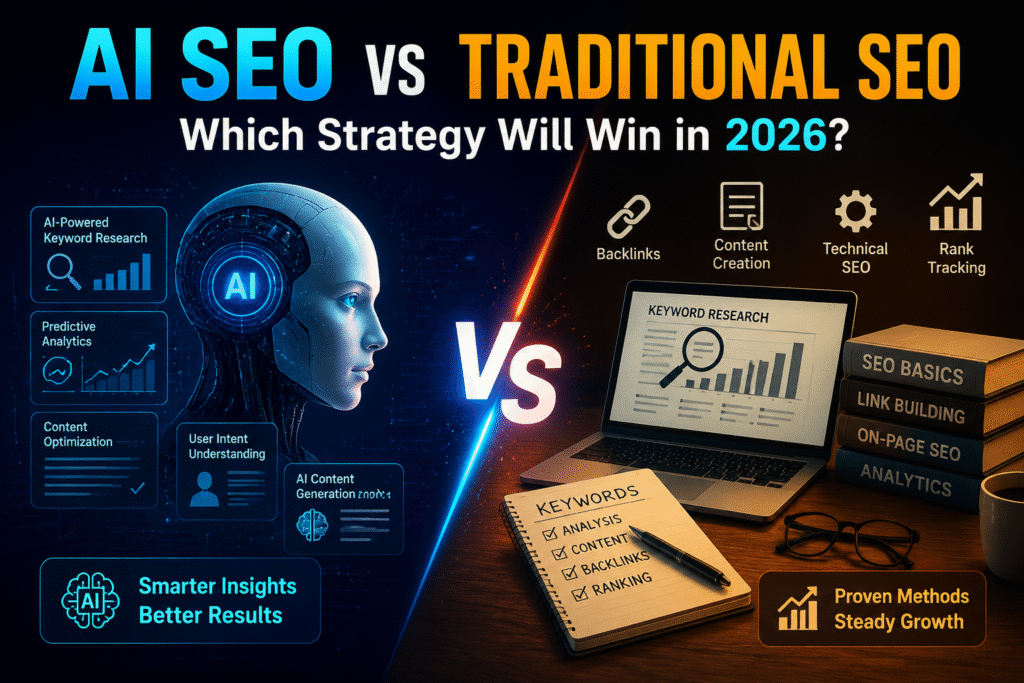
I’ve spent over seven years building SEO strategies for businesses across India, and 2026 is the first year I’ve had to genuinely rethink the playbook instead of just updating it. Clients keep asking me the same question: should we chase AI SEO now, or stick with traditional SEO? The honest answer, after running both side by side for the past year, is that this isn’t a competition with one winner — it’s a shift in what “ranking” even means.
What Traditional SEO Still Does Best
Traditional SEO is the discipline of ranking in the classic results list — the ten links people scroll through, click, and compare. It runs on fundamentals that haven’t changed in years: technical health, backlink authority, keyword-to-intent matching, and content depth. It still drives the bulk of measurable website traffic for most businesses I work with, especially for transactional and local searches where people want to compare options before buying.
This is also where working with an experienced SEO company in India still matters most. Rankings compound over months, and the technical foundation — site speed, crawlability, structured data — is exactly what determines whether your content even gets considered by newer AI systems in the first place.
What AI SEO Actually Means
AI SEO (often discussed alongside Answer Engine Optimization and Generative Engine Optimization) is the practice of structuring content so AI systems — Google AI Mode, ChatGPT, Perplexity, Gemini — can lift it directly into a generated answer, often without the user clicking through at all. Success here isn’t a session in Google Analytics. It’s a citation, a brand mention inside someone’s AI conversation before they’ve even opened a browser tab.
This is genuinely new territory, and it rewards different things: direct, extractable answers near the top of a page, consistent factual data about your business across the web, and demonstrable first-hand expertise rather than generic claims.
The Numbers I’m Actually Watching in 2026
The scale of this shift is real, but it’s easy to overstate. A January 2026 Search Engine Land study found that 37% of consumers now start their searches with AI tools rather than Google — a genuinely significant behavioral shift, especially among younger users. At the same time, Graphite’s traffic research found that measured organic search traffic has only declined by roughly 2.5% between early 2024 and late 2025 — nowhere near the 25–50% collapse some predicted. Both things are true at once: AI is capturing a growing share of how people start their research, while classic search still closes a large share of the actual decisions.
That’s the nuance most “SEO is dead” articles miss, and it’s exactly why I don’t recommend any client — whether they’re working with an seo agency in india or handling it in-house — abandon traditional SEO to chase AI visibility alone.
I’ve also noticed a pattern worth flagging: AI platforms still lean heavily on the same traditional search index to find candidate content in the first place. A page with weak technical SEO or thin backlink authority rarely gets surfaced by an AI system either, regardless of how well the content itself is written. In other words, AI SEO doesn’t operate independently of traditional SEO — it sits on top of it, which is a big part of why I keep pushing back on clients who want to skip the fundamentals and jump straight to “optimizing for ChatGPT.”
So Which One Actually Wins?
It depends entirely on the query. For informational, definitional searches — “what is,” “how does X work” — AI SEO is already winning; users rarely click through when a summarized answer satisfies them. For transactional and comparison searches — anything with real money or commitment attached — traditional SEO still dominates, because people verify before they buy. For brand and reputation queries, both matter, since AI systems now shape first impressions before a website visit ever happens.
The businesses I work with that treat this as an either/or decision consistently underperform the ones that treat it as one connected strategy: strong technical SEO as the foundation, with content restructured to also win AI citations on top of it.
Why This Matters More for SEO in India Right Now
SEO in India is at an interesting inflection point. Competition for traditional rankings has never been tighter, and most businesses here are only just starting to think about AI visibility, which means the brands that move now have a real first-mover advantage before this space gets as saturated as traditional SEO already is. I’d rather see a client invest in getting genuinely cited by AI platforms this year than wait until every competitor is doing it and the advantage disappears.
My Recommendation, After Running Both
Fix the foundation first — technical SEO, site speed, and content depth are still the access layer everything else depends on, AI platforms included. Once that’s solid, restructure your highest-value content with direct-answer formatting and consistent, fact-checkable data about your business across the web. If you’re evaluating who to bring in for this, look for an seo expert who can show you both a ranking track record and an understanding of how AI platforms retrieve and cite content — not just one or the other.
Neither strategy wins outright in 2026. The businesses that win are the ones treating AI SEO as the next layer of traditional SEO, not a replacement for it — and the ones that start building that layer now, while most competitors are still debating which side to pick.