Written by a search visibility strategist with 7+ years of hands-on experience connecting AEO, GEO, and LLM SEO work to actual lead and revenue outcomes, not just visibility metrics. This guide is grounded in published conversion data, including the honest cases where the advantage doesn’t hold, rather than a one-sided pitch.
Most conversations about AI search visibility focus entirely on whether a business gets mentioned by ChatGPT or Gemini, without addressing the question that actually matters to a business owner: does any of this translate into real leads and revenue? The data on this question is genuinely encouraging, though not uniformly so, and understanding both the advantage and its limits is what separates a realistic AI search strategy from an oversold one.
The Core Data: AI-Referred Visitors Convert Significantly Higher
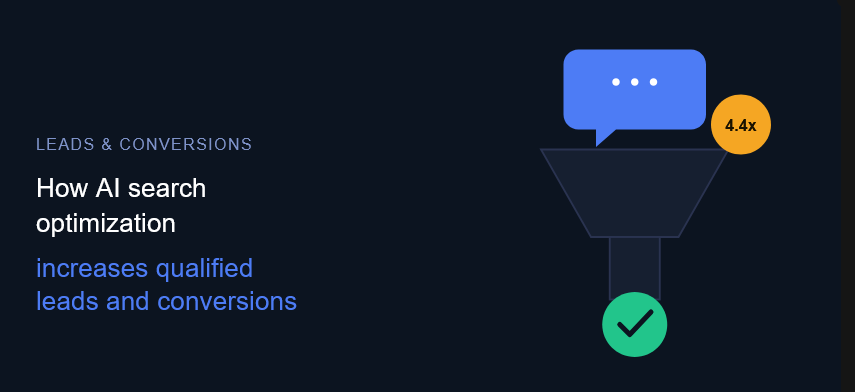
Semrush’s June 2025 study, analyzing more than 500 high-value B2B and digital marketing topics, found that AI search visitors convert at 4.4 times the rate of traditional organic search visitors. This isn’t an outlier finding — Ahrefs separately reported that AI search traffic accounted for just 0.5% of its total sessions but drove 12.1% of all signups, a roughly 23x conversion multiplier, and an independent 312-company B2B benchmark study found AI referrals converting at 14.2% compared to 2.8% for Google organic. The pattern holds across multiple independent studies, even though the exact multiplier varies. You can review the original methodology and findings directly in Search Engine Land’s analysis of why AI search conversion studies reach different conclusions, which is worth reading precisely because it doesn’t cherry-pick the most favorable number — it explains honestly why different studies land on different figures.
Why AI-Referred Traffic Converts Higher
1. The Visitor Arrives Already Pre-Qualified
By the time someone clicks through from an AI-generated answer, the AI system has typically already synthesized information from several sources, compared alternatives, and presented a curated recommendation. The visitor isn’t starting their research at your website — they’re arriving near the decision point, having already worked through much of the comparison process an organic search visitor would still be doing.
2. AI Queries Encode More Buying Context
Research into query length and structure shows AI prompts average significantly more words than typical search queries — often more than double. That extra length typically encodes use case, budget, timeline, and specific constraints, which functions as a form of self-qualification a sales team would otherwise have to extract manually during a discovery call.
3. AI Recommendations Carry a Persuasive Framing Effect
An AI-generated response presenting a specific business as an answer reads more like a personal recommendation than a ranked list of blue links. That framing appears to carry real behavioral weight — Adobe’s retail analysis found AI-referred shoppers spending substantially more time on product pages and viewing more pages per visit than non-AI visitors, consistent with a more engaged, further-along buyer.
The Important Caveat: This Advantage Isn’t Universal
This is the part most coverage of this topic skips, and it matters for setting honest expectations. A large-scale academic study covering 973 e-commerce websites and more than $20 billion in combined revenue found the opposite pattern for standard e-commerce transactions: Google organic search outperformed ChatGPT referral traffic by roughly 13% for these purchases. The explanation lines up with how AI assistants actually get used: research-heavy, comparison-driven purchases — B2B software, professional services, high-consideration decisions — are exactly where AI’s pre-qualification advantage shows up strongly. Low-consideration, impulse purchases — a phone case, a snack, a small accessory — rarely involve someone consulting an AI assistant first, since browsing and visual discovery drive that kind of buying decision instead.
The honest takeaway: if your business sells through research-heavy, higher-consideration decisions, the conversion premium is real and well-documented. If your business relies heavily on impulse or low-consideration purchases, particularly in e-commerce, the advantage is weaker or may not apply at all, and traditional organic and paid channels likely still deserve primary focus.
How AI Search Optimization Actually Drives This Outcome
Getting AI-referred visitors in the first place, and having them convert once they arrive, depends on specific, connected work:
1. Getting Cited in the First Place
None of the conversion advantage matters if a business isn’t being cited or recommended by AI systems at all. This is the core function of Answer Engine Optimization (AEO) — structuring content to directly answer the specific questions AI systems are asked — and Generative Engine Optimization (GEO), which builds the topical depth and entity authority that makes a source worth citing repeatedly across a category.
2. Being Described Accurately and Favorably
A citation that includes outdated pricing, an inaccurate service description, or an unclear value proposition undermines the pre-qualification advantage that makes AI-referred traffic convert well in the first place. Strengthening entity consistency and structured data, core LLM SEO work, helps ensure AI systems describe a business accurately when they do reference it.
3. Making Sure the Landing Experience Matches the Intent
Since AI-referred visitors arrive with more specific context and higher intent, the page they land on needs to match that specificity rather than sending them to a generic homepage. This connects AI visibility work directly to solid SEO and content structure fundamentals — the same clear, direct, well-organized content that earns a citation is also what converts a high-intent visitor once they arrive.
A Realistic Framework for Setting Expectations
- Volume will stay modest for now. AI referral traffic still represents roughly 1% of total website sessions across most studies, even as it grows rapidly year over year. This is a high-value, low-volume channel today, not a replacement for existing traffic sources.
- The conversion premium concentrates in research-heavy decisions. B2B, professional services, and considered purchases see the strongest advantage; low-consideration and impulse e-commerce categories see a weaker or reversed effect.
- Growth trajectory matters more than current volume. AI referral traffic has grown several hundred percent year-over-year across multiple studies, meaning even a small current share compounds meaningfully if the underlying visibility work starts now rather than later.
Frequently Asked Questions
Does AI search traffic really convert better than organic search traffic?
For research-heavy, higher-consideration purchases, yes — multiple independent studies show AI-referred visitors converting at several times the rate of organic search visitors. For low-consideration or impulse purchases, particularly in e-commerce, some large-scale research shows organic search actually outperforming AI referral traffic.
Why does AI-referred traffic convert at a higher rate in most studies?
AI-referred visitors typically arrive after the AI system has already compared options and provided a recommendation, meaning much of the research and comparison phase is complete before they click through, unlike a typical organic search visitor still early in their research.
Is AI search traffic significant enough in volume to matter yet?
Volume remains modest, generally around 1% of total referral traffic across most published studies, though it’s growing rapidly. The value proposition currently comes from conversion quality rather than traffic volume.
Does this conversion advantage apply to every industry?
No. The advantage concentrates most strongly in research-heavy, comparison-driven purchase categories like B2B software and professional services. Low-consideration, impulse-purchase categories, particularly in e-commerce, show a weaker or even reversed pattern in some studies.
How does AI search optimization actually lead to more conversions, not just more visibility?
It works in three connected steps: getting cited by AI systems through AEO and GEO, ensuring that citation is accurate and favorable through LLM SEO and entity consistency work, and making sure the landing page matches the specificity of a high-intent AI-referred visitor.
Should a business shift its entire marketing budget toward AI search optimization based on this data?
Not entirely. AI referral traffic still represents a small share of total volume for most businesses, so it’s best treated as a high-value, fast-growing addition to existing SEO, content, and paid strategies rather than a wholesale replacement for them.
The data on AI search optimization and conversions is genuinely encouraging, but the honest picture is more specific than “AI traffic always converts better.” For research-heavy, higher-consideration decisions, the conversion premium is real, well-documented across independent studies, and driven by a clear mechanism: visitors arrive pre-qualified by the AI system’s own research process. For lower-consideration, impulse-driven purchases, the advantage weakens or reverses. Understanding which category your business falls into — and building AI visibility work around getting cited accurately, favorably, and matched to genuine buyer intent — is what turns this data from an interesting statistic into an actual lead generation strategy.

Vishal is a Digital Marketing Specialist, SEO Consultant and AEO (Answer Engine Optimisation) Specialist with over 6 years of experience in the digital marketing industry. He has worked on 50+ projects across multiple industries, helping businesses improve their online visibility, organic search performance and digital presence.
His expertise includes Technical SEO, On-Page SEO, Off-Page SEO, Local SEO, Google Ads, Content Optimisation, AI SEO, Generative Engine Optimisation (GEO) and Answer Engine Optimisation (AEO).
Vishal specialises in developing SEO strategies that help businesses improve their visibility across traditional search engines like Google and emerging AI-powered platforms such as ChatGPT, Google Gemini and Perplexity.
He also works with Google Analytics 4 (GA4), Google Search Console and Looker Studio to monitor website performance, analyse search trends and measure digital marketing results.
Through his practical experience working with businesses across different industries, Vishal shares actionable insights, industry knowledge and proven digital marketing practices to help businesses strengthen their online presence and adapt to the evolving search landscape.