Written by a search visibility strategist with 7+ years of hands-on experience running AEO, GEO, and LLM SEO campaigns for local service businesses across construction, real estate, and automotive repair in India. This guide reflects real audits comparing Google Maps visibility against actual AI recommendation outcomes for these exact trades.
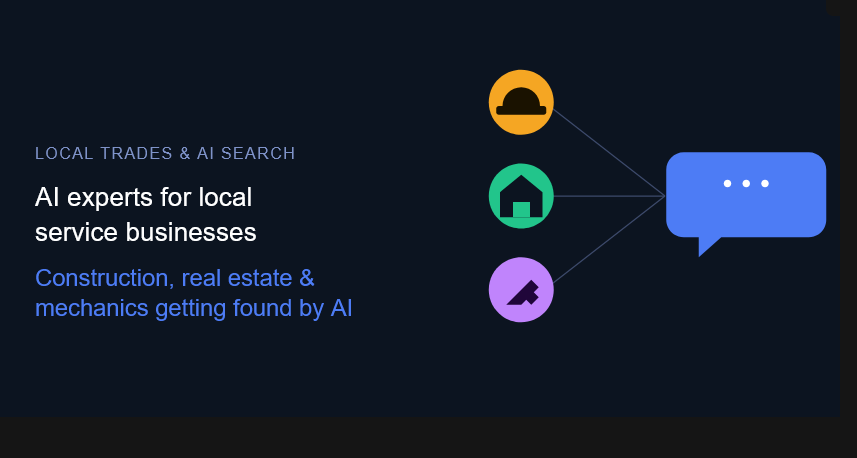
A car breaks down on a highway outside Pune, and the driver doesn’t scroll through ten search results — they ask ChatGPT or Google’s AI assistant “nearest reliable mechanic workshop open now” and call whoever gets named. A homeowner planning a renovation asks “best construction contractor for a 2BHK renovation in [city]” months before ever visiting a website. These aren’t hypothetical scenarios anymore — they’re becoming the default first step for exactly the kind of urgent, high-stakes, or high-cost decisions that construction, real estate, and mechanic businesses handle every day. This guide explains how AI experts help these three trades specifically get found, trusted, and recommended by AI search.
Why Urgency and High Stakes Make These Trades Especially AI-Search-Sensitive
Construction, real estate, and mechanic work share a pattern that makes them particularly exposed to this shift: decisions are either urgent (a breakdown, a leak, an emergency repair) or high-value and research-heavy (a renovation, a property purchase). Both patterns favor AI-assisted search. Urgent decisions favor speed and confidence — a driver stranded on the road wants one clear answer, not ten links to evaluate. High-value decisions favor depth and comparison — a family planning a home renovation wants detailed, trustworthy information before committing lakhs of rupees. AI assistants are increasingly the tool people reach for in both scenarios, and industry data backs up how significant the underlying shift already is: AI Overview presence correlates with organic click-through rates dropping by more than half for the same queries that used to send traffic directly to a business’s website. You can read more in Search Engine Land’s coverage of AI Overview click-through rate research, which documents this pattern in detail. For local trades, that means a growing share of potential customers are getting a direct AI-generated answer — and either calling the business it names, or never seeing your listing at all.
How AI Assistants Decide Which Local Trade Businesses to Recommend
AI systems generally pull from the same underlying data these trades have always relied on for local SEO — but they cross-reference it more rigorously before recommending a business.
1. Consistent, Verifiable Business Information
Business name, service area, contact number, and address need to match exactly across the website, Google Business Profile, and any directories or trade platforms the business appears on. A mismatch in even one place makes it harder for an AI system to confidently verify and recommend the business over a competitor with cleaner data.
2. Recent, Detailed Reviews
For urgent trades like mechanic workshops, recent reviews matter enormously, since they signal current reliability rather than a reputation built years ago. For construction and real estate, detailed reviews describing specific project outcomes carry more weight than a simple star rating alone.
3. Clear Service and Specialty Information
AI systems favor businesses with clearly stated service areas, specialties, and licensing or certification details over vague, generic listings. A mechanic workshop that specifies which vehicle brands or issues it specializes in, or a construction contractor that clearly lists project types handled, gives an AI system more confident, specific material to match against a customer’s exact question.
4. Website Content That Answers Real Customer Questions
A business with only a homepage and a contact form gives an AI system little to verify or cite. Content that directly answers common questions — pricing ranges, project timelines, service availability, what to expect during a repair or renovation — gives AI systems the depth needed to construct a confident, detailed answer rather than a vague, uncertain one.
5. Trust and Credential Signals
For high-stakes categories like construction and real estate specifically, licensing, certifications, RERA registration where applicable, and verifiable project history function as critical trust signals. AI systems, much like cautious human customers, weigh these credibility markers heavily before confidently recommending a business for a significant financial decision.
What This Looks Like for Each Trade Specifically
Construction and Renovation Contractors
Customers researching construction work tend to ask detailed, comparison-style questions well in advance of hiring — “best contractor for a kitchen renovation in [city],” “how much does a 2BHK renovation typically cost,” “questions to ask before hiring a contractor.” Building content that directly answers these questions, alongside clear project galleries and verifiable credentials, positions a contractor to be cited in exactly this research phase.
Real Estate and Property Services
Beyond project-based real estate content, service-oriented real estate businesses — property management, rental agencies, real estate consultants — benefit from the same entity consistency and review strength that drives AI visibility for developers, with an added emphasis on locality-specific expertise and responsiveness.
Mechanic Workshops and Automotive Repair
Urgency changes the calculus here. Customers asking AI assistants for a nearby mechanic want a fast, confident answer, which means current hours, accurate service area information, and recent reviews matter more than a long, detailed content library. A workshop with consistent, verifiable “open now” and location data has a real advantage over one with outdated or inconsistent listings.
AEO, GEO, and LLM SEO Applied to Local Trades
| Discipline | Application for These Trades |
|---|---|
| AEO | Direct answers to urgent and comparison questions — availability, pricing, specialties — for quick AI responses |
| GEO | Locality-specific content, project galleries, and comparison guides that build topical authority in a service area |
| LLM SEO | Entity consistency across platforms, structured data, and credential verification that strengthens AI trust |
This work builds directly on a strong Google Business Profile, which functions as a foundational trust and verification layer for exactly these kinds of local, trade-specific searches, alongside a well-structured website and solid SEO fundamentals that support both traditional and AI-driven discovery.
What Local Trade Businesses Should Do Now
- Test your own AI visibility directly, asking ChatGPT and Gemini the exact questions a real customer would ask for your trade and city.
- Audit consistency of your business name, service area, and contact details across your website, Google Business Profile, and every trade directory you’re listed on.
- Strengthen your review pipeline, prioritizing recent, detailed reviews over a purely historical rating, especially for urgent-service trades.
- Build content answering real customer questions — pricing, process, credentials, specialties — rather than relying on a thin homepage and contact form.
- Make credentials and licensing visible and verifiable, particularly for construction and real estate, where trust signals carry outsized weight in AI-generated recommendations.
Frequently Asked Questions
How do AI assistants find mechanic workshops for urgent searches like a roadside breakdown?
They rely on consistent, verifiable business information, current hours and service area data, and recent reviews to confidently recommend a nearby option quickly, favoring businesses with clean, up-to-date listings over ones with outdated or inconsistent information.
Is AI search visibility relevant for construction contractors, who typically don’t need urgent same-day customers?
Yes. Construction decisions tend to be high-value and research-heavy, and customers increasingly use AI assistants during the comparison and research phase, well before contacting a contractor directly, making detailed, credible content especially valuable for this trade.
Do small, independent workshops or contractors have a real chance against larger competitors in AI search?
Yes. AI systems favor consistency, accuracy, and trust signals over sheer business size, meaning a smaller business with clean, verifiable data can be recommended ahead of a larger competitor with inconsistent or outdated information.
How important are reviews specifically for these trades?
Very important, though the emphasis differs slightly: urgent trades like mechanic workshops benefit most from recent review volume, while construction and real estate benefit from detailed reviews describing specific project outcomes and experiences.
Does having a strong Google Business Profile guarantee AI recommendations for these trades?
No, but it’s foundational. A complete, accurate, and consistent Google Business Profile significantly improves the odds of being confidently recommended, though it typically needs to be paired with supporting website content and credential verification for the strongest results.
How long does it take for a local trade business to see improvement in AI search visibility?
Fixing data consistency and strengthening a Google Business Profile can show early signals within a few weeks, while building the review volume and content depth needed for consistent, reliable AI recommendations typically takes several months of sustained effort.
Construction, real estate, and mechanic businesses in India sit at two ends of a spectrum that both favor AI-assisted search — the urgent, need-it-now decision and the high-stakes, research-heavy one. In both cases, customers are increasingly letting an AI assistant do the first round of filtering before a phone call ever happens. Getting found in that moment requires the same fundamentals that have always mattered in local business — consistent information, strong reviews, verifiable credentials, and clear, helpful content — applied with a deliberate understanding of how AI systems specifically verify and recommend a business before naming it.

Vishal is a Digital Marketing Specialist, SEO Consultant and AEO (Answer Engine Optimisation) Specialist with over 6 years of experience in the digital marketing industry. He has worked on 50+ projects across multiple industries, helping businesses improve their online visibility, organic search performance and digital presence.
His expertise includes Technical SEO, On-Page SEO, Off-Page SEO, Local SEO, Google Ads, Content Optimisation, AI SEO, Generative Engine Optimisation (GEO) and Answer Engine Optimisation (AEO).
Vishal specialises in developing SEO strategies that help businesses improve their visibility across traditional search engines like Google and emerging AI-powered platforms such as ChatGPT, Google Gemini and Perplexity.
He also works with Google Analytics 4 (GA4), Google Search Console and Looker Studio to monitor website performance, analyse search trends and measure digital marketing results.
Through his practical experience working with businesses across different industries, Vishal shares actionable insights, industry knowledge and proven digital marketing practices to help businesses strengthen their online presence and adapt to the evolving search landscape.